


What is the acceptable concrete temperature range during placement and curing?

A ten-degree swing in concrete temperature can be the difference between a slab that cures on schedule and one that cracks, sets too fast, or never reaches its design strength. Most contractors know that extreme weather is a problem. Fewer know exactly where the safe concrete temperature range starts and ends, or what happens once you cross it.
In this blog, you’ll learn the acceptable concrete temperature range for placement and curing according to ACI standards, what happens when concrete falls outside that range, and how real-time sensors help you stay ahead of the problem instead of reacting to it after a failed test.
What Is the Acceptable Concrete Temperature Range?
The acceptable concrete temperature range for most placements is between 50°F (10°C) and 90°F (32°C), based on ACI 306 (cold weather) and ACI 305.1 (hot weather) guidance. Concrete placed and cured within this range hydrates at a predictable rate, which supports normal setting time and strength development.

Outside that window, you need active management. ACI 305.1 sets a hard maximum of 95°F (35°C) at the time of discharge for general construction, unless the engineer accepts a higher limit based on documented field experience or preconstruction testing. Mass concrete doesn’t get a single flat cutoff: CSA A23.1’s Table 14 scales both the minimum and maximum placing temperature by section thickness, from 50°F to 95°F (10°C to 35°C) for sections under 0.3 m down to 41°F to 68°F (5°C to 20°C) for sections over 2 m, figures independently corroborated by ASTM C94’s and ACI 306’s own thickness-scaled minimums. The Iowa Mass Concrete for Bridge Foundations Study documented exactly this kind of thickness-based control on the WB I-80 and US 34 Missouri River bridges, where footings and pier caps up to 10.5 ft thick were monitored against these limits.
| Section Thickness | Minimum Placing Temp | Maximum Placing Temp | Governing Standard |
| < 0.3 m (< 12 in) | 50°F (10°C) | 95°F (35°C) | CSA A23.1, Table 14 |
| 0.3–1 m (12–36 in) | 50°F (10°C) | 86°F (30°C) | CSA A23.1, Table 14 |
| 1–2 m (36–72 in) | 41°F (5°C) | 77°F (25°C) | CSA A23.1, Table 14 |
| > 2 m (> 72 in) | 41°F (5°C) | 68°F (20°C) | CSA A23.1, Table 14 |
Thickness-scaled minimums cross-checked against ASTM C94 §12.8 and ACI 306 Table 5.1, which report matching minimum values independently.
On the cold side, ACI 306 triggers protection requirements once the concrete’s own temperature falls to, or is expected to fall to, 40°F (4°C) during the protection period, and the placed concrete itself must be kept at a minimum of 50°F to 55°F (10°C to 13°C) for thinner sections, depending on element thickness and protection period. CSA A23.1 sets a related but distinct Canadian trigger of 41°F (5°C) air temperature within 24 hours of placing, and considers concrete frost-safe at 7 MPa (1,000 psi), a higher bar than ACI’s 3.5 MPa (500 psi) benchmark.
These are not arbitrary numbers. They reflect the chemistry of cement hydration, which slows dramatically below 4°C (40°F) and speeds up unpredictably above 35°C (95°F).
Why Temperature Controls the Whole Curing Process
Concrete gains strength through hydration, the chemical reaction between cement and water. Temperature is the single biggest variable in how fast that reaction happens.
Warmer concrete cures faster but can lose workability and durability if it gets too hot. Colder concrete cures more slowly, and below freezing, risks permanent damage from ice formation inside the still-soft paste. Either direction pulls your schedule and your quality control in the wrong way.
This is why maturity-based strength testing (ASTM C1074) uses temperature as its core input. The method tracks the time-temperature history of the concrete to calculate in-place strength, rather than relying on a cylinder break days later. ACI 318 now allows curing itself to end once in-place strength, verified by an approved method such as ASTM C1074’s maturity method, reaches 70% of specified strength under standard exposure conditions, or 90% for higher-durability exposure classes, replacing a fixed curing duration with a verified strength target.
What Happens in Cold Weather Below the Safe Range
When concrete temperature drops below 40°F (4°C), cement hydration nearly stalls. Left unprotected, several things can happen at once:
- Strength gain slows or stops, delaying formwork removal and the next construction phase.
- Mix water inside the paste can freeze and expand before the concrete reaches roughly 3.5 MPa (500 psi)—a threshold established by Powers’ 1962 research on frost damage in fresh concrete—which can cause permanent strength loss.
- The internal heat the concrete generates gets lost to the environment faster than it can build, worsening the problem.
- The cement paste develops a weaker, more porous structure, increasing long-term vulnerability to freeze-thaw damage and chloride intrusion, even if the 28-day strength test eventually passes.
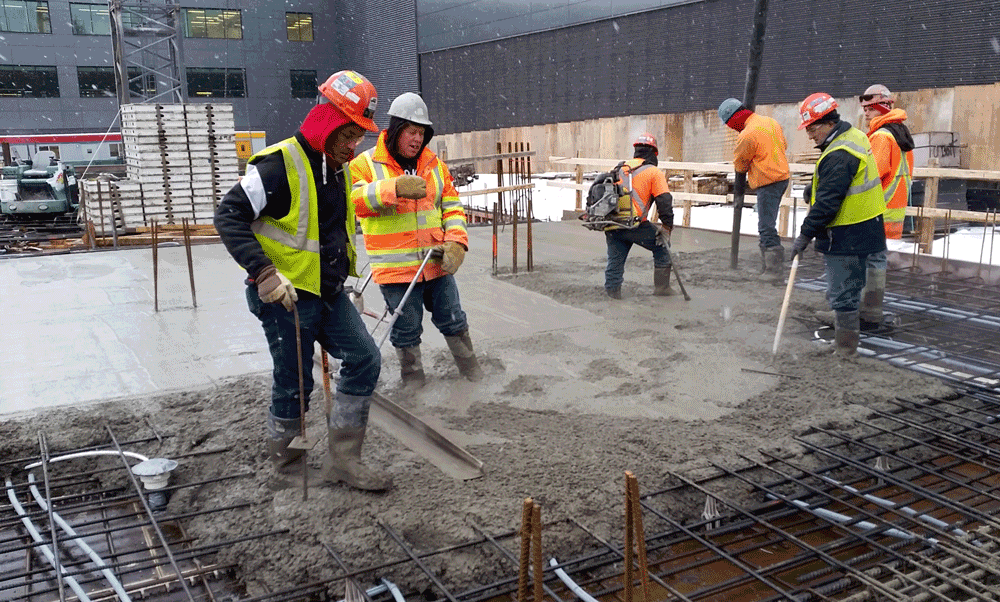
ACI 306 addresses this by requiring that placed concrete be maintained at a minimum protection temperature (typically 50°F to 55°F, or 10°C to 13°C, for standard sections) for a defined protection period, ranging from two days for unloaded, unexposed concrete up to six days for partially loaded, exposed concrete, depending on service condition and admixtures used.
Want to learn more about the practical tools crews use to hit these thresholds on site? Check out our concrete monitoring solutions!
What Happens in Hot Weather Above the Safe Range
Heat creates a different set of problems. Above 90°F to 95°F (32°C to 35°C), hydration accelerates, which shortens working time and increases the risk of plastic shrinkage cracking as surface moisture evaporates faster than bleed water can replace it. That risk becomes likely across nearly all mixes once the evaporation rate reaches 1.0 kg/m²/hr (0.2 lb/ft²/hr) — a threshold both ACI 305.1 and ACI 305R identify directly, independent of the temperature ceiling itself.
Common effects of concrete placed too hot include:
- Faster setting, which reduces time for placing, consolidating, and finishing
- Increased water demand and a higher tendency toward drying shrinkage
- Reduced long-term durability and greater variability in surface properties
- A wider gap between air temperature and actual mix temperature, since a 90°F (32°C) day with an unmanaged mix can easily produce concrete at 100°F (38°C) or higher at discharge
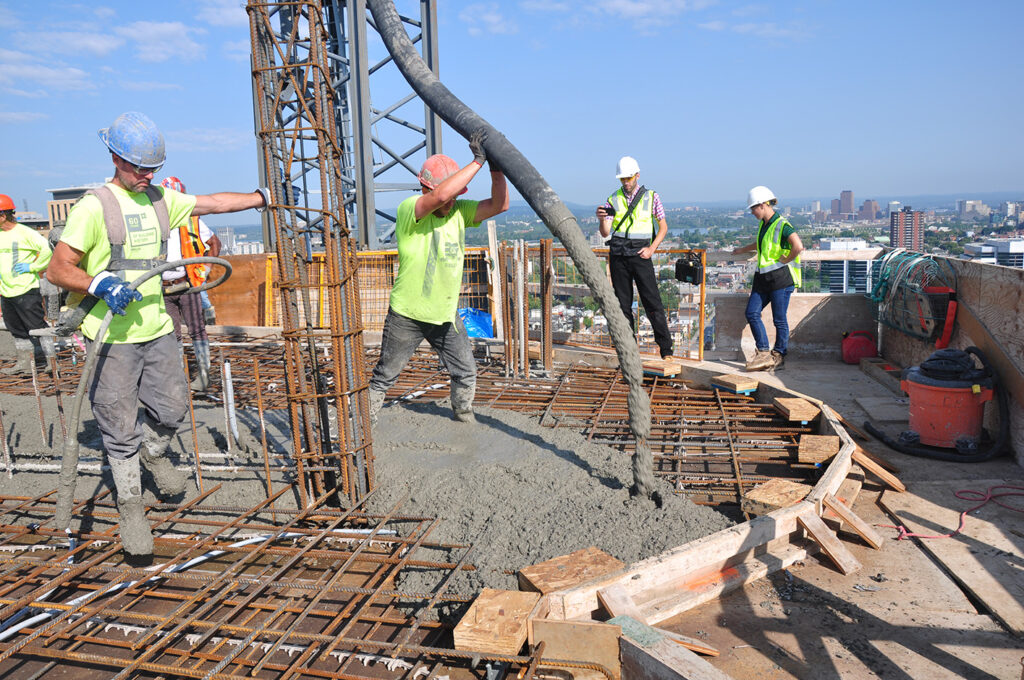
ACI 305.1 sets the 95°F (35°C) discharge limit specifically to keep these risks in check. Exceeding it requires documented field experience or preconstruction testing to support the mix design.
For region-specific strategies, check out our hot weather strategies in warmer climates!
Signs Your Concrete Temperature Is Out of Range
You don’t need to wait for a failed break test to catch a temperature problem. Watch for:
- Unusually fast or unusually slow setting compared to the expected timeline
- Surface cracking within the first few hours after finishing
- A large gap between ambient air temperature and your mix design assumptions
- Break test results that vary widely from cylinder to cylinder on the same pour
Any of these should prompt a closer look at your temperature data, not just the air temperature on-site that day.
How to Monitor Concrete Temperature in Real Time
Thermocouples and manual data loggers can track temperature, but they require wired connections and site visits to retrieve readings. On a fast-moving or remote pour, that lag between data collection and decision-making is exactly when problems compound.
Wireless, embedded sensors solve this by collecting temperature continuously and pushing it to your phone or dashboard as the concrete cures. This lets your team catch a cold snap or a hot mix before it turns into a compliance issue or a delay.
SmartRock®: Proven in the Field
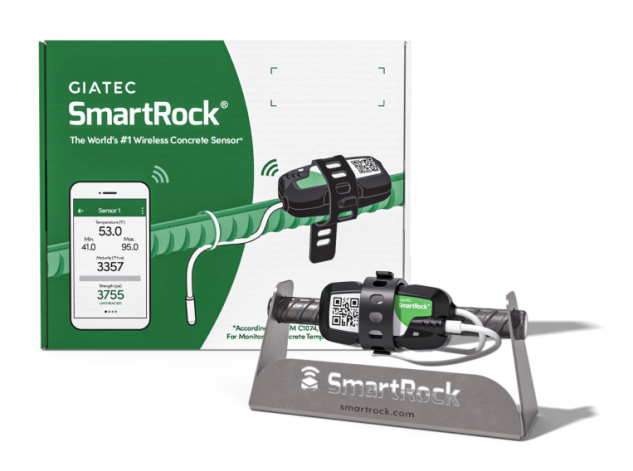
SmartRock sensors, attached to the rebar and embedded in concrete, have already put this real-time approach to work on active job sites, from bridge rehabilitation projects to precast bridge decks.
- On the I-90 Fuller Road bridge rehabilitation in New York, ceEntek used SmartRock’s maturity-method data to verify that its UHPC connections had reached 70 MPa (10,000 psi), allowing formwork removal in 8 to 10 hours and reopening the bridge to traffic in under 24 hours.
- On a precast bridge deck project in Delaware, UHPC Solutions added SmartRock’s wireless sensors even though thermocouples weren’t required, so the project team had continuous real-time temperature and strength data throughout the pour rather than relying on periodic manual checks.
For teams managing several pours at once, SmartRock Web adds dashboard-level alerting when any sensor reading moves outside your specified range, so a temperature exception surfaces automatically instead of waiting for someone to check the app.
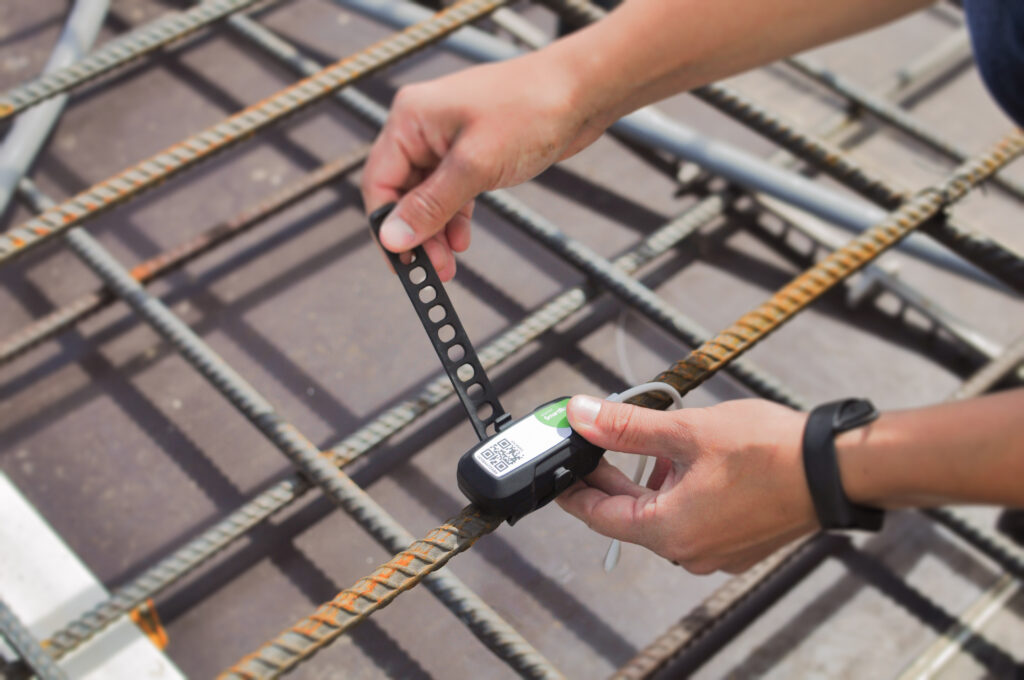
SmartRock Pro: Built for Any Temperature, Any Mix
SmartRock Pro is the first fully self-calibrating concrete strength monitoring sensor. It attaches to the rebar before the pour and becomes embedded in the concrete, measuring temperature and strength continuously without requiring break-test calibration for each mix.
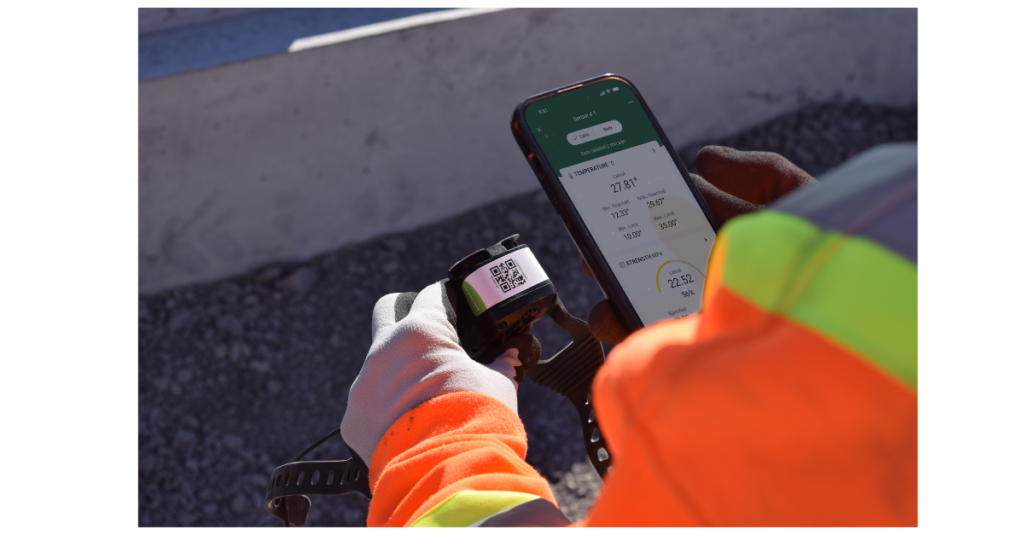
That mix independence matters most when temperature is already working against you. A cold snap or a hot afternoon can shift how a given mix behaves, and SmartRock Pro’s CEMMA technology adjusts to those conditions instead of relying on a maturity curve calibrated under different weather. You get real-time strength and temperature data through the SmartRock mobile app, so you can confirm concrete has reached its required protection temperature or safe discharge range without waiting on a lab.
For crews working through winter pours or summer concrete slabs, this turns temperature monitoring from a manual, delay-prone process into a live decision-making tool solution.
Interested in learning about how SmartRock Pro can revolutionize your concrete testing by the pros themselves? Check out our webinar!
Building a Temperature Monitoring Plan That Works
A reliable plan combines the right standard, the right protection method, and the right data. Start with the applicable ACI guidance for your climate and season, plan protection measures such as insulated blankets or heated enclosures before the pour, and use embedded sensors to verify that your concrete actually stays within range throughout the protection period, not just at the moment of placement.
Contractors who have made this shift report meaningful labor savings from skipping manual site visits and wired data collection, on top of avoiding the delays that come from an unexpected low break or a rejected pour. Real-time visibility turns temperature management from guesswork into a documented, defensible process.
Conclusion
The safe concrete temperature range for most placements sits between 50°F and 90°F (10°C and 32°C), with ACI 306 and ACI 305.1 defining stricter limits and protection requirements at the cold and hot extremes. Staying inside that range, and proving it with real data, protects both your schedule and your structure’s long-term durability.
Interested in learning more about thermal control plans? Check out our Knowledge Center!
Frequently Asked Questions
What is the acceptable concrete temperature range during placement and curing?
Most placements should stay between 50°F and 90°F (10°C and 32°C). ACI 305.1 sets a hard ceiling of 95°F (35°C) at discharge, and ACI 306 triggers cold-weather protection once concrete temperature falls to 40°F (4°C). The exact minimum and maximum shift with section thickness under CSA A23.1 and ASTM C94.
What is the minimum temperature to pour concrete?
ACI 306 requires placed concrete to be kept at 50°F to 55°F (10°C to 13°C) for standard sections during the protection period, though thicker sections can run slightly cooler under CSA A23.1’s thickness-scaled minimums. Below 40°F (4°C), hydration nearly stalls and freeze damage becomes a risk before the concrete reaches about 3.5 MPa (500 psi).
What happens if concrete freezes before it cures?
If concrete freezes before reaching roughly 3.5 MPa (500 psi), the resulting ice formation can cause permanent strength loss that later curing cannot reverse, a threshold established by Powers’ 1962 research on frost damage. CSA A23.1 sets a higher frost-safe bar of 7 MPa for Canadian projects.
What happens if concrete is placed in hot weather?
Above 90°F to 95°F (32°C to 35°C), hydration accelerates, shortening working time and increasing the risk of plastic shrinkage cracking. That cracking risk becomes likely once the evaporation rate reaches 1.0 kg/m²/hr (0.2 lb/ft²/hr), independent of the temperature ceiling itself.
Does the acceptable temperature range change for mass concrete?
Yes. CSA A23.1’s Table 14 scales both the minimum and maximum placing temperature by section thickness, from 50°F to 95°F (10°C to 35°C) for sections under 0.3 m down to 41°F to 68°F (5°C to 20°C) for sections over 2 m. ASTM C94 and ACI 306 report matching thickness-scaled minimums independently.
How do you verify concrete temperature without relying on air temperature readings?
Wireless embedded sensors placed directly in the concrete give continuous, real-time temperature and, with the maturity method under ASTM C1074, in-place strength, rather than the ambient jobsite reading. ACI 318 now allows curing to end once in-place strength, verified this way, reaches 70% (or 90% for higher-durability exposure classes) of specified strength.
Sources
CSA Group. Concrete materials and methods of concrete construction (CSA A23.1). CSA Group.
ASTM International. Standard specification for ready-mixed concrete (ASTM C94). ASTM International.