
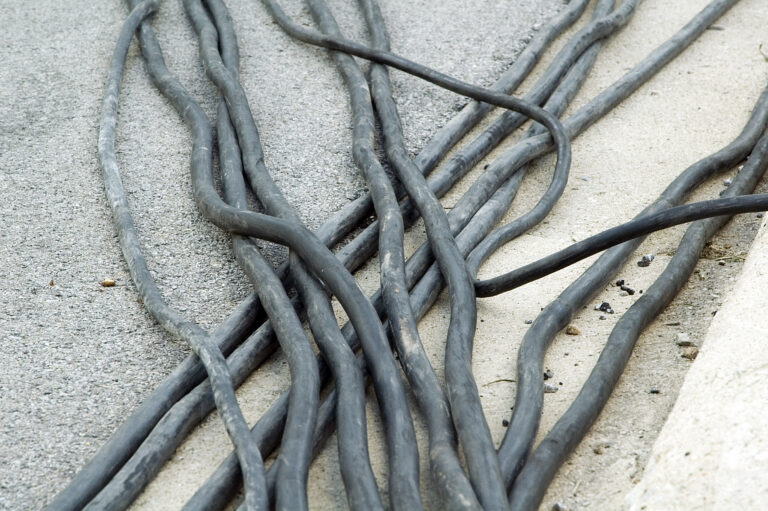
If you have ever lost a temperature reading mid-pour because a wire got cut, you already know the real problem with thermocouples is not accuracy.
K-type thermocouples still measure temperature well. But modern projects need more than measurement, they need reliable, continuous, and accessible data. ACI 305R, ACI 306R, mass concrete thermal control plans, and maturity-based strength verification per ASTM C1074 all require more than a wired sensor and data logger can reliably deliver.
In this blog, let’s explore what K-type thermocouples are, where they fall short in practice, and how wireless concrete sensors have surpassed them for most monitoring applications.
What Is a K-Type Thermocouple?
A thermocouple is a temperature sensor built on the Seebeck effect: when two dissimilar metals are joined at one end and exposed to a temperature gradient, they generate a small voltage proportional to the temperature difference between the hot junction (the measurement point) and the cold junction (the reference point, typically at the readout instrument).
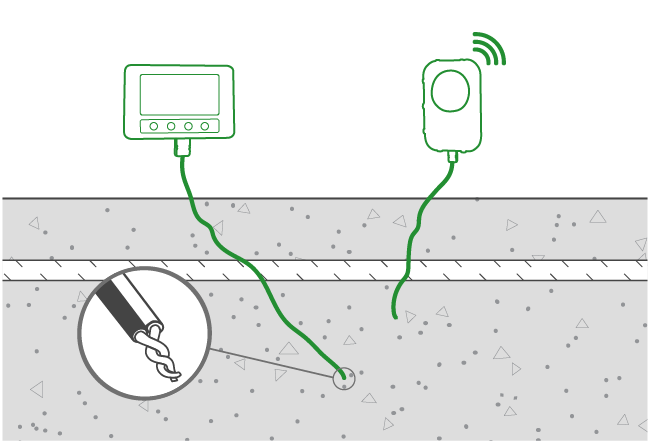
The K-type designation refers to the specific metal pairing: chromel and alumel. NIST and IEC 60584 define the standardized voltage-temperature relationship for K-type thermocouples. At concrete-relevant temperatures, the output is approximately 41 microvolts per degree Celsius.
K-Type Performance Specifications
Per IEC 60584-1, K-type thermocouples:
- Are rated for a measurement range of -328°F (-200°C) to +2300°F (+1260°C). Class 2 tolerance.
- Have a standard industrial grade, which is ±2.5°C or ±0.75% (whichever is greater) across the -40°F (-40°C) to +1832°F (+1000°C) range. Class 1, the higher-accuracy grade, reduces this to ±1.5°C or ±0.4% across the same range.
For concrete temperature monitoring, which typically falls between 14°F (-10°C) and 176°F (80°C), this accuracy is more than adequate for ACI 301 and ACI 207.2R compliance requirements. Accuracy is not where K-type thermocouples fall short.
How K-Type Thermocouples Are Used in Concrete
In practice, concrete temperature monitoring with K-type thermocouples involves embedding the probe at specified depths and locations within the pour, running extension leads (which must be matched to the thermocouple alloy to avoid introducing a secondary junction error) to a data acquisition unit or handheld readout, and recording temperature at defined intervals.
For mass concrete applications, ACI 207.2R requires monitoring at the core and near the surface to track the temperature differential. The traditional differential limit cited in most thermal control plans is 35°F (19°C), though ACI 207.2R also supports a performance-based approach and project-specific specifications may apply more conservative or calculated limits. This workflow has been standard practice on everything from highway bridge decks to high-rise mat foundations and dam placements where multiple simultaneous monitoring points are required under a formal thermal control plan.
The setup works. Engineers have trusted it for decades because the underlying physics is sound, the wire is cheap, and the failure modes are well understood.
Where Wired Monitoring Creates Real Problems
The practical limitations of K-type thermocouple systems are not measurement accuracy. They are operational.
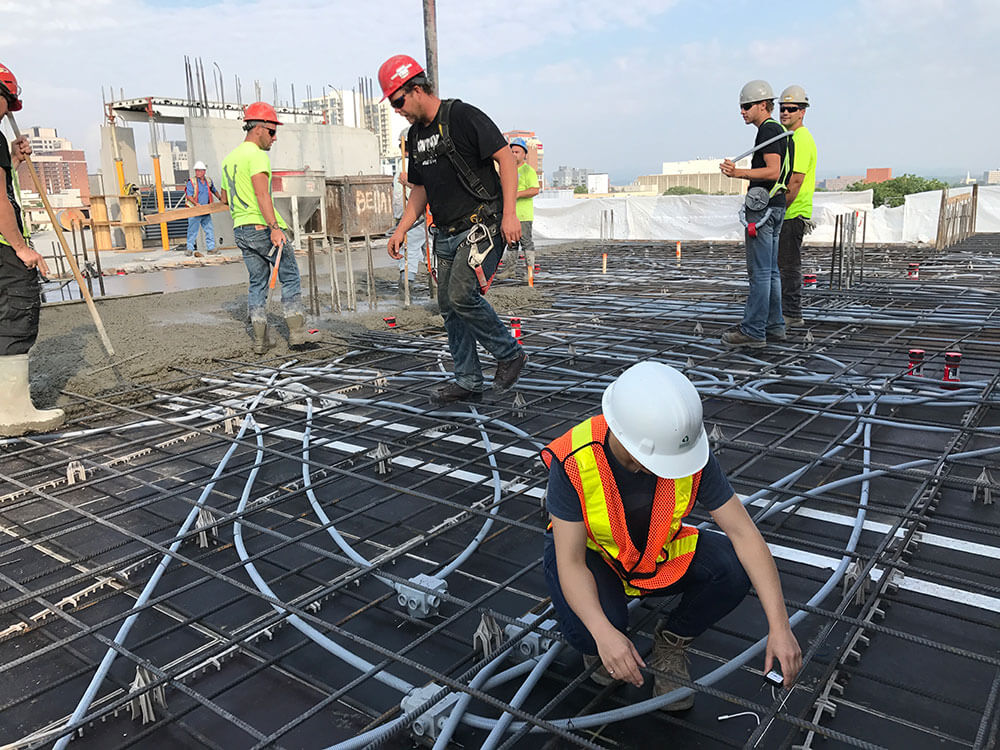
- Wire management on active job sites is a liability. Extension leads running across forming systems, through rebar cages, and along formwork edges are routinely cut, snagged, or crushed during construction operations. Each compromised lead produces erroneous readings or no reading at all, often without any obvious indicator at the data logger.
- Cold junction compensation errors accumulate. The readout device compensates for the cold junction temperature using an internal reference sensor. If that sensor drifts, or if the extension lead experiences a temperature gradient (common on outdoor sites), compensation error propagates into every reading.
- Extension lead matching is a non-negotiable requirement. Using standard copper wire instead of matched K-type extension leads introduces a parasitic thermoelectric junction at the connection point, adding systematic error that is invisible unless the installer knows to look for it. This is a common field mistake.
- Scalability is limited by wire runs. Monitoring a large mat pour at multiple depths and locations requires a corresponding number of independent circuits, data logger channels, and wire runs. The logistics compound as the project scales.
- Data retrieval requires physical presence. A wired system delivers readings to a fixed logger on site. Remote project teams, owners, or QC inspectors cannot access data without being there or relying on manual transmission from whoever is on site.
What’s the difference between wired vs. wireless concrete monitoring? Learn more here!
The Maturity Method: Why Temperature Data Determines Strength Estimates
Temperature monitoring in concrete is rarely just about temperature. In most structural applications, the real goal is knowing when your concrete has reached the strength it needs to strip forms, tension cables, open a lane to traffic, or advance to the next lift.
That determination comes from the maturity method, standardized in ASTM C1074. The principle is straightforward: concrete gains strength as a function of both time and temperature.
A mix cured at 25°C for three days may reach the same compressive strength as the same mix cured at 10°C for seven days. The maturity index formalizes this by integrating the temperature history of the in-place concrete and mapping it to a strength estimate through a calibration curve.
What this means in practice: the thermocouple is the first link in a chain. Every degree of measurement error, every data gap from a cut wire, every cold junction drift accumulates in the maturity index and carries through to the strength estimate. The physics of the thermocouple may be sound, but on an active jobsite, the data it produces is only as reliable as the infrastructure connecting it to your logger.
See how the maturity method turns temperature data into real-time strength estimates. Explore the maturity method!
How SmartRock® and SmartRock Pro Solve Each of These Problems
Giatec offers two wireless concrete sensors that directly address the operational limitations of K-type thermocouple systems. SmartRock is the world’s leading wireless maturity sensor, using the ASTM C1074 method to calculate in-place concrete strength from a continuous time-temperature record. SmartRock Pro is the world’s first fully self-calibrating concrete strength monitoring sensor, using patent-pending Concrete Electro-Mechanical Microstructural Analysis (CEMMA) technology to measure in-situ strength without any manual calibration or mix-specific setup. Both are fully embedded, wireless, and require no extension leads, data loggers, or physical presence to retrieve data.
SmartRock: Wireless Maturity Monitoring per ASTM C1074
Fully embedded and secured to the rebar, SmartRock collects temperature data and calculates in-place concrete strength automatically using the ASTM C1074 maturity method. No wires, no data logger, no lab turnaround.
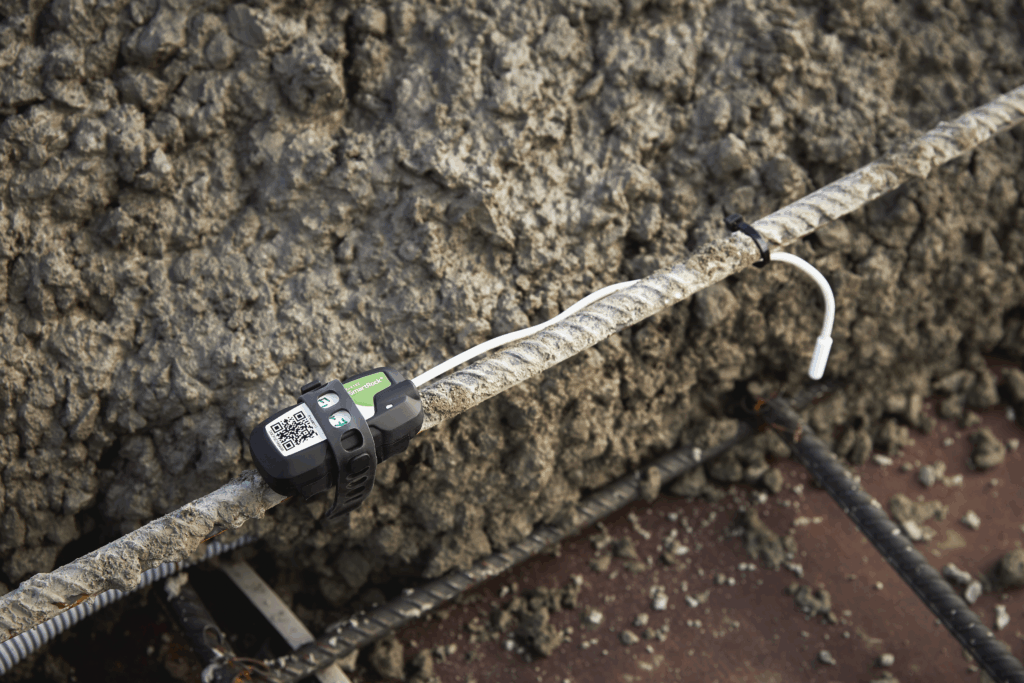
Data is accessible in real time through the SmartRock mobile app and SmartRock Web cloud dashboard, with AI assistant Roxi™ sending smart notifications to help project managers make informed decisions on pour scheduling, formwork stripping, and cold-weather curing.
No Wires to Manage, Damage, or Misconnect
SmartRock sensors require no wires, no extension leads, and no data logger connections. You attach the sensor to rebar or embed it at the specified monitoring location before the pour, and that is the entirety of the installation step. There are no leads to route through the formwork, no circuits to protect from construction traffic, and no junction connections that can introduce measurement error if wired incorrectly.
On a large mat pour, that means placing sensors at the required locations and walking away; the data collects continuously without any field intervention.
Real-Time Data Accessible From Anywhere
SmartRock gives your entire project team live access to temperature and maturity data from any device, anywhere, without anyone needing to be on site. Thermocouple systems deliver data to a fixed logger on site. If you are not standing next to it, you do not have the data. SmartRock transmits readings via Bluetooth® to a mobile device or gateway, which pushes the data to SmartRock Web. Your engineer of record, the owner’s QC representative, and anyone else who needs visibility can access live readings at any time.
Cold Weather Performance Without Wire Vulnerabilities
K-type thermocouples rely on two measurement points:
- The probe inside the concrete (the hot junction)
- A reference point at the readout device (the cold junction)
The readout calculates temperature by comparing the two. If the reference point drifts, because the readout device is sitting in fluctuating ambient temperatures or the wire picks up heat from the environment, every reading is skewed. In cold weather, where the wire and readout are exposed to changing conditions throughout the pour, this is a consistent and often invisible source of error.
SmartRock eliminates this entirely. It is an embedded sensor with no external wire and no external reference point. There is nothing to drift.
Pouring in cold weather? Avoid the most common mistakes that compromise strength gain. Learn more about 7 cold weather concreting mistakes!
One Platform for Any Pour Scale
SmartRock centralizes data from every sensor on every pour into one platform, regardless of scale. Each K-type thermocouple circuit is independent. Scaling up to monitor more locations means more wires, more data logger channels, and more coordination overhead. Whether you are monitoring two locations on a single footing or twenty locations on a bridge deck pour, SmartRock data is centralized, timestamped, and accessible through the same interface.
Compliance Documentation Without Manual Assembly
SmartRock generates audit-ready compliance reports directly from sensor data, with no manual assembly required. Thermal control plan documentation, ACI 305R and ACI 306R compliance records, and ASTM C1074 maturity logs all require a defensible, complete time-temperature history. With thermocouple systems, assembling that record means exporting data logger files, formatting them for reporting, and accounting for any gaps in the monitoring record.
SmartRock generates reports directly from sensor data. The time-temperature record is continuous, timestamped, and audit-ready. For projects where the owner, contractor, or specifying engineer requires documented compliance, this removes a documentation step that carries real risk when done manually.
SmartRock Pro: Self-Calibrating Strength Monitoring Without the Calibration Step
SmartRock Pro is the world’s first fully self-calibrating concrete strength monitoring sensor. Where SmartRock calculates strength via the ASTM C1074 maturity method, which requires a pre-pour calibration curve developed for each specific mix design, SmartRock Pro eliminates that step entirely. Using patent-pending CEMMA technology, it measures the development of concrete microstructure directly, calculating compressive strength in real time without any manual input or mix-specific setup.
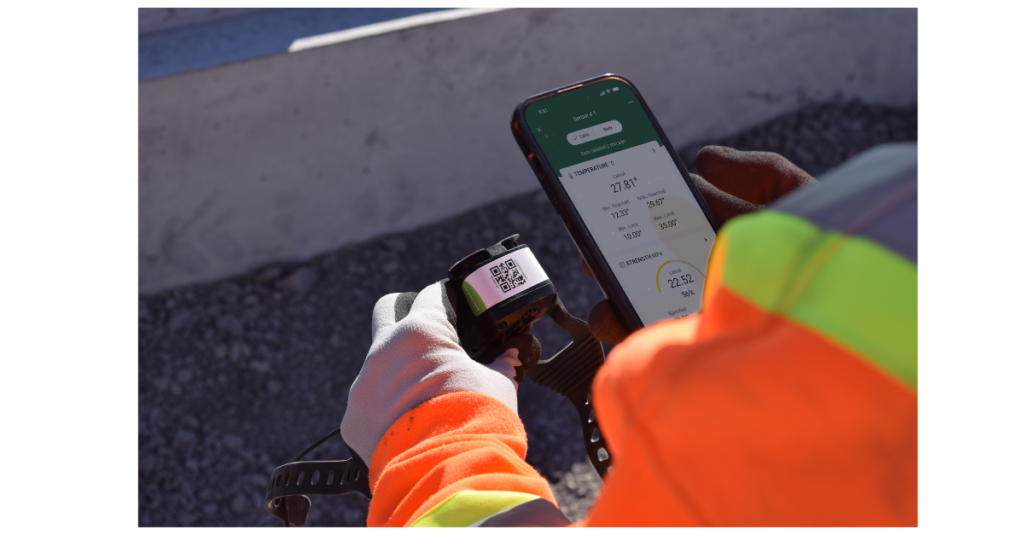
This matters most on projects where mix variability is a real operational risk. Weather conditions, last-minute changes to mix orders, truck-to-truck delivery variability, and changes in supplementary cementitious materials all affect how concrete gains strength. A thermocouple system gives you no visibility into any of that: it measures temperature and stops there. SmartRock Pro detects those fluctuations directly, because it is measuring what is happening in the concrete microstructure, not inferring strength from a calibration curve built on a different mix.
SmartRock Pro is mix-independent and compatible with Portland cement-based mixes including Type 1L and supplementary cementitious materials such as slag, silica fume, and fly ash. It operates within the 0 to 70 MPa strength range, covering the large majority of structural concrete applications. Like SmartRock, it is fully embedded, attached to the rebar before the pour, and accessible via the SmartRock mobile app and SmartRock Web. Roxi AI monitors performance in real time and can flag anomalies in strength development that might otherwise go undetected until a break test comes back low.
Thermocouples measure temperature. SmartRock translates temperature into maturity-based strength. SmartRock Pro measures strength directly, in real time, independent of the mix design it receives.
K-Type Thermocouple vs. SmartRock vs. SmartRock Pro: Direct Comparison
The table below compares all three approaches across the factors that matter most to engineers and QC teams on real projects.
| Factor | K-Type Thermocouple | SmartRock | SmartRock Pro |
| Installation | Wires run to DAQ or readout unit; requires lead management and protection from construction traffic | Self-contained; attaches to rebar before pour; no external wiring | Self-contained; attaches to rebar before pour; no external wiring |
| Data access | Manual or hardwired data logger; readings retrieved on-site | Continuous, real-time data streamed to cloud via SmartRock app and SmartRock Web | Continuous, real-time data streamed to cloud via SmartRock app and SmartRock Web |
| Cold-weather risk | Wire exposure is a failure point; freezing conditions can compromise the junction | Fully encapsulated; no exposed conductors | Fully encapsulated; no exposed conductors |
| Accuracy | ±1.5°C (Class 1) to ±2.5°C (Class 2) per IEC 60584-1; extension lead mismatch and cold junction drift add further error in field conditions | Calibrated digital sensor; no cold junction or lead mismatch | Self-calibrating via CEMMA; eliminates field drift |
| Strength measurement method | None — temperature only; strength must be calculated separately | ASTM C1074 maturity method; requires pre-pour calibration curve per mix design | CEMMA technology; self-calibrating, mix-independent, no calibration curve required |
| Maturity calculation | Requires external software or manual computation; prone to data-entry error | Automated in-app maturity calculation per ASTM C1074 | Not maturity-based; CEMMA measures in-situ strength directly |
| Scalability | Each thermocouple requires its own circuit; large pours become wire-management exercises | Multiple sensors per pour; all data centralized in one platform | Multiple sensors per pour; all data centralized in one platform |
| Documentation | Manual logs or separate data logger export; additional step for compliance reporting | Automated reports generated directly from sensor data | Automated reports generated directly from sensor data |
| Reusability | Single-use or limited reuse; calibration degrades over time | Sensor embedded in concrete (lost in place); data platform is persistent | Sensor embedded in concrete (lost in place); data platform is persistent |
Real-World Example: UHPC Solutions
UHPC Solutions, a New York-based UHPC contractor, abandoned wired thermocouples after finding them unworkable on active job sites. “We learned quickly that the wired thermal couplers were very impractical in the field and difficult to use,” says Scott Facompre, Estimator at UHPC Solutions. “We wanted the real-time data without the hassles that come from plugging wires into a machine.”
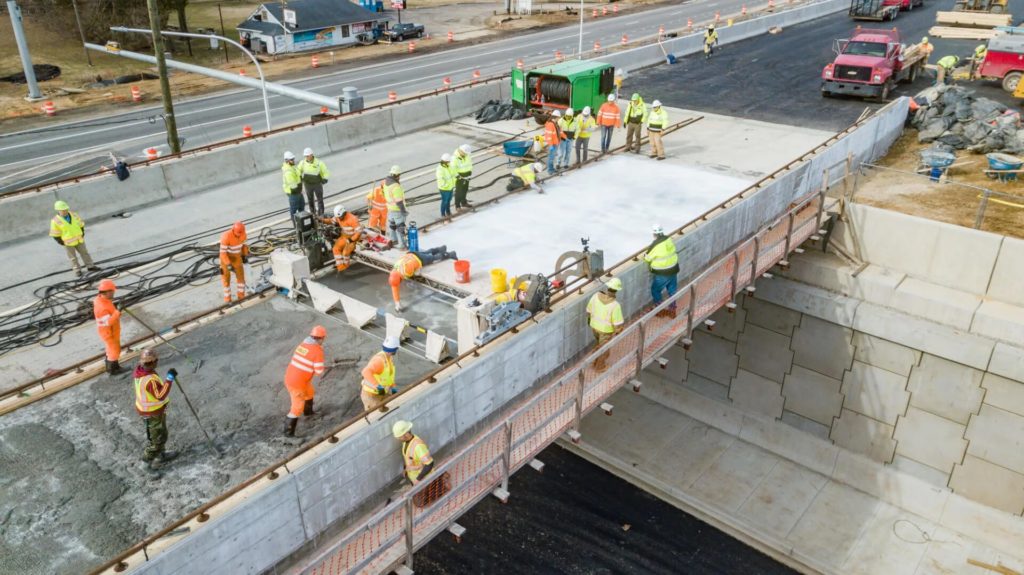
Switching to SmartRock on a Delaware bridge project, the team monitored strength and maturity in real time. Break tests later confirmed the accuracy of the wireless data, giving the team confidence to advance to live loads on schedule. Today, SmartRock is now standard across all UHPC Solutions projects.
See how UHPC Solutions replaced wired thermocouples with SmartRock across every project. Read the full UHPC Solutions case study!
When Thermocouples Still Make Sense
Wired thermocouples have a defensible place in concrete monitoring under specific conditions.
- High-temperature environments above the operational range of wireless sensors. K-type thermocouples are rated to 2300°F (1260°C), making them the appropriate instrument for refractory or industrial concrete applications.
- Legacy data acquisition infrastructure. If your QC program is built around established thermocouple systems with historical calibration records, switching instruments mid-program requires careful validation.
- Short-duration, single-point spot checks where a thermocouple probe and handheld readout is a low-cost, immediate option.
For the vast majority of structural concrete projects, none of these exceptions apply. Wireless monitoring is simpler to install, more reliable in the field, and produces better data with less effort.
Which Monitoring Approach Fits Your Project?
If you need a simple, low-cost temperature check on a non-critical pour, a K-type thermocouple with a handheld readout is sufficient. The physics works. The cost is low. The limitation is in what happens next: manual data collection, manual maturity calculation, manual documentation.
If your project requires continuous time-temperature monitoring, ASTM C1074 maturity-based strength verification, and real-time remote access, SmartRock is the right tool.
If your project involves frequent mix design changes, unpredictable delivery variability, or situations where pre-pour calibration is impractical or too costly, SmartRock Pro is the stronger choice. Its self-calibrating CEMMA technology measures concrete strength independently of mix fluctuations, with no calibration curve required and no guesswork about whether the delivered mix matches what was tested in the lab.
Conclusion
K-type thermocouples are accurate instruments. For most structural concrete monitoring today, wireless has surpassed them, not in measurement physics, but in every operational dimension that determines whether monitoring data gets collected, acted on, and documented correctly. SmartRock and SmartRock Pro address those operational gaps directly, whether your project requires ASTM C1074 maturity verification or self-calibrating in-situ strength monitoring with no manual setup.
The thermocouple is not broken. But concrete construction has moved on to real-time data, remote access, and strength estimates that update every 15 minutes from a sensor embedded in the rebar. For most projects, the question is no longer whether to go wireless. It is which wireless tool fits the work.
Ready to see wireless concrete monitoring in action on a project like yours? Book a demo with our expert!
Frequently Asked Questions
What is a K-type thermocouple?
A K-type thermocouple is a temperature sensor made from two dissimilar metal alloys, chromel and alumel, that generates a small voltage proportional to temperature. Per IEC 60584-1, the standard Class 2 tolerance is ±2.5°C and the measurement range is -328°F (-200°C) to +2300°F (+1260°C). In concrete monitoring, it is embedded in the pour and wired to a data logger or readout unit to record temperature over time.
Is a K-type thermocouple still the best way to monitor concrete temperature?
For most structural concrete applications, no. K-type thermocouples measure temperature accurately but rely on wired infrastructure that is vulnerable to job site damage, requires physical presence for data retrieval, and cannot natively calculate maturity or in-situ strength. SmartRock addresses these limitations via ASTM C1074 maturity calculation. SmartRock Pro goes further, eliminating calibration entirely through CEMMA technology.
Has wireless concrete monitoring surpassed K-type thermocouples?
Yes, for most concrete monitoring applications. SmartRock matches thermocouple accuracy while automating maturity calculation per ASTM C1074 and eliminating wired infrastructure. SmartRock Pro removes the calibration requirement entirely using CEMMA technology. In both cases, the accuracy of K-type thermocouples was never the limiting factor. The operational overhead of wired systems is.
When should you still use a K-type thermocouple for concrete?
K-type thermocouples remain appropriate in three specific scenarios: high-temperature industrial or refractory applications above the range of wireless sensors; existing QC programs built around legacy thermocouple infrastructure where switching mid-program requires careful validation; and simple, short-duration spot checks where a handheld readout is sufficient and maturity calculation is not required.
References
ACI 207.2R: Report on Thermal and Volume Change Effects on Cracking of Mass Concrete
ACI 305R: Guide to Hot Weather Concreting
ACI 306R: Guide to Cold Weather Concreting
ACI 228.1R: Report on Methods for Estimating In-Place Concrete Strength
ASTM C1074: Standard Practice for Estimating Concrete Strength by the Maturity Method
IEC 60584-1: Thermocouples — Part 1: EMF Specifications and Tolerances