



Concrete gains strength through hydration, the chemical reaction between cement and water. Temperature controls the rate of that reaction from the moment water touches cement. Too cold and hydration stalls or stops. Too hot and it overshoots, locking in a weaker microstructure that no amount of curing will reverse. Understanding the right temperature to pour concrete is what separates a protected reaction from a gamble.


What most site teams miss is that by the time the truck backs up to the chute, the concrete’s temperature has already been shaped by the plant, the haul, and the mix chemistry. The jobsite reading is the last checkpoint. It is not the only one that matters.
In this blog, let’s cover the standards that set the temperature limits, what actually controls fresh concrete temperature from the plant through transit, how admixtures shift the pour window, how to measure correctly, and what to do when a load arrives out of range.
Why Concrete Temperature Matters on Every Pour
Concrete placed below 10°C (50°F) hydrates slowly and gains strength late. If it freezes before reaching 3.5 MPa (500 psi), the mix water expands inside the paste and causes permanent microcracking. That damage cannot be reversed by rewarming. According to ACI 306R-16, concrete that freezes at this stage can lose up to 50% of its potential 28-day strength.

On the hot end, concrete placed above 32°C (90°F) gains strength faster early but finishes weaker at 28 days. Above 70°C internally, delayed ettringite formation (DEF) risk rises sharply, an expansive reaction that causes cracking months or years after placement with no warning at the time of pour.
Neither failure shows up immediately. Both are irreversible by the time they are detected. That is why the temperature window matters: it is the only stage where rejection is still an option. Once concrete is in the ground, the decision has been made.
What the Standards Say: Temperature Limits You Need to Know
The enforceable boundaries for fresh concrete temperature are consistent across major standards, with meaningful differences in how cold weather is defined and how minimum placement temperatures are calculated.
| Standard | Upper limit | Cold weather trigger | Min. placement temp |
| ACI 305.1-14 | 35°C (95°F) at discharge | — | — |
| ACI 306R-16 | — | Air at or forecast below 4°C (40°F) | 5–13°C by section size |
| ACI 318-19 Sec. 26.5.4/26.5.5 | Enforces 305.1 and 306 under IBC | — | — |
| ASTM C94-23 | 90 min or 300 revolutions from water addition | — | — |
| EN 206 | 35°C at delivery | Point-in-time below 5°C | 5°C regardless of section size |
All major standards agree on 35°C as the upper discharge limit. The key difference is in the cold-weather trigger: ACI 306R-16 activates on forecast alone, which is more protective than EN 206‘s point-in-time approach. ACI 306 also differentiates minimum placement temperature by section thickness, recognizing that thicker elements retain more hydration heat and can tolerate a lower starting temperature. EN 206 applies a single 5°C minimum regardless of geometry.
One common specification error worth flagging: many project documents still reference the older ACI 306.1-90 three-consecutive-days cold weather definition. ACI 306R-16 replaced it with a simpler forecast-based trigger. When the spec and the inspector reference different editions, disputes follow.
What Actually Controls Fresh Concrete Temperature
The temperature to pour concrete that shows at the chute is the sum of everything that happened upstream. Understanding the chain from batch to jobsite is what separates proactive temperature management from reactive load rejection.

Cement, aggregate, and mix water each contribute to discharge temperature in proportion to their mass and specific heat. The practical point is that the largest contributors by mass are the ones that matter most.
At the Plant
Cement retains heat from manufacturing, and freshly delivered cement can arrive at the silo significantly hotter than ambient temperature. This heat does not dissipate quickly, particularly in dark steel silos under direct sun, which absorb additional solar radiation on top of the retained manufacturing heat. Both conditions elevate discharge temperature before any other variable is considered. Light-colored or insulated silos reduce this effect. Checking cement temperature at the silo is a basic hot weather control that many plants skip.
Aggregates make up 60 to 75% of concrete by volume, making them the dominant temperature contributor in the batch. Stockpile color and storage conditions matter as much as stockpile temperature. Dark aggregates under direct sun absorb significantly more heat than light-colored or shaded material. Drawing from the sun-baked surface of a stockpile rather than the cooler interior adds heat before a single calculation is made. Standard hot weather controls include shading stockpiles, sprinkling with water for evaporative cooling, and sourcing from the interior. In cold weather, aggregate heating is the secondary adjustment lever after mix water heating.
Mix water has the highest specific heat of any constituent, making it the most efficient temperature adjustment in either direction. Replacing all mix water with ice can reduce fresh concrete temperature by approximately 8 to 11°C (15 to 20°F). In cold weather, heated mix water is the first correction before aggregate heating becomes necessary.
Supplementary Cementitious Materials (SCMs) change the heat profile of the mix from the moment of batching. Class F fly ash reacts slowly and reduces peak hydration heat, useful in hot weather and mass pours. Silica fume increases early reactivity and heat output, useful in cold weather to shorten the time to the 3.5 MPa freeze-damage threshold. The choice of SCM is a temperature management decision, not just a durability one.
A common mistake at this stage is fixing hot discharge temperatures with chilled water alone while ignoring silo color and aggregate stockpile conditions. The water fix works once. The storage problem comes back on every load.
In Transit
NRMCA TIP 18 quantifies what happens on the road: producers should account for a temperature rise of 1 to 5°F (0.5 to 3°C) during delivery, driven by drum rotation, ambient heat absorption, and continued hydration. Drum color is a contributing factor that is consistently overlooked. Dark drums absorb more solar radiation than light or reflective drums, adding heat to the concrete on every warm-weather haul. The effect compounds with distance.
Beyond the final reading at the chute, the temperature history during transit carries diagnostic value. If continuous logging shows that concrete ran 5°C above the expected range for 40 minutes, that history tells the team whether a retarder performed as specified or whether the slump loss at discharge is admixture failure versus temperature-driven workability loss. Without the history, you have one number at one moment. With it, you have a basis for a meaningful conversation between the producer and the contractor about mix performance.
ASTM C94-23 limits discharge to 90 minutes or 300 drum revolutions from water introduction. In hot weather, temperature-driven slump loss and accelerated setting can make this window effectively shorter than the clock suggests.
The most common mistake at this stage is assuming the plant temperature equals the discharge temperature. On a summer haul with a dark drum and a 60-minute drive, they are not the same number.
Giatec MixPilot™ in-transit slump monitoring has shifted how modern concrete quality decisions are made. Read our case study to learn how!
At the Jobsite
The chute reading under ASTM C1064-23 is the compliance checkpoint. Thermometer inserted minimum 3 in (75 mm), stabilized for two minutes. This number determines acceptance or rejection under ACI 305.1 and ACI 306. It does not tell you what the concrete will do inside the element.
Adding water or ice at the jobsite to adjust temperature is never an acceptable correction. Adding water to cool an overheated load raises the w/cm ratio, reduces design strength, and creates a second non-compliance on top of the first. Adding ice at the chute has the same effect: it changes mix proportions, lowers the cement-to-water balance, and invalidates the design. ACI 305.1-14 Section 5.7 explicitly prohibits adding water in excess of the proportioned w/cm ratio. The only correct response to an out-of-range load is rejection. The fix belongs at the plant.
The Role of Admixtures in Temperature Management
Admixtures shift the effective pour window by modifying the rate and timing of hydration. The ACI temperature limits are written for a reference Portland cement mix without admixture adjustments. The moment admixtures are introduced, those limits apply differently to that specific mix.
The rule that applies to every admixture on this list: performance is temperature-dependent. A dosage rate established at 20°C in a lab does not transfer directly to a pour at 5°C or 38°C. Pre-pour trial batches at the expected placement temperature are the minimum required to use admixtures reliably in temperature-extreme conditions.
Accelerators speed hydration in cold weather, raising early heat output and shortening the time to reach the 3.5 MPa freeze-damage threshold. Calcium chloride (ASTM C494-19 Type C or E) is effective but prohibited in prestressed concrete and limited in reinforced elements by ACI 318-19 Section 26.4 chloride ion limits. Non-chloride accelerators are the default for structural reinforced work. Effectiveness drops nonlinearly below 4°C due to the Arrhenius activation energy shift: a dose that works at 10°C may be insufficient at 2°C without approaching corrosion risk thresholds.
Retarders (ASTM C494-19 Type B or D) extend workability in hot weather without adding water. Adding water to restore slump is not a retarder. It is a w/cm violation. The trade-off with retarders is cold joint risk in multi-lift placements if the pour rate does not keep pace with the extended set time.
Hydration controllers go further than retarders by suspending hydration entirely through surface adsorption on cement particles, then allowing it to resume when conditions permit. They are increasingly used where haul times are variable and a standard retarder cannot provide sufficient hold time without over-retarding the mix.
High-performance water reducer (HPWR) polycarboxylate admixtures lose dispersion effectiveness above 30°C due to zeta potential decay on cement particle surfaces. Slump loss in transit accelerates beyond what w/cm alone predicts. According to ASTM C1611-21, a slump flow significantly lower at the jobsite than at the plant is a diagnostic indicator of this mechanism, not a reason to add water.
Air-entraining admixtures require dosage adjustment at elevated temperatures. Air content decreases as concrete temperature increases, so the same dose that produces 5.5% air at 20°C will produce less at 30°C. For freeze-thaw exposure, ACI 318-19 requires 4 to 7% total air content, depending on aggregate size. That target must be achieved at placement temperature, not at lab temperature.
How to Measure Concrete Temperature Correctly
Temperature is measured at three points in the delivery and placement process. Each answers a different question, and conflating them is where measurement errors originate.
The plant temperature reflects batching conditions. It tells you what was sent. The chute temperature is the compliance reading under ASTM C1064-23. It tells you what arrived and whether the load meets the standard. The in-place temperature is what governs strength development, cracking risk, and every critical construction operation after placement. Most projects measure the first two and assume the third. That assumption is where temperature-related failures originate.
A single thermometer reading at the chute satisfies the ASTM C1064 requirement. It is a point-in-time measurement of one location. Wired thermocouples improve on this by providing continuous data, but they require cable management through active construction. A broken wire means lost data at that monitoring point, with no indication that the gap exists until the record is reviewed.
Continuous in-place monitoring using the maturity method closes this gap. ASTM C1074-19 uses the Arrhenius equation to convert the full temperature history into equivalent age at a reference temperature, applied to a mix-specific calibration curve for real-time in-place strength. Every temperature fluctuation through the curing period is factored in. ACI 318-19 permits maturity acceptance as an alternative to field-cured cylinders for structural operations, including form stripping and post-tensioning.
The operational impact is direct. The key decision point: use continuous in-place monitoring on any pour where a critical operation depends on confirmed in-place strength, ambient conditions are variable, or the element geometry means the temperature history will differ significantly from what lab curing assumes.
Want to learn more about monitoring approaches for concrete temperature testing? Check out our blog!
Monitor Your Concrete Temperature With SmartRock®
SmartRock is a wireless sensor that embeds directly onto the rebar before you pour and records real-time temperature and strength data using the maturity method as your concrete cures.
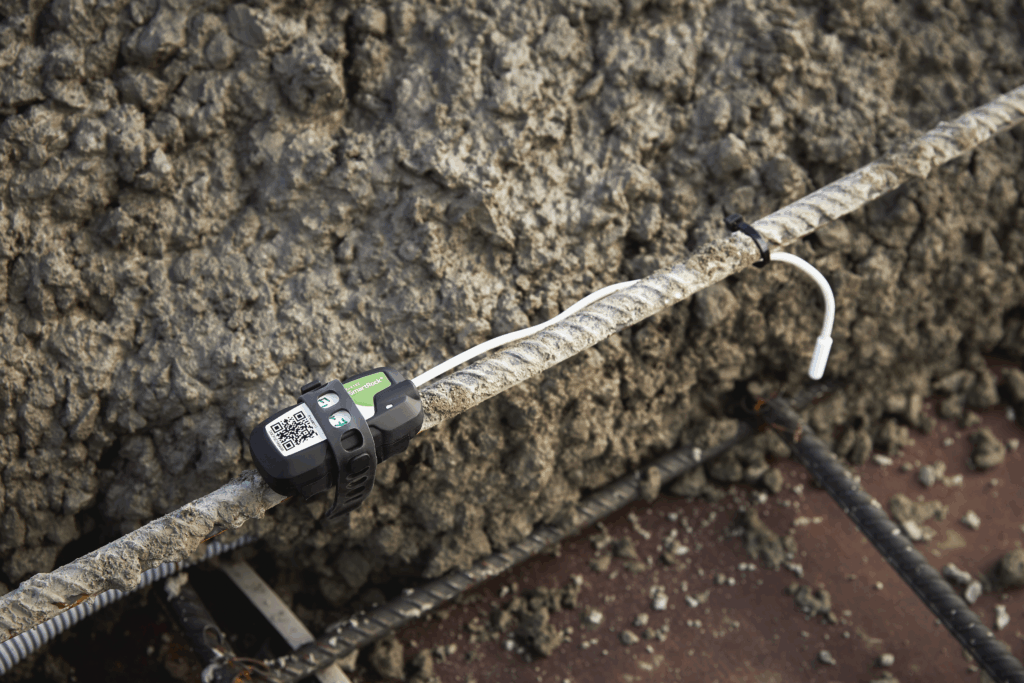
In cold weather, it can allow your team to ensure that your temperature stays above the 10°C threshold required by ACI 306 through the full protection period. Using the maturity method per ASTM C1074-19, it also converts that temperature history into real-time strength estimates, so teams know when the concrete has actually reached the minimum strength needed to strip forms, apply loads, or proceed with post-tensioning. It can also let your team know when to step in and apply measures to protect your concrete, such as deploying heat blankets.
Decisions about the temperature to pour concrete should be based on what the concrete actually experienced, not assumed lab-cure conditions.
Conclusion
The temperature to pour concrete is a window that starts at the plant, runs through transit, and closes only when the concrete has cured past the point of vulnerability. Knowing the standards is the baseline. Managing the full chain from silo to strip is what actually protects the pour.
Frequently Asked Questions
What should you do when concrete arrives outside the acceptable temperature range?
Reject the load. If discharge temperature exceeds 35°C, do not add water or ice. Both raise the w/cm ratio, reduce design strength, and create a second non-compliance. If the concrete is below the minimum specified temperature for the section thickness, reject it unless a documented thermal management plan with active in-place monitoring confirms the concrete will stay within the required range for the full protection period. The correction belongs at the plant: adjust constituent temperatures, reduce haul time, or reschedule. In-transit temperature monitoring allows producers to catch temperature trends before the truck reaches the site.
What is the ideal temperature to pour concrete?
The ideal temperature to pour concrete falls between 10°C (50°F) and 25°C (77°F). Within this range, hydration proceeds at a consistent rate that supports predictable strength gain, workability, and minimal cracking risk. Outside the 10 to 25°C window, concrete can still be placed successfully but requires active thermal management from batching through the protection period.
Can you pour concrete below freezing?
Yes, with specific preparation. The concrete must arrive at the minimum placement temperature for the section thickness per ACI 306 (5 to 13°C depending on geometry), which requires heating at the plant through mix water or aggregate heating. It cannot be placed on frozen ground, ice, or snow. If in-place concrete freezes before reaching 3.5 MPa (500 psi), the damage is permanent. In-place temperature must be maintained above 10°C for three to seven days per ACI 306 and ACI 318-19 Section 26.5.4.
What happens if concrete gets too hot during curing?
Long-term strength drops. Concrete cured at 38°C can lose 10 to 15% of its potential 28-day strength compared to concrete cured at 23°C. Above 70°C internally, DEF risk rises, causing expansive cracking months or years after placement. Above 85°C, it is severe and largely irreversible. Core-to-surface temperature differentials exceeding 19°C (35°F) cause thermal gradient cracking regardless of absolute temperature.
How does fly ash affect concrete temperature during curing?
Class F fly ash is a pozzolan that reacts slowly, requiring calcium hydroxide from cement hydration before its own reaction begins. At 30 to 50% replacement, it reduces peak hydration heat by approximately 5 to 10°C per 10% replacement level. This is the primary mix-design tool for keeping core temperatures below DEF risk thresholds in mass pours. The trade-off is slower early strength gain, which extends the cold weather protection period and must be reflected in the maturity calibration curve. ACI 207.1R-21 provides heat generation estimates for SCM-modified mix designs.
How does the maturity method account for temperature changes during curing?
ASTM C1074-19 uses the Arrhenius equation to convert the full temperature history of in-place concrete into equivalent age at a reference temperature, applied to a mix-specific calibration curve for real-time in-place strength estimation. Every fluctuation through the curing period is factored in, including diurnal swings and protection system variability. ACI 318-19 permits maturity acceptance as an alternative to field-cured cylinders for structural operations.
What is the difference between air temperature and concrete temperature?
Air temperature is the ambient condition around the placement. Concrete temperature is the internal condition of the mix, determined by constituent material temperatures, hydration heat, and thermal interaction with the surrounding environment. The two can differ significantly. Concrete placed at 25°C ambient can reach 35°C or higher internally within 12 hours due to hydration heat alone. A slab placed on a cold subgrade in mild air temperature can have a bottom-face temperature 5 to 8°C lower than the surface within minutes of placement. Air temperature governs the environment. Concrete temperature governs strength development and code compliance.
Does wind affect concrete pour temperature?
Wind does not directly change the fresh concrete temperature at the chute, but it significantly increases the surface evaporation rate after placement. Per ACI 305.1, evaporation rate is a function of four simultaneous variables: air temperature, relative humidity, concrete surface temperature, and wind speed. Wind at 25 km/h on a warm, dry day can push evaporation above the 1.0 kg/m²/hr plastic shrinkage cracking threshold even when all other conditions appear acceptable. In cold weather, wind accelerates surface cooling and widens the core-to-surface temperature differential.