


Data centers are the most schedule-sensitive concrete projects being built today. Hyperscale owners are delivering facilities on aggressive timelines where a single week of delay can cost hundreds of thousands of dollars in penalties, lost incentives, and cascading downstream schedule failures.
Concrete is almost always the first major scope that determines whether the rest of the project stays on track or doesn’t. And yet, many contractors on these projects still rely on traditional testing methods that were never designed for the speed, scale, or structural demands that modern data center construction requires.
Data center construction temperature monitoring isn’t just a quality control checkbox. It’s the difference between building on schedule and watching your critical path slip because a lab result came back 24 hours too late.
In this guide, we’ll cover why data centers create unique concrete challenges, what the standards require, how modern wireless monitoring works at hyperscale, and how the top general contractors delivering hyperscale facilities are doing it differently.
Why Data Center Construction Creates Unique Concrete Challenges
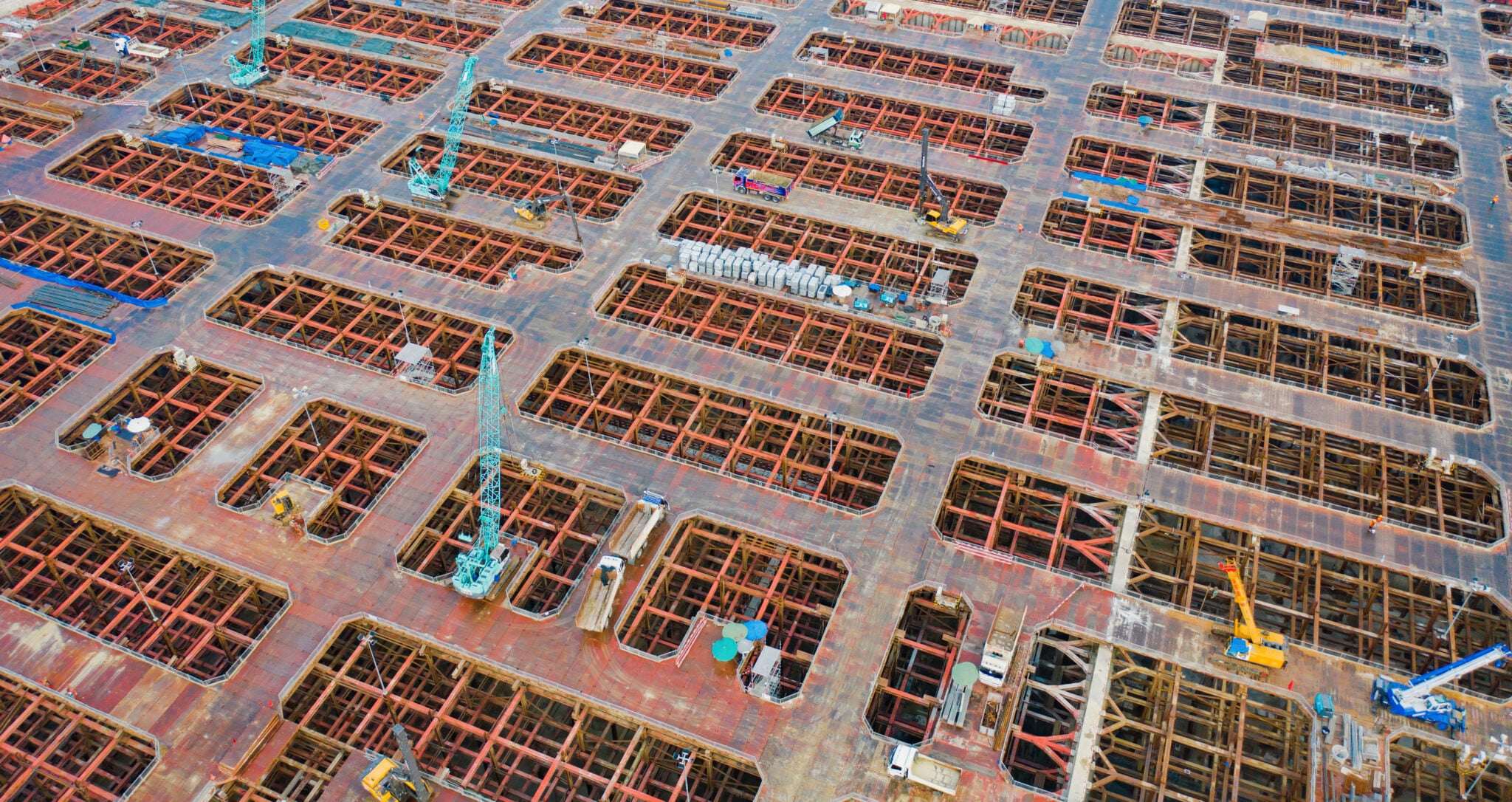
Modern data centers aren’t just large buildings. They’re mission-critical infrastructure designed to operate continuously for decades under significant mechanical and electrical loads. The structural requirements of that mission create concrete challenges that are simply more demanding than most other building types.
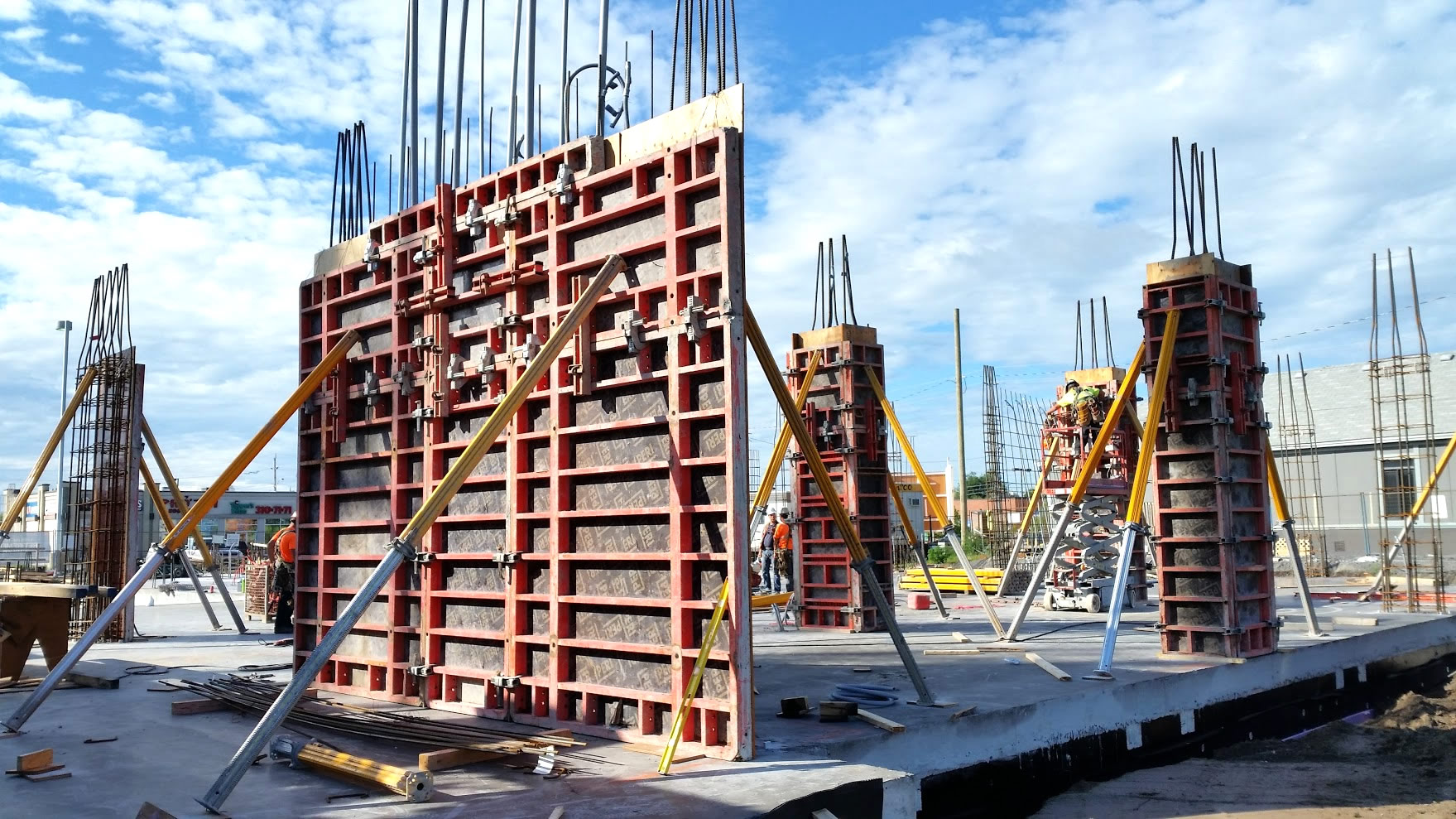
- Scale: Hyperscale data center campuses involve enormous quantities of concrete poured in concentrated timeframes. Large mat foundations, thick structural slabs, equipment pads, tilt-up wall panels, and reinforced cores are all common elements. Many of these pours are classified as mass concrete, which brings a distinct set of thermal risks during curing.
- Speed: Data center construction programmes are typically fast-tracked, with owners expecting continuous progress across multiple concurrent pours. On a large campus, crews may be managing dozens of active placements simultaneously. There is little tolerance for the kind of “wait-and-see” approach that traditional cylinder break testing forces upon construction teams.
- Precision sequencing: Data centers involve tightly coordinated construction activities where one phase directly enables the next. Formwork removal, tilt operations, post-tensioning, slab loading; all these activities depend on concrete having reached specific strength thresholds. If the field team doesn’t know when those thresholds have been reached, they are either waiting longer than necessary or making decisions based on assumptions.
- Owner expectations: Hyperscale developers have sophisticated quality and sustainability programs. They expect contractors to use data-driven methods, reduce material waste, and document concrete performance digitally. Showing up with cylinder breaks and wired thermocouples is increasingly out of step with what owners expect from top-tier GCs.
What Is Mass Concrete and Why Data Centers Are Full of It
According to the American Concrete Institute (ACI), mass concrete is any volume of concrete with dimensions large enough to require that measures be taken to manage the heat generated by cement hydration and the resulting volume changes in order to minimize cracking.
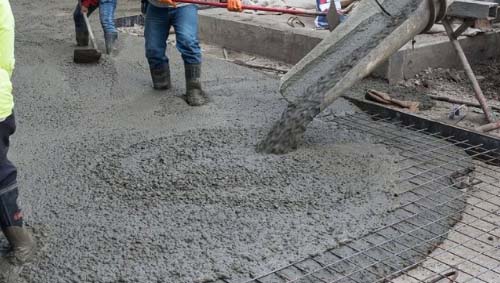
In plain terms, when you pour a very large volume of concrete, the chemical reaction between cement and water generates significant heat. The interior of a thick foundation or slab stays hot much longer than the outer surfaces, which cool more quickly when exposed to air or formwork. This creates a temperature gradient between the hot core and cooler exterior.
When that gradient becomes too large, the concrete expands and contracts unevenly. The resulting internal stresses can exceed the tensile strength of the concrete at early age and, when that happens, thermal cracking occurs.
At data centers, mass concrete shows up everywhere:
- Thick mat foundations supporting heavy mechanical and electrical equipment
- Large structural equipment pads and bases
- Massive tilt-up wall panels
- Reinforced concrete cores and shear walls
- Extensive slab-on-grade systems
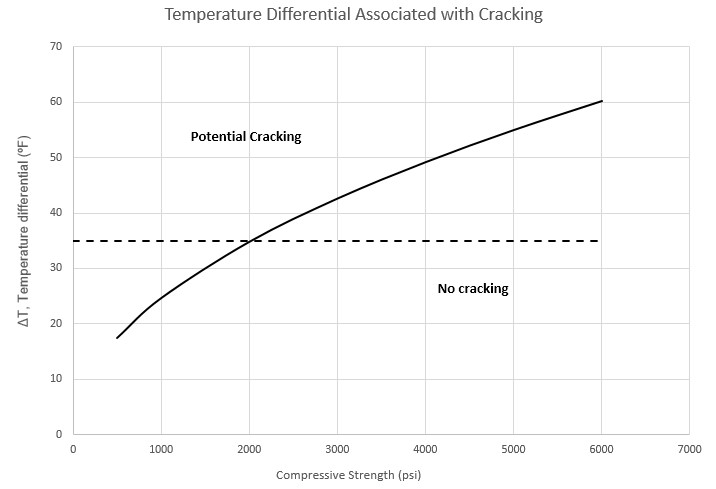
The ACI 301 standard and most owner-specified thermal control plans require that the temperature differential between the core and surface of mass concrete elements be controlled, typically to within 35°F (19°C), to prevent thermal cracking. Meeting that requirement means monitoring temperature continuously throughout curing, not periodically or manually.
The Real Risk: What Happens When Temperature Isn’t Monitored
Thermal cracking is the obvious risk. But the consequences of poor temperature monitoring in data center construction go well beyond a crack in a foundation slab.
- Structural remediation: Thermal cracks in critical elements may require investigation, testing, and repair before the next construction phase can proceed. On a fast-track schedule, the delay and cost associated with a single rework event can far outpace the cost of preventing it.
- Schedule cascade: When a foundation pour requires inspection or remediation, every subsequent activity, framing, MEP rough-in, equipment installation, shifts. On a hyperscale campus where the owner has made commitments to operational dates, a cascade delay is a serious contractual exposure.
- Low cylinder breaks: Field-cured test cylinders don’t replicate the conditions inside the actual structure. Cold nights, inconsistent storage, and transportation handling can produce cylinder results that don’t reflect in-place strength. This leads to either unnecessary waiting or premature loading. Either outcome costs time or creates risk.
- Incomplete quality records: Sophisticated hyperscale owners increasingly require digital documentation of concrete performance throughout curing. Manual monitoring methods produce incomplete, inconsistent records that create problems during owner reviews and project closeout.
What Data Center Construction Temperature Monitoring Actually Requires
For any pour classified as mass concrete, the project’s thermal control plan will typically specify:
- Continuous temperature monitoring of the core and surface throughout curing
- Maximum internal temperature limits, typically 160°F to 180°F (70°C to 82°C) depending on mix design and specification
- Maximum temperature differential between core and surface, typically no more than 35°F (19°C)
- Minimum concrete placement temperature and maximum ambient temperature differential requirements for cold and hot weather concreting
- Data documentation in a format suitable for project records and owner review
Meeting these requirements with traditional methods, like periodic manual measurements with a thermometer, or wired thermocouple systems requiring field personnel to physically download data, creates significant operational friction on a fast-moving data center project. The labor cost of manual monitoring on a large campus pour is substantial. The risk of missed readings during nighttime hours or shift transitions is real.
Modern wireless embedded sensors automate continuous data collection and transmit readings to cloud-based platforms in real time, eliminating the operational burden while improving the quality and completeness of the monitoring record.
Why Temperature Alone Isn’t Enough on Fast-Track Data Center Projects
Here’s what Giatec understands that most basic temperature monitoring solutions miss: on a data center project, the goal isn’t just to prevent cracking, it’s to build as fast as possible without taking on risk.
Temperature data tells you when a pour might be in danger. In-place strength data tells you when you can move.
Knowing actual concrete strength in real time is what allows a field team to make confident decisions about:
- Formwork removal: stripping as soon as the concrete is genuinely ready, not days after
- Tilt operations: activating wall-tilt schedules the moment strength targets are hit, not when the next cylinder break comes back from the lab
- Post-tensioning: stressing cables precisely when in-place strength reaches the required threshold
- Equipment loading: confirming slab capacity before expensive MEP equipment is set
- Sequencing decisions: letting the next crew begin their work earlier, compressing the overall schedule
Traditional temperature-only monitoring tells you whether you’re staying within thermal limits. It doesn’t tell you when you can strip forms. SmartRock® Long Range does both, simultaneously and automatically.
How SmartRock Long Range Works on Data Center Job Sites
SmartRock Long Range is purpose-built for the demands of hyperscale data center construction. Here’s how the system works in the field.
The Sensor
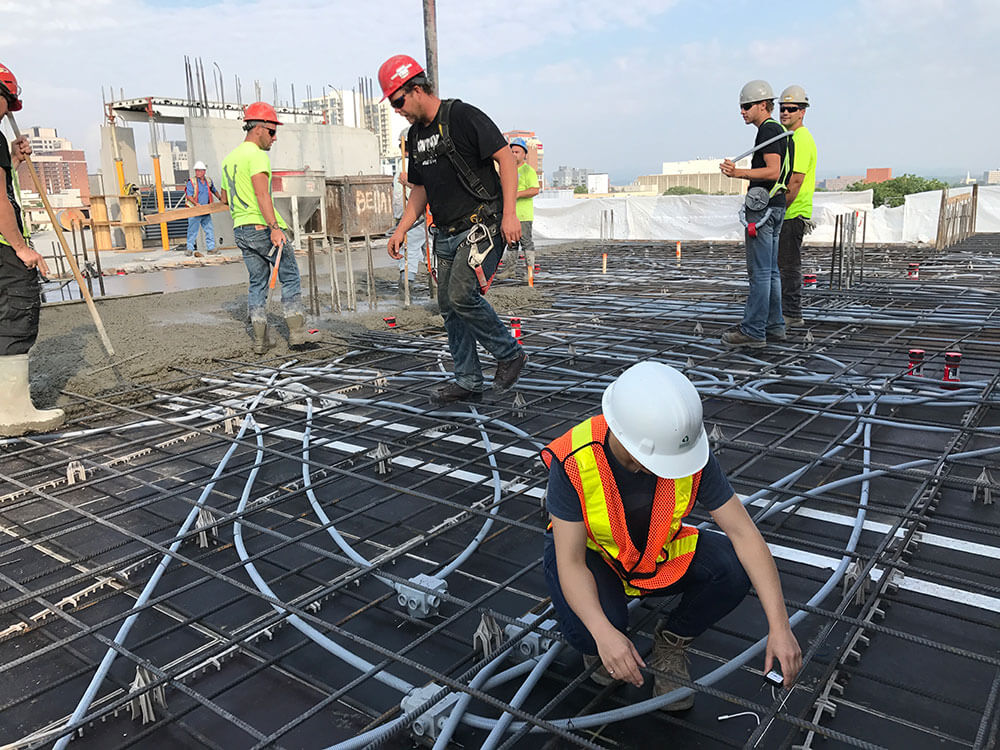
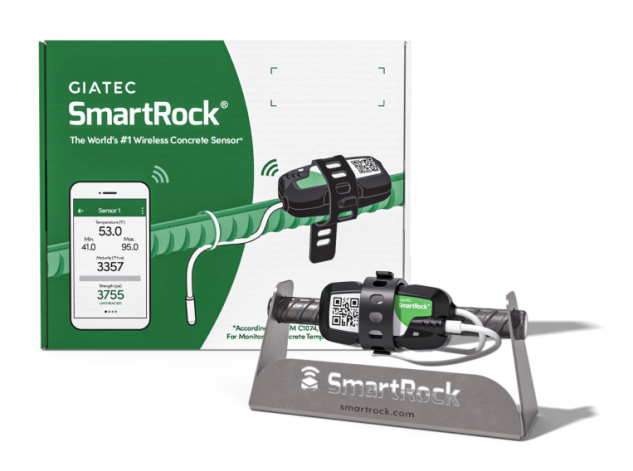
The SmartRock Long Range sensor is fully embedded! It installs directly on the rebar before the pour and stays in place permanently. There are no wires to manage, no data loggers to retrieve, and no setup complexity that slows down a crew working under pressure.
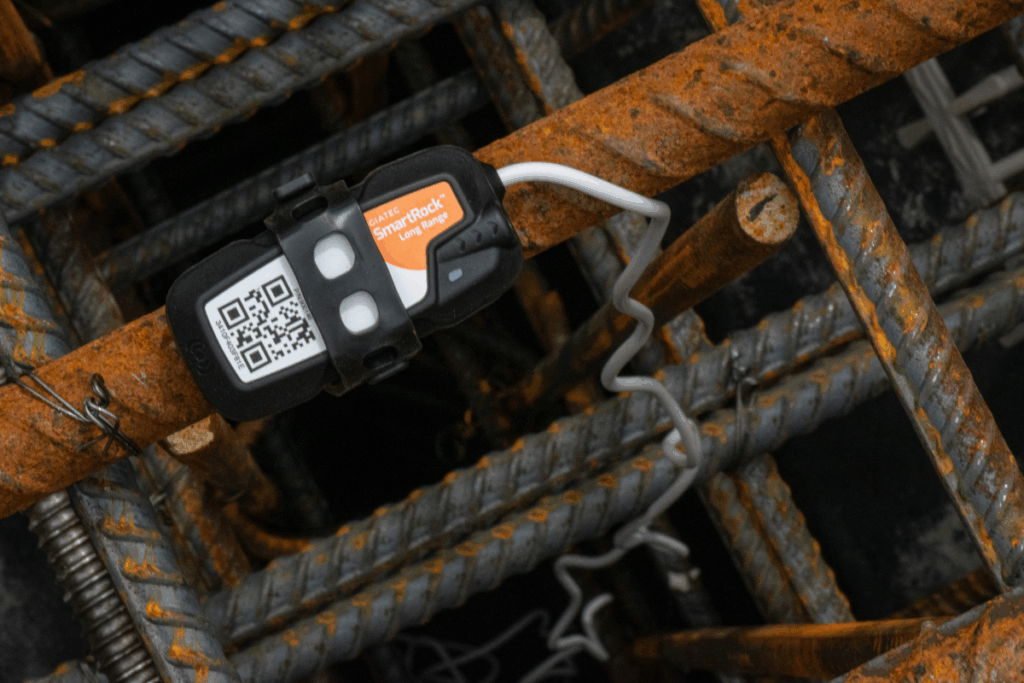
Each sensor measures from two locations simultaneously. The probe at the end of the cable, positioned at depth in the pour, and the sensor body near the rebar. This dual-point measurement provides direct insight into surface-to-core temperature behavior, exactly the visibility a thermal control plan requires, while also capturing the maturity-based in-place strength data that drives schedule decisions.
Data is collected every 15 minutes and transmitted wirelessly at a range of up to 1,000 ft (300 m), making it practical for the expansive, multi-zone job sites typical of hyperscale campuses.
The Gateway
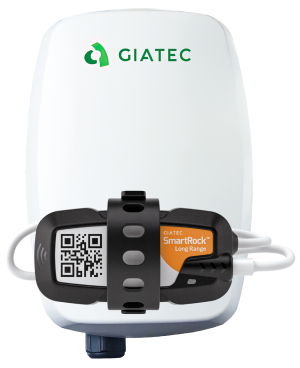
The SmartHub™ Long Range gateway automatically connects to an unlimited number of SmartRock Long Range sensors across the job site and syncs data to the SmartRock® Web cloud platform via LTE. A single gateway can cover a massive area. Teams can place the gateway at ground level and maintain live connectivity with sensors embedded across multiple floors or spread across an expansive campus, no manual data collection required.
The Platform
All data flows to the SmartRock® Web cloud dashboard, where project teams can:
- Monitor temperature and strength for every active pour in real time
- View temperature gradient data between core and surface locations
- Use the Thermal Modeling feature to predict concrete temperature behavior in mass elements before issues develop
- Generate shareable digital reports for owner documentation
- Access data from any device, anywhere
The SmartRock mobile app gives field engineers instant access to the same data directly on their phones, supporting real-time decisions at the pour without needing to return to an office or wait for a report.
Roxi™ AI Assistant
Roxi is Giatec’s AI-powered monitoring assistant, built into the SmartRock Web platform. Roxi monitors curing conditions continuously and delivers intelligent alerts when temperature differentials approach limits, when strength targets are reached, or when anomalies appear in the data. Instead of relying on field personnel to manually check sensor readings at regular intervals, Roxi automatically notifies the right people at the right time, so the crew can act immediately rather than discovering an issue hours later.
Real Data Centers. Real Results.
SmartRock Long Range isn’t a theoretical solution for data center construction, it’s the tool trusted by the GCs actually building the world’s most demanding hyperscale facilities. Here are three recent examples.
Hyperscale Cloud Campus | Northern Virginia
Large-Scale Data Center Project
This project, located in one of North America’s most active data center corridors, involved large-scale structural concrete elements, tilt-up walls, and an accelerated construction schedule driven by reliability, speed, and sustainability goals set by a major global cloud provider.
The general contractor deployed SmartRock Long Range to replace field-cured cylinder testing, reducing dependency on lab results while supporting the project’s sustainability and material waste objectives. Live strength alerts notified the crew the moment targets were reached, allowing them to optimize their wall-tilt schedule in real time. The field team gained better visibility into curing conditions across quality-critical pours, supporting faster on-site decisions and more consistent results.
Hyperscale AI Computing Campus | North Texas
Large-Scale Data Center Project
This campus was designed to support high-performance computing and AI-driven platforms, with massive foundations and critical mass concrete pours on an aggressive delivery timeline. Schedule certainty and sustainability were primary objectives for the owner.
The general contractor used SmartRock Long Range to monitor early-age concrete behavior and prevent thermal cracking in mass pours, a direct quality requirement on a project of this structural scale. In-place strength data supported accelerated sequencing and earlier formwork removal, compressing the overall schedule. The team was also able to confirm slab capacity before loading equipment, eliminating the uncertainty that traditionally delays MEP and equipment installation activities.
Cloud Region Data Center | South Texas
Hyperscale Data Center Project
This facility was built as a key component of a major technology company’s regional cloud infrastructure, designed for scalability, security, and long-term performance. The project required precise control of concrete curing to meet strict quality standards and aggressive construction milestones.
The general contractor used SmartRock Long Range to enable early formwork removal through real-time strength monitoring, and to optimize curing strategies using live temperature data, reducing unnecessary heating and cooling costs in the process. Accelerated slab cycles helped the team maintain their critical path schedule throughout the project.
Choosing the Right Temperature Monitoring Solution for Your Data Center Project
Not all monitoring solutions are built for the scale and speed of hyperscale data center construction. Here’s what to evaluate when choosing a system:
Wireless range. Large data center campuses require connectivity across significant distances. Solutions limited to short wireless ranges require field personnel to physically visit each pour to retrieve data, negating the labor savings of wireless monitoring and creating gaps in continuous coverage.
Dual-point temperature measurement. A thermal control plan requires core and surface temperature data. A sensor that measures only a single location cannot satisfy this requirement without deploying multiple devices per pour.
Real-time strength data. Temperature monitoring alone doesn’t give teams the information they need to make schedule decisions. A solution that combines temperature monitoring with maturity-based in-place strength monitoring enables earlier, more confident decisions on formwork removal, post-tensioning, and sequencing.
Cloud connectivity and reporting. Hyperscale owners expect digital documentation of concrete performance. A system that requires manual data export or doesn’t produce owner-ready reports creates unnecessary administrative burden and audit risk.
Scalability. A campus with multiple concurrent pours requires a system that can scale. Solutions with sensor count limitations or per-gateway constraints become bottlenecks on large projects.
SmartRock Long Range is engineered to meet all of these requirements — and has been validated on the most demanding hyperscale data center projects in North America.
Frequently Asked Questions: Data Center Construction Temperature Monitoring
What is data center construction temperature monitoring?
Data center construction temperature monitoring is the practice of continuously measuring temperature within concrete elements, particularly mass concrete foundations, slabs, and walls, during curing to prevent thermal cracking, comply with thermal control plan requirements, and support confident schedule decisions. On fast-track data center projects, real-time wireless monitoring systems like SmartRock Long Range provide continuous visibility into curing conditions without requiring manual field checks.
What is the maximum temperature differential allowed in mass concrete?
The American Concrete Institute (ACI 301) and most project-specific thermal control plans specify a maximum temperature differential of 35°F (19°C) between the core and surface of a mass concrete element. Exceeding this threshold creates internal stresses that can lead to thermal cracking. Continuous monitoring with embedded sensors positioned at both depth and surface is required to ensure this limit is maintained throughout the curing period.
What standards govern temperature monitoring in data center construction?
The primary standards governing temperature monitoring for mass concrete include ACI 301 (Specifications for Structural Concrete), ACI 305R (Guide to Hot Weather Concreting), ACI 306R (Guide to Cold Weather Concreting), and ASTM C1074 (Standard Practice for Estimating Concrete Strength by the Maturity Method). Project-specific thermal control plans, which are commonly required by hyperscale owners, typically reference these standards and specify monitoring frequencies, temperature limits, and documentation requirements.
How do wireless concrete sensors work on large data center job sites?
Wireless concrete sensors, like SmartRock Long Range, are embedded directly on the rebar before a pour and remain in place permanently. They measure temperature and in-place strength at 15-minute intervals and transmit data wirelessly to a SmartHub gateway, which syncs information to a cloud-based dashboard in real time. With a wireless range of up to 1,000 ft (300 m), a single gateway can cover the expansive areas typical of hyperscale data center campuses. This gives project teams continuous visibility across all active pours without requiring field personnel to manually collect data.
How does real-time temperature monitoring reduce data center construction delays?
Real-time temperature monitoring reduces data center construction delays in two key ways. First, it enables early detection of conditions that could lead to thermal cracking, allowing curing strategies to be adjusted before a problem occurs rather than responding to damage after the fact. Second, and more importantly for schedule, when combined with real-time in-place strength monitoring, it tells construction teams exactly when concrete has reached the strength thresholds required for formwork removal, post-tensioning, and sequential work. This eliminates the waiting time associated with traditional cylinder break testing, which can save one to two days per pour. On a large data center campus with dozens of concurrent pours, those savings compound significantly across the project schedule.
Can SmartRock Long Range monitor temperature differentials for mass concrete thermal control plans?
Yes. Each SmartRock Long Range sensor measures temperature from two locations simultaneously, the probe at depth within the pour and the sensor body positioned near the concrete surface. This dual-point measurement provides direct core-to-surface temperature differential data. It meets the continuous monitoring requirements of thermal control plans without requiring multiple separate devices per pour location.
What types of data center projects has SmartRock Long Range been used on?
SmartRock Long Range has been deployed on major hyperscale data center projects across North America, including large-scale cloud campuses in Northern Virginia, North Texas, and South Texas. Projects have involved tilt-up wall construction, mass concrete foundations, and aggressive fast-track schedules for some of the world’s leading technology companies and cloud providers.
Build Your Next Data Center Pour with Confidence
Data center construction is too fast, too complex, and too high-stakes to rely on monitoring methods that were designed for a slower era of construction. The contractors delivering the world’s most demanding hyperscale projects have moved to real-time, wireless, cloud-connected monitoring, because it’s the only approach that gives field teams the visibility they need to move fast without taking on unnecessary risk.
SmartRock Long Range gives your team continuous temperature and in-place strength data from every pour, across the entire job site, accessible from anywhere. It’s the concrete monitoring solution trusted by HITT, JE Dunn, Turner, Holder, DPR, Whiting-Turner, Clayco, and Mortenson on the projects that matter most.
Planning a data center project? Talk to a Giatec expert about whether SmartRock Long Range is the right fit.