



What is AASHTO T 413-24?
If you work on DOT projects, whether as a state materials engineer, a contractor’s QC manager, or a testing lab lead, you’ve likely heard some version of this question lately: “Have you looked at AASHTO T 413 yet?” AASHTO does not publish brand-new test methods often, and in 2024 it released one built around a single, high-stakes decision: when is it safe to open a concrete pavement to traffic?


AASHTO T 413-24, officially titled “Standard Method of Test for Estimating the Early Opening Strength of Concrete Pavements by Maturity Tests,” gives agencies and contractors a standardized, code-recognized way to answer that question using the maturity method instead of waiting on lab-cured beams or cylinders. It was one of only eight new standards in AASHTO’s 2024 Materials Standards edition, and it is already shaping how DOTs and paving contractors approach opening-to-traffic decisions.
In this blog, you’ll learn what AASHTO T 413-24 requires, why AASHTO created it, and what it means for how your agency or crew decides when a concrete pavement is ready for traffic.
The Problem AASHTO T 413 Was Built to Solve
Ask a DOT materials engineer how pavement opening strength gets verified today, and you’ll usually hear the same process. Crews cast beams or cylinders, cure them alongside the pour, and break them in a lab until one hits the required strength, often 550 psi modulus of rupture or an equivalent compressive strength, depending on the agency.
This method works, but it is slow, and it does not always reflect reality. A sample sitting in a curing box does not experience the same heat of hydration, temperature swings, or exposure conditions as the slab it is meant to represent. In the case of beams, which are easy to damage or mishandle in transport, field results often come in more conservative than the concrete’s actual condition. Because the whole process depends on a physical break test, the earliest an agency can confirm readiness is however long it takes to schedule and run that test, sometimes a full day added onto an already tight schedule.
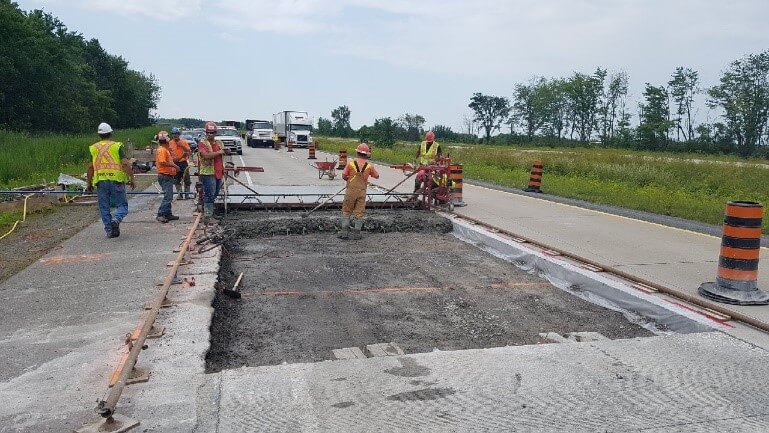
The maturity method has answered this problem for years. Instead of breaking a physical specimen, you track the concrete’s temperature history over time and use it to estimate strength development, based on the relationship between heat and hydration that governs how concrete gains strength. This concept underlies ASTM C1074, and dozens of state DOTs already allow some version of it.
The catch is that “some version of it” was exactly the problem. Every state that adopted maturity testing built its own procedure, its own thresholds, and its own paperwork. No single national method existed for the opening-to-traffic decision specifically, until AASHTO T413.
What AASHTO T 413-24 Actually Requires
T 413 is deliberately narrow in scope, and that is a feature, not a limitation. It exists to answer one question: is this pavement ready for traffic? The standard is explicit that it cannot be used to determine 28-day strength or general concrete acceptance. Acceptance testing still runs through standards like AASHTO T 22 for cylinders or T 97 for beams, with T 23 governing field curing. Think of T 413 as a specialist tool, not a general one.
Here is what the standard requires:
- Build a strength-maturity curve, typically at the plant, though T 413 also permits developing the curve in the field from production concrete. Using the actual job mix, cast a minimum of 12 specimens (beams or cylinders) and test them for strength at four different ages.
- Track temperature in the field. Once paving starts, sensors go in near the pavement’s mid-depth, with a minimum of two placements per day’s run (more if daytime and nighttime temperatures swing widely). The standard uses the Nurse-Saul function to calculate a time-temperature factor (TTF), a running tally of the maturity the concrete has accumulated, based on a datum temperature of 14°F (-10°C).
- Compare field maturity to the curve, and open once it clears the threshold. Once the field TTF matches the point on the strength-maturity curve corresponding to the required opening strength, the pavement is clear to open. No beam break required.
- Revalidate on a schedule. A curve does not last forever. T 413 requires revalidation at least every 60 days, and a new curve any time the mix changes materially: a shift in water-cement ratio of more than 0.02, a change in cementitious material source, a change in coarse aggregate source, or a mix proportion change greater than 5 percent by weight. Revalidation itself has a built-in tolerance: the calculated strength must fall within 10% of the original curve, and it may never sit more than 10% below it. Some agencies allow a larger margin on the high side, since a result above the curve means the concrete is stronger than expected, making the opening decision more conservative rather than less. These guardrails address the most common skepticism about maturity testing: it is not a set-it-and-trust-it-forever system.
One nuance worth knowing if you dig into the standards: in typical implementations of AASHTO T 413 for concrete pavements, the datum temperature is commonly specified as 14°F (−10°C) by convention. ASTM C1074, by contrast, does not fix this value; it suggests that 32°F (0°C) may be more appropriate for many applications and recommends determining the datum temperature experimentally for the specific mixture
Why This Standard Is Getting Attention Now
T 413 has not stayed a quiet addition to a materials standards binder. The industry has been actively building around it.
In November 2024, the Iowa State CP Tech Center, FHWA, and the Southwest Concrete Pavement Association hosted a Concrete Pavement Maturity Workshop at Caltrans headquarters to walk agencies and contractors through the maturity concept and how T 413 streamlines its use. Soon after, the CP Tech Center published a MAP Brief built around the standard, and trade publications picked up the story too.
Dr. Armen Amirkhanian of the University of Alabama summarized the appeal in Roads & Bridges: the new standard offers a more automated, reliable way to determine opening strength, and even a modest improvement, such as eight hours earlier, can meaningfully benefit drivers and schedules on a busy corridor.
Every hour a lane stays closed adds to congestion, detours, and work-zone exposure for the paving crew. A standardized maturity method recognized nationally, rather than agency by agency, gives DOTs an easier path to adopting a faster, more defensible process.
Adoption is already underway. As of last year, roughly three dozen states already accepted maturity testing in some form in their specifications. T 413 gives that patchwork of state-by-state approaches a common national reference point.
What This Means for Your Team
- If you’re a DOT engineer, T 413 gives you a defensible, standardized basis for opening decisions, one you did not have to build in-house, and one that is easier to hold contractors to consistently across projects.
- If you’re a paving contractor, faster opening decisions mean shorter lane closures, less schedule risk, and a real shot at opening a pavement on the first day of paving, something T 413 explicitly anticipates in its implementation guidance.
- If you’re running a testing lab, this is also a case for advocating for sensors internally. A technician who would otherwise be tied to a single job site, waiting on break times, can instead service multiple projects in a day. Fewer trips per project means your lab can take on more work with the same staff, a direct efficiency gain worth pointing to when you’re making the case for sensor adoption.
Making T 413 Practical: Where SmartRock® Fits
Reading a standard is one thing. Complying with it in the middle of a paving season is another, and that is where the maturity method succeeds or falls short. You need sensors that install quickly, a reliable way to log temperature from the moment concrete goes down, and a system that turns raw temperature data into a maturity curve you can defend to an agency.
That is the gap SmartRock® was built to close. On reinforced pavements, the sensor body attaches to the rebar, while its tail extends down to sit at the pavement’s mid-depth, exactly where T 413 calls for it. On non-reinforced pavements, where there is no rebar to attach to, SmartRock uses a fresh-set installation instead, placing the sensor at the center of the slab. Either way, the sensor streams real-time temperature and calculated strength data to the SmartRock app and the SmartRock Web dashboard, using the same Nurse-Saul maturity function used in T 413. For larger paving projects with multiple lanes or long linear runs, SmartRock Long Range extends that same real-time visibility across the jobsite through a long-range gateway, so your team is not stuck walking the length of a highway to check a sensor.
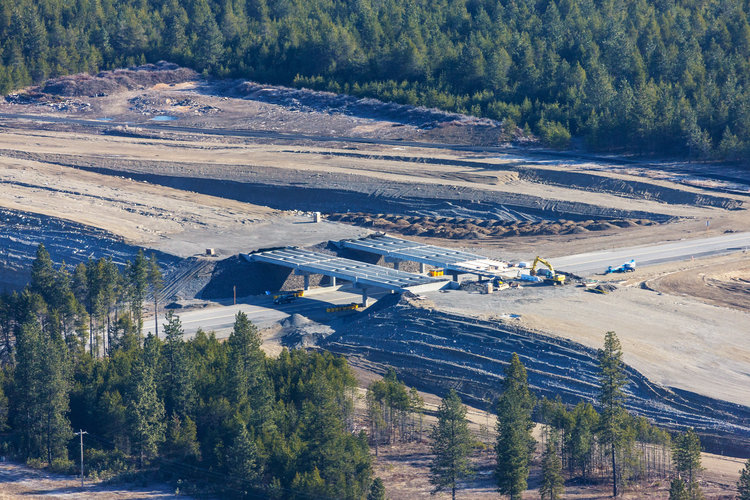
C.L. Heilman put this to the test on an interchange project north of Coeur d’Alene, Idaho, after the Idaho Transportation Department mandated ASTM C1074 maturity testing for form removal and loading decisions on the job. The bridge contractor swapped wired thermocouples for SmartRock sensors, letting the crew and the site inspector each check strength readings from the mobile app instead of waiting on a lab. Across roughly 20 pours on the project, the company estimated the approach shaved five to ten days off the schedule and finished the work 10 to 15% faster.
Conclusion
AASHTO T 413-24 does not reinvent the maturity method. It standardizes and simplifies it, specifically for the opening-to-traffic decision that DOTs and paving contractors make on nearly every project. For an industry that has spent years working with a patchwork of state-specific maturity provisions, that is a meaningful step: one method, nationally recognized, with clear rules for building a curve, validating it, and knowing when a pavement is ready.
If your agency or crew has not looked closely at what T 413 requires, now is a good time, before the next paving season puts the question in front of you on a live jobsite.
Learn how SmartRock helps teams comply with maturity-based opening standards. Book a demo today!
Frequently Asked Questions for AASHTO T 413-24
What is AASHTO T 413-24?
It is a AASHTO standard test method, published in 2024 with no prior editions, that provides a standardized procedure for using the maturity method to estimate the early strength of concrete pavements, specifically for determining when they can be opened to traffic.
How is T 413 different from ASTM C1074 and AASHTO T 325?
ASTM C1074 establishes the general maturity method concept, and AASHTO T 325 and T 276 apply that concept more broadly to concrete strength estimation in transportation construction. None of these methods, including ASTM C1074, are recommended for estimating later-age or 28-day strength. T 413 is narrower still: it is built specifically for pavement opening-strength decisions, and its calibration requirements reflect that. It calls for a minimum of 12 specimens across four break ages, compared to ASTM C1074’s minimum of 17 specimens across five break ages, which makes T 413 a faster, more targeted calibration for this one decision.
What maturity function does T 413 use?
The Nurse-Saul function, which calculates a time-temperature factor (TTF) using a datum temperature of 14°F (-10°C).
How many specimens do you need to build a T 413 curve?
A minimum of 12 beams or cylinders, cast from the approved job mix and tested for strength at four different ages, with two of the specimens instrumented to track temperature and maturity.
How often does a maturity curve need revalidation under T 413?
At least once every 60 days during normal production, and immediately if the mix changes, including shifts in water-cement ratio, cementitious material source, coarse aggregate source, or mix proportions beyond the thresholds the standard specifies.
What strength is typically required to open a pavement to traffic?
Requirements vary by agency, but common thresholds include roughly 550 psi modulus of rupture (flexural) or an equivalent compressive strength in the 2,500 to 4,000 psi range, depending on the DOT’s specifications.
Do DOTs accept maturity testing for concrete acceptance, not just opening?
Generally, no. Most agencies that allow maturity testing, including under T 413, use it specifically for the opening-to-traffic decision, not as a substitute for standard acceptance testing.