



Concrete maturity is an index value that represents the progression of concrete curing. It is based on an equation that takes into account concrete temperature, time, and strength gain. The maturity method uses that index to estimate the in-place compressive strength of curing concrete in real time, following ASTM C1074.
What Is ASTM C1074?
ASTM C1074 is the Standard Practice for Estimating Concrete Strength by the Maturity Method. It sets out how to establish the relationship between a specific concrete mix’s temperature history and its compressive strength, and how to use that relationship to estimate the in-place strength of concrete in a structure. It is a practice rather than a test method, which is the important distinction: it does not measure strength, it standardises how strength is estimated from temperature so that the estimate is defensible.
The standard is what makes maturity acceptable to engineers and departments of transportation. Without a calibrated relationship developed and validated to C1074, a strength number derived from temperature is an opinion. With it, it is a documented estimate with a recognised basis.
| What the standard covers | What it requires | Why it matters on site |
|---|---|---|
| Maturity functions | Two are permitted: Nurse-Saul, which produces a temperature-time factor in degree-hours, and Arrhenius, which produces an equivalent age at a reference temperature | Nurse-Saul is simpler and is what most field work uses. Arrhenius handles wide temperature swings better. Your specification or agency may name one |
| Datum temperature or activation energy | A mix-specific value, determined by the procedure in the standard, or a documented default where permitted | Get this wrong and every maturity value downstream is wrong. It is a property of the mix, not a universal constant |
| Developing the strength-maturity relationship | Cylinders cast from the specific mix, at least two carrying embedded temperature sensors, cured under controlled conditions and broken in compression at a series of ages, typically 1, 3, 7, 14, and 28 days | This is the calibration, and it is done once per mix. It is also the step most often skipped or reused from another mix, which is the main cause of bad estimates |
| Recording temperature in the element | Temperature logged at intervals no longer than half an hour for the first 48 hours, and no longer than one hour after that | Sets the minimum logging frequency any sensor or logger has to meet to be compliant |
| Validating the relationship in the field | Field-cast cylinders broken and compared against the maturity estimate, with the relationship re-examined if the two consistently diverge | This is what keeps the method honest as materials and conditions drift through a project |
| Limits of the method | The standard states the conditions under which the estimate becomes unreliable, including in-place concrete that differs from the calibration batch, poor placement or curing, and very high early-age temperatures | Knowing where the method stops working is what lets you defend it where it does |
One thing ASTM C1074 does not do is replace acceptance testing. Standard-cured cylinders tested under ASTM C39 still govern acceptance against the specified strength. C1074 governs the in-place estimate used for stripping, post-tensioning, opening to traffic, and load application.
A Fast Approach for Estimating In-Situ Compressive Strength
Early, rapid, and accurate in-situ estimation of the compressive strength of concrete is one of the major challenges for the concrete industry. A practical solution for such challenges can prevent multi-million dollars of extra annual investment for the construction industry and owners of civil structures. Concrete is the most used human-made material on the planet. The Global Cement and Concrete Association put annual production at around 14 billion cubic metres in 2021, so even small improvements can have a major impact. Therefore, an accurate and reasonable in-situ estimation of the compressive strength can optimize the concrete mix design, including the formwork removal time. The optimization of mix design affects the consumption of raw materials (e.g. cement and aggregates) and alternative materials (e.g. natural pozzolans and supplementary cementitious materials like fly ash and silica-fume). Considering the high volume of global consumption of concrete, this could effectively optimize the consumption of resources and reduce a great extent of CO2 and toxic materials (emitted during cement production) in the atmosphere.
What Is the Concrete Maturity Method?
The maturity method is a convenient approach to predict the early-age strength gain of concrete. This concrete maturity measurement method uses the principle that the concrete strength is directly related to the hydration temperature history of cementitious paste. The maturity concept for estimating the strength gain is described in ASTM C1074. It can address many immediate challenges facing the concrete industry. For example, predicting the appropriate time for formwork stripping and post-tensioning, especially at low temperatures when strength development is hindered, and optimizing concrete mix formula and curing conditions (e.g. heating at low temperatures or surface protection in hot, dry weather). Lack of an accurate early-age strength estimation creates two risks. 1) Contractors wait too long for the next action, causing costly project delays. Or 2) they act prematurely, which could cause the concrete structure to crack. This would lead to future durability and performance issues, or even structural collapse.

Learn all about the maturity method, including its theory and applications.
Common Challenges with Traditional Strength Testing
In most construction sites, field-cured concrete samples are tested for strength at various ages during the first week since concrete is poured. This is done to make a decision on formwork removal. As such, ASTM C873 offers a test method for cast-in-place cylindrical specimens. These specimens can be removed later to measure compressive strength in the lab. Usually, if the concrete reaches 75% of its designed strength, the structural engineers allow for the stripping of forms. However, the problem is that only one specimen is crushed for strength estimation. This is not necessarily accurate. The method is limited to use in horizontal and thick concrete elements like slabs. In addition, the construction crew is usually on the job site while they wait to hear about the compressive strength results from the lab. This adds to the cost of construction and its uncertainty decreases the efficiency of the construction.
Why Is There Resistance to Using Maturity Measurement?
Although alternative methods such as concrete maturity measurement exist, there is resistance to utilizing them for most concrete projects. Except for specific projects, the concrete industry shows interest in the commonly used compressive strength test. This is mainly due to the upfront cost of concrete mixture calibration for maturity curves. It is also caused by the lack of expertise in installing concrete temperature sensors, data collection, and analysis.
Such approaches to compressive strength evaluation may cause concrete contractors to make conservative decisions, face more complicated technical problems (e.g. delay in formwork stripping, and unnecessary long-term curing and surface protection), and spend more financial resources.
Benefits of the Concrete Maturity Method
As non-destructive testing, the concrete maturity measurement method may be a reasonable candidate to fill this gap. In comparison to most on-site non-destructive technologies (e.g. Schmidt Hammer or Ultrasonic Pulse Velocity), the privilege that the maturity method stands on is that the procedure for estimating the compressive strength would be objective and qualitative once the maturity curve is developed and adopted.
This technical article describes how the maturity curve is developed and how it is applied for on-site estimation of the compressive strength of concrete.
Interested in learning about how we use concrete maturity measurement for our SmartRock wireless sensors? Read all about it!
What Is the Principle of the Concrete Maturity Measurement Method?
The maturity method is a relatively simple approach for estimating the in-place compressive strength of concrete, specifically at early ages less than 14 days. Once the maturity curve is developed in the laboratory for a specific project, it can be used for on-site estimation of the compressive strength of concrete in real time.
The maturity value is governed by the fundamental assumption that a given concrete mix design poured during the course of a specific project has the same compressive strength when it has the same “maturity index”. It means that a given concrete mix formula or mix, for example, may reach the same compressive strength after 7 days of curing at 10 °C when it is cured at 25 °C for 3 days.
Understanding the Maturity Functions: Nurse-Saul and Arrhenius
The concrete maturity measurement method based on the ASTM C1074 is the most commonly used to estimate the in-situ strength of concrete. ASTM C1074 provides two maturity functions: 1) Nurse-Saul function; and 2) Arrhenius function. Based on the Nurse-Saul method, there is a linear relationship between the maturity and the temperature in real-time. The underlying assumption is that the strength development in concrete is a linear function of hydration temperature. Equation 1 shows the relationship between maturity and hydration temperature history.
Where: M(t) is the maturity index at age t; Ta is the average temperature during time interval ∆t; T0 is the datum temperature. ASTM C1074 provides a standard procedure to find the datum temperature for a specific mix design. However, most of the previous studies suggest a practical estimation of the datum temperature that is between 0 °C and -10 °C. Indeed, this is the temperature at which the hydration of cementitious paste stops; hence, the strength development of concrete ceases. Unpublished results by Giatec Scientific Inc. show that this temperature resides within an interval between 0 °C and -5 °C, dependent on the concrete mix formula.
The second approach is the Arrhenius function. This assumes that there is an exponential relationship between the compressive strength and hydration temperature. The maturity index is defined in the form of an equivalent age at a reference temperature. It means the actual age should be normalized to the reference temperature in order to estimate the compressive strength. This function needs a value of activation energy that can be determined as the procedure detailed in ASTM C1074.
Why the Nurse-Saul Method Is More Common in Practice
Even though the Arrhenius function is scientifically more accurate, the Nurse-Saul function is more commonly used by the concrete industry. The reason being:
- The accuracy of the Nurse-Saul function is adequate for most field applications;
- The Nurse-Saul function is relatively simpler compared with the Arrhenius function.
How is the Maturity–Strength Curve Adopted Via the Nurse-Saul Function?
In ASTM C1074, there is a step-by-step guide for developing the maturity curve and for estimating the compressive strength. These steps are described as follows.
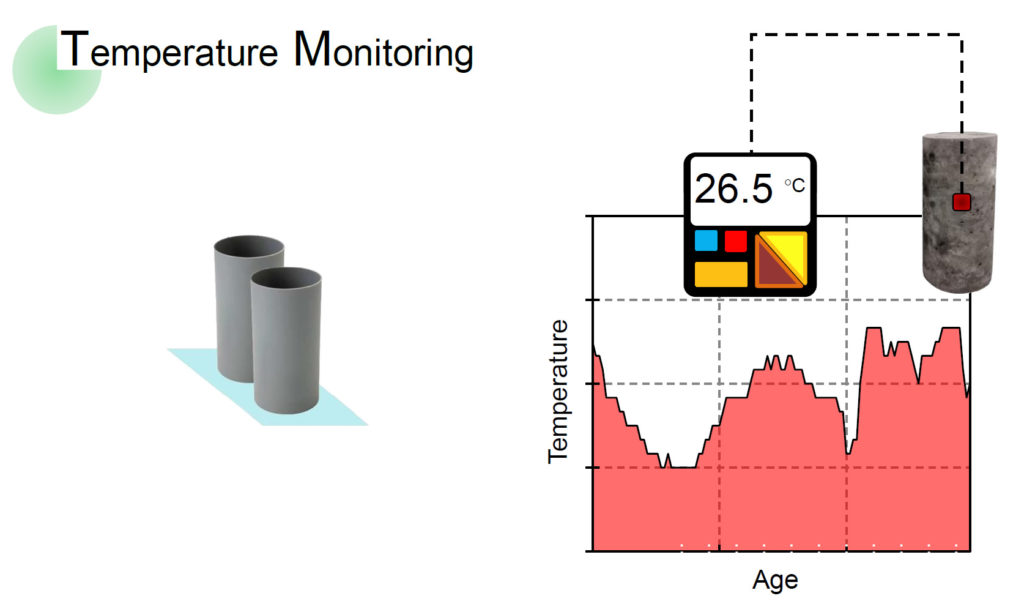
Step 1: Cast and Prepare Concrete Cylinders with Embedded Temperature Sensors
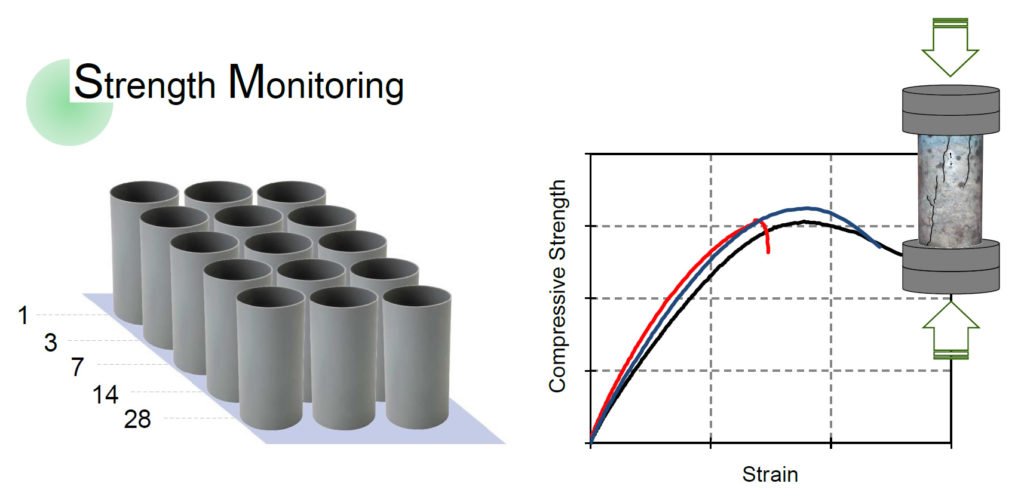
The maturity-strength curve represents the relationship between maturity index and compressive strength for a specific concrete mix design, adopted in the laboratory. To do so, adequate concrete cylindrical specimens should be cast, and then stored in the semi-adiabatic condition for curing. A certain number of concrete cylinders (i.e. at least two concrete specimens) should be equipped with embedded temperature sensors for recording the hydration temperature history. The compressive strength of concrete is measured at ages of 1, 3, 7, 14 and 28 days.
Step 2: Calculate Maturity Index and Develop the Strength-Maturity Curve
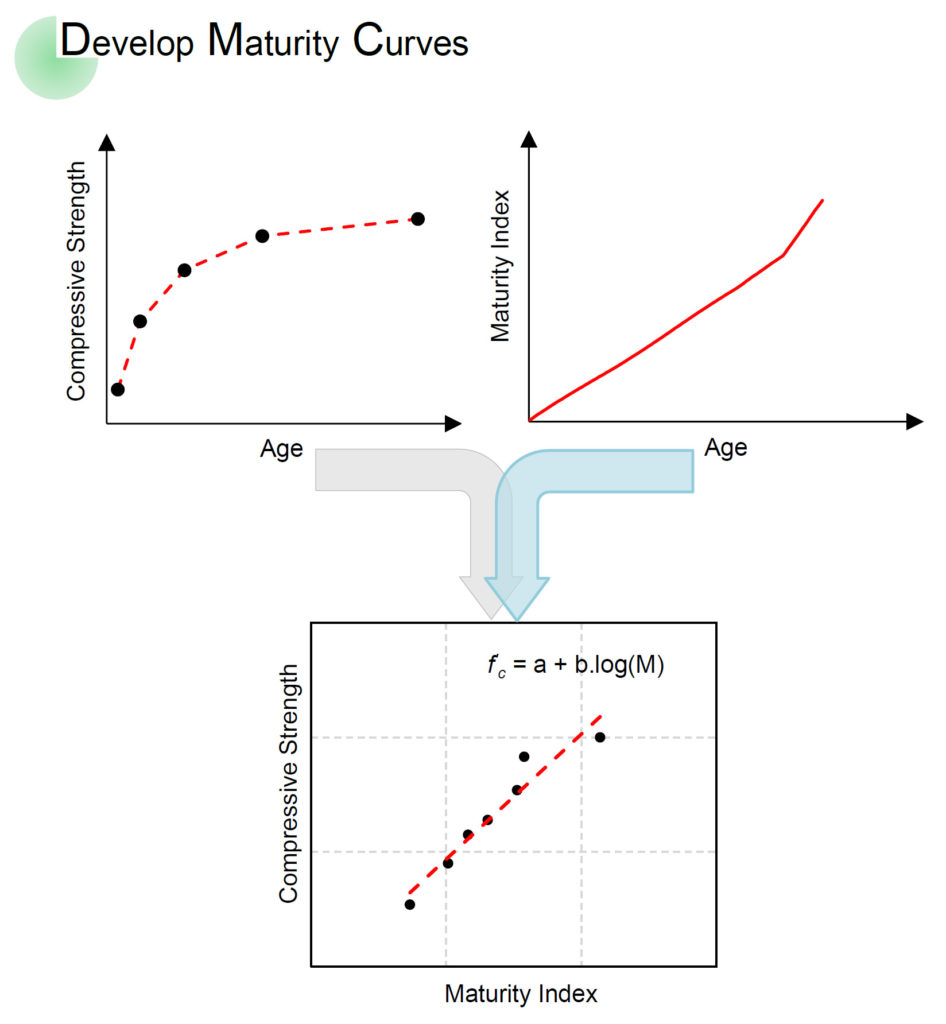
The maturity index is calculated at strength testing times using Equation 1. Then, the best curve will be fitted for the strength data versus maturity index data. It should be noted that it is important to test the concrete mix design that will be the same as that used in the construction project. Any deviations from the original mix design (such as water-to-cement ratio, cement content, etc.) will reduce the accuracy of the maturity method to estimate the compressive strength.
Step 3: Monitor Temperature History and Apply the Maturity-Strength Curve On-Site
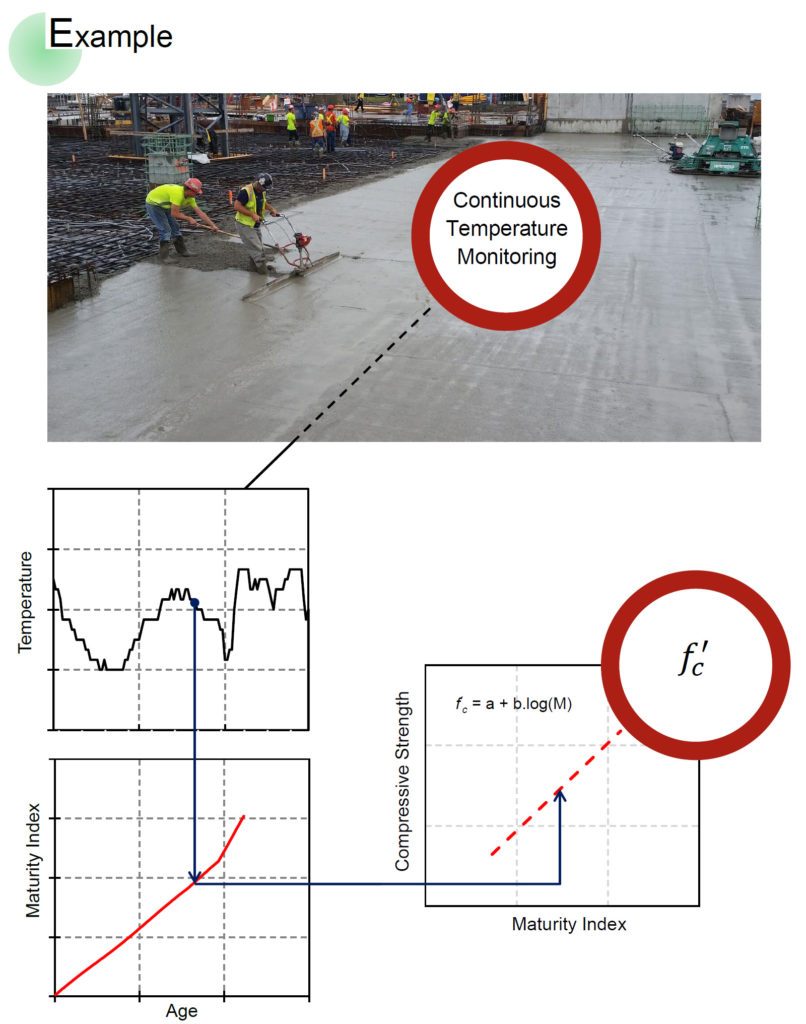
Once the maturity–strength curve is developed, it can be used to estimate the in-place concrete strength using the hydration temperature history. To do so, the temperature history of the concrete elements should be recorded after pouring using embedded sensors at the locations that are generally critical in terms of exposure conditions, curing and structural requirements. Routine quality control tests should be performed to ensure the accuracy of the maturity–strength curve. These controls minimize any error in the estimation of in-place strength due to inherent limitations of the concrete maturity measurement method.
Some of the important limitations of this method are listed as follows:
- In-place concrete is not representative of the concrete used to develop the calibration in the lab. This can be because of changes in materials, water-to-cement ratio, air content, batching method, etc.
- In-place concrete is not properly placed, consolidated, cured, etc.
- Very high early-age temperatures can lead to inaccurate estimation of strength at later ages;
- Using a datum temperature (for the Nurse-Saul function) that is not representative of the concrete mixture can result in an incorrect estimation of strength.
Several maturity meter devices have been developed that can measure the hydration temperature of concrete in real time. Several maturity systems, such as COMMAND Center from The Transtec Group and Con-Cure NEX, use embedded temperature sensors connected by cable to a reader or node to calculate maturity and estimate in-place strength. They can include a temperature sensor embedded into the concrete elements, plugged into the data logger via an electrical cable. Alternatively, a simple thermocouple could be embedded in concrete for temperature monitoring using a connected data logger. The data should then be extracted and used to calculate the maturity index and estimate the concrete strength from the maturity curve.
Standards for Concrete Maturity Measurement
The maturity method is widely standardized and accepted by building codes. This section summarizes different codes and standards accepted by different countries or regions. Countries that do not define maturity in their code typically follow ASTM standards. There are also multiple countries that are actively working on standardizing or approving the method for their own standard practice.
United States
ASTM C1074: Standard Practice for Estimating Concrete Strength by Maturity Method
ASTM C918: Standard Test Method for Measuring Early-Age Compressive Strength and Projecting Later-Age Strength
ACI 318: Building Code Requirement for Structural Concrete and Commentary
ACI 228.1R: In-place Methods to Estimate Concrete Strength
ACI 306R: Guide to Cold Weather Concreting
AASHTO T325: Standard Method of Test for Estimating the Strength of Concrete in Transportation Construction by Maturity Tests.
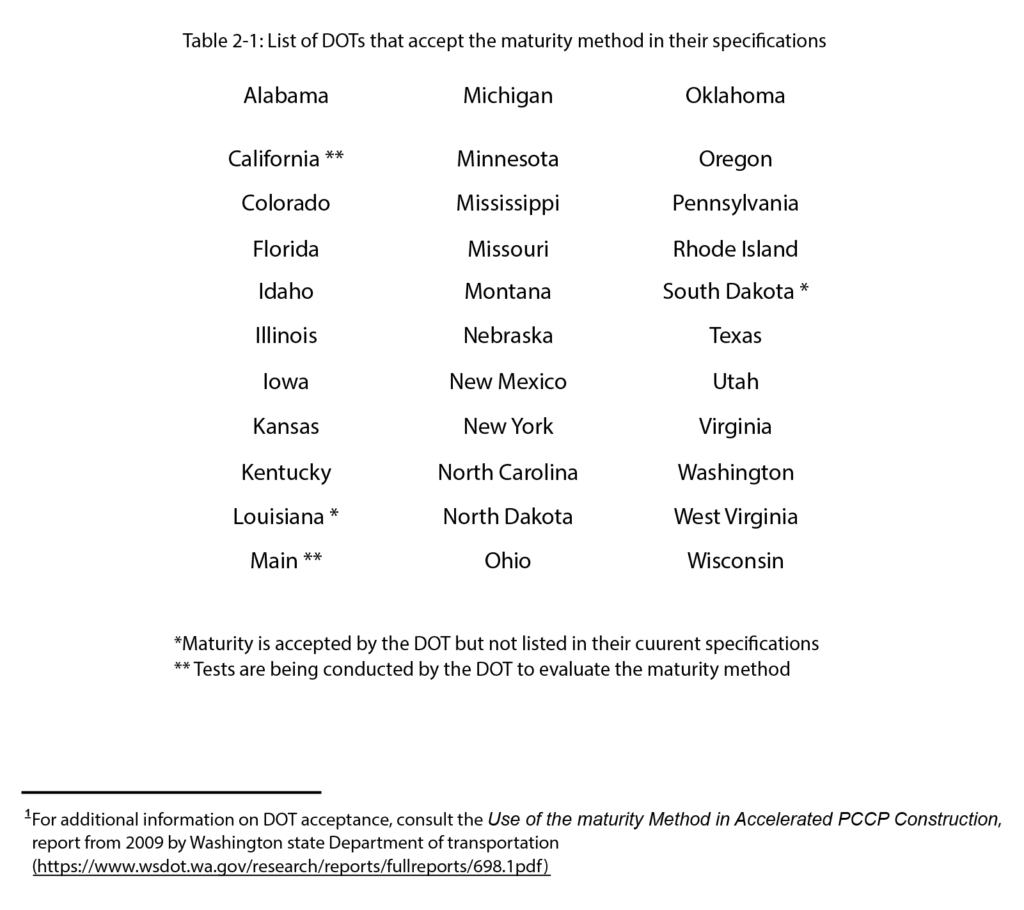
DOT: The maturity method is widely adopted by most DOTs in the United States. As of April 2025, 36 states accept maturity as one of the testing methods in their specifications. A list of those states is presented in Table 2-1. The specifications in regards to maturity change per DOT, as some mandate the use of the maturity method. Some simply accept it as an alternative to field-cured specimens or use it only for specific applications. Other states are currently in the process of implementing the method for future revisions.
Canada
CSA A23.1/A23.2: Concrete Materials and Methods of Concrete Construction/Test Methods and Standard Practices for Concrete
South America
NCH 170: Hormigon- Requisitos generals (Concrete- General requirements)
Europe
Multiple European countries allow for the maturity value to be used as a measurement for in-place strength by specifying maturity in their specific standards. The three standards that are generally used as a guide for measuring maturity:
EN 206-1: 2002, Concrete – Part 1: Specification, performance, production and conformity
BS EN 13670: Execution of concrete structures
NEN 5970: Determination of Strength of Fresh Concrete with the Method of Weighted Maturity
Comparing Maturity to Other Strength Methods
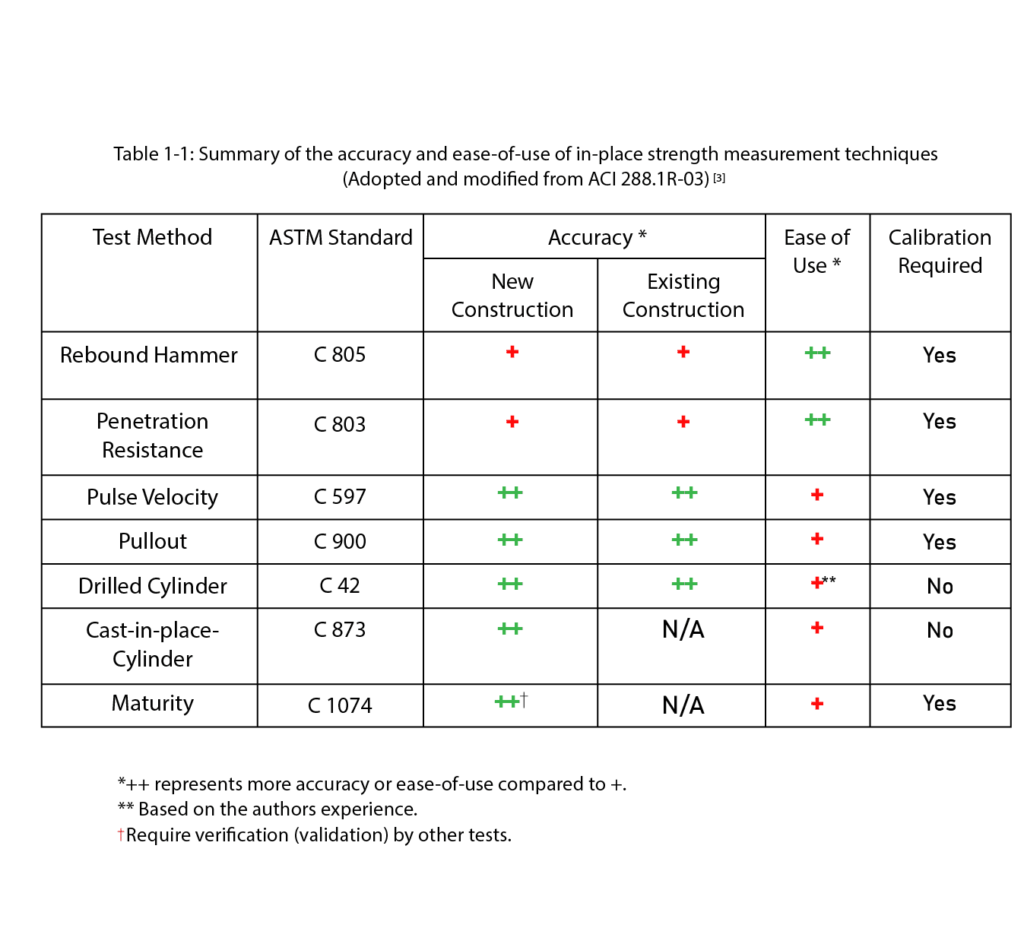
With the exception of the maturity method, all of the other methods have some limitations. This is in regards to the applicable range of compressive strength and/or location of the tests. Table 1-1 presents the accuracy, ease of use, and required specifications for different in-place strength monitoring methods. Table 1-1 was adapted and modified from ACI 228.1R, In-Place Methods to Estimate Concrete Strength. Since that guide was last released, developments in sensing and data collection have made several of these methods considerably easier to use, the maturity method most of all. Even though a large range of in-place techniques is available to contractors that measure the in-place strength, the chosen method is often the break tests. Lately, concrete maturity measurement has largely gained popularity in North America, as well as throughout the world, albeit at a slower pace. It is the preferred method for a wide variety of projects and applications.
ASTM C1074 FAQ
What is ASTM C1074 used for?
It is used to estimate the compressive strength of concrete already in place, from the temperature history of that concrete, so that construction operations can proceed on evidence rather than on a fixed waiting period. The usual applications are formwork removal, post-tensioning, saw cutting, opening pavement to traffic, and applying construction loads.
Does ASTM C1074 replace cylinder break tests?
No, and the standard does not claim to. Standard-cured cylinders tested under ASTM C39 remain the basis for accepting concrete against its specified strength. Cylinders are also what the strength-maturity relationship is calibrated against in the first place, and what it is periodically validated against. What C1074 displaces is the extra set of field-cured cylinders many projects cast purely to decide when an element is ready.
How many cylinders does ASTM C1074 require for calibration?
The standard specifies a set of cylinders cast from the mix being calibrated, with temperature sensors embedded in at least two of them, tested in compression at a series of ages, typically 1, 3, 7, 14, and 28 days. The exact specimen count and the rules for handling scattered results are set out in the standard and should be read from the current edition rather than from memory, since projects have been rejected over exactly this.
How often does temperature have to be recorded under ASTM C1074?
At intervals no longer than half an hour for the first 48 hours after placement, and no longer than one hour thereafter. Any sensor or logger used for maturity has to meet at least that frequency. Modern embedded sensors typically record far more often than the minimum.
Is ASTM C1074 accepted by DOTs and building codes?
Widely, though the detail varies by jurisdiction. In the United States the maturity method is referenced in ACI 318 and ACI 228.1R and adopted by most state DOTs, with AASHTO T 325 covering its use in transportation construction. Canada addresses it through CSA A23.1 and A23.2, and several European standards permit maturity-based in-place strength. Requirements differ enough that the governing specification, not the general position, is what to work to.
Does a sensor measure concrete strength under ASTM C1074?
No. The sensor measures the concrete’s internal temperature. The standard defines how that temperature history is converted into a maturity index and then into an estimated compressive strength, using a relationship calibrated for the specific mix. The output is an estimate with a standardised basis, and describing it as a direct strength measurement is both inaccurate and, on a submittal, a problem.