


What is a concrete cylinder break machine, and is destructive cylinder testing still necessary to verify in-place strength?
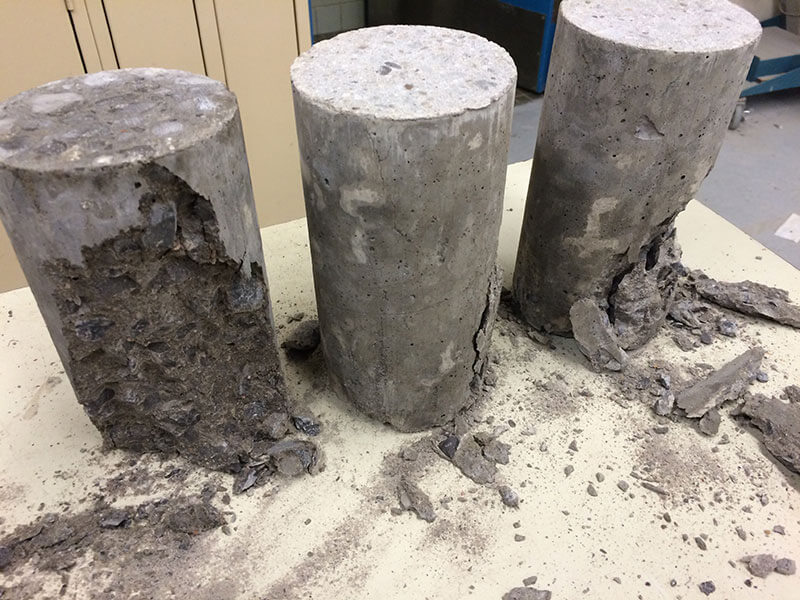
A concrete cylinder break machine, also called a compression testing machine, applies a controlled axial load to a cured concrete cylinder until it fails, producing the compressive strength value used for code acceptance. That result describes the cylinder under standard curing, not necessarily the concrete curing inside your actual structure at the same moment.
In this blog, gain an understanding of how a concrete cylinder break machine works, what ASTM C39 requires, and whether destructive testing is still necessary now that self-calibrating strength monitoring exists.
What Is a Concrete Cylinder Break Machine?
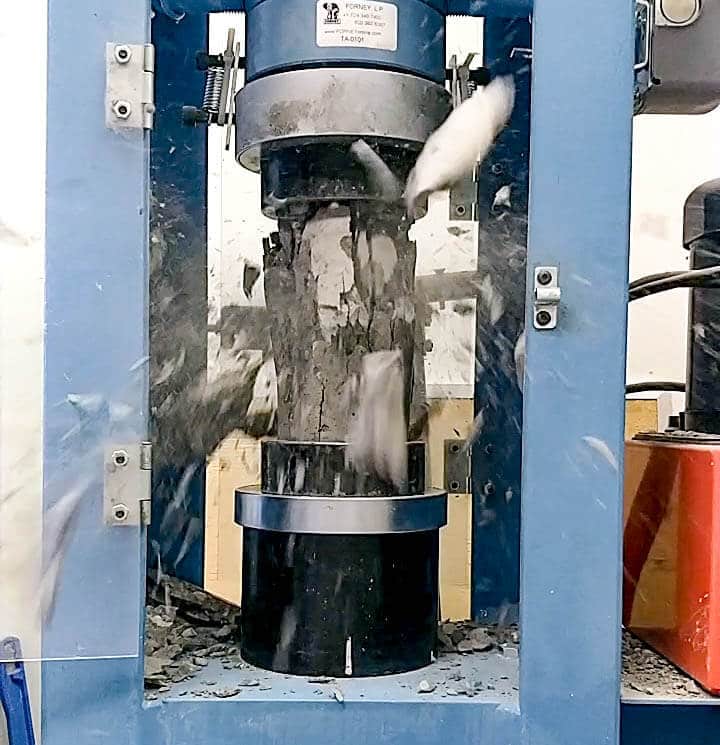
A concrete cylinder break machine, more formally called a compression testing machine, applies a controlled axial load to a cured concrete cylinder until the specimen fails. The test follows ASTM C39/AASHTO T22, the standard method for determining the compressive strength of cylindrical concrete specimens.
The machine itself consists of a rigid load frame, an upper platen with a spherical bearing block, a lower platen, and a load-measuring system such as a calibrated load cell or hydraulic gauge. Older manual frames rely on a technician to control the load rate by hand, while newer automatic and connected machines regulate the loading rate electronically and record results directly into quality management software.
Compression testing has served as the baseline acceptance test for structural concrete for more than 80 years, and it remains the method most building codes reference when specifying how compressive strength must be verified. The same compression frame is also used with cube molds under BS EN 12390-3, the standard practice across the UK, EU, and much of the Middle East; this guide focuses on the ASTM C39/AASHTO T22 cylinder procedure used across North America.

How Does a Concrete Cylinder Break Machine Work?
A standard cylinder break test follows a consistent sequence of steps.
- Technicians cast fresh concrete into 6 by 12 in. (150 by 300 mm) or 4 by 8 in. (100 by 200 mm) cylinder molds per ASTM C31 and moist-cure the specimens in a curing tank or room.
- Before testing, the cylinder ends are capped or ground flat. ASTM C39 requires the difference in elevation between the ends to stay within 0.002 in. (0.05 mm) over a 12 in. (300 mm) length.
- The cylinder is centered on the lower platen so its axis aligns with the center of thrust of the spherical bearing block.
- The machine applies an axial load continuously and without shock at a controlled stress rate of 0.25 ± 0.05 MPa/s (35 ± 7 psi/s) per ASTM C39, until the cylinder fails.
- The technician records the maximum load and the break pattern, then divides the load by the cylinder’s cross-sectional area to calculate compressive strength in psi (MPa).
What Can’t a Cylinder Break Machine Tell You About In-Place Strength?
A break machine gives you one number with confidence: the compressive strength of that specific cylinder, cured under standardized laboratory conditions. That number is essential for mix design verification and long-term quality control records.
What it cannot tell you is how much strength the concrete inside your actual wall, slab, or footing has gained at that same moment. Lab-cured cylinders sit in a controlled curing tank, while the concrete in your structure cures at whatever temperature the job site produces. In cold weather or mass pours, that gap can be significant.
This gap has a name: the Crossover Effect. Mass concrete generates its own heat and often cures hotter than a lab cylinder sitting in a 23°C tank, so the structure gains strength faster in the first days but can plateau at a lower ultimate strength than the cylinder meant to represent it (Yang et al., 2015). Cylinder results and in-place strength are expected to diverge for this reason, not because either measurement is wrong. A closer look at how mold quality, curing history, and machine alignment each affect a single cylinder result can be found in ASTM C39 Under the Microscope.
The test is also sensitive to handling. Misaligned specimens, non-plane cylinder ends, and inconsistent loading rates all introduce variability, which is part of why so many low-break investigations trace back to specimen preparation rather than the concrete itself.
Want to dig deeper into how those investigations typically unfold? Learn about the most common causes of low breaks.
Is Destructive Cylinder Testing Still Necessary?
In most jurisdictions, yes. ACI 318 and the majority of building codes still require standard-cured cylinder breaks as the official acceptance test for concrete compressive strength, since that test is the benchmark the mix design was proportioned against in the first place.
The maturity method, standardized under ASTM C1074, supplements the break test rather than replacing it in most projects. Maturity sensors estimate in-place strength gain by tracking a cylinder’s temperature history against a calibrated strength-maturity relationship, which is what makes them so useful for time-sensitive decisions like formwork removal, post-tensioning, or opening a slab to traffic.
State DOTs increasingly accept maturity data for specific applications; Florida DOT, for example, has a published qualification procedure for the maturity method under FM 3-C1074, alongside similar practices at agencies like TxDOT and Caltrans. That said, acceptance requirements vary by agency and by project. Always confirm with your engineer of record before treating a maturity-based estimate as a substitute for a required acceptance cylinder.
Can Real-Time Strength Monitoring Complement the Break Test?
Wireless maturity sensors like SmartRock® attach to the rebar before the pour and become embedded in the concrete once it sets. The sensor tracks temperature continuously and calculates estimated in-place strength using the ASTM C1074 maturity method, with results available in real time through a mobile app or the SmartRock Web dashboard.
- At a Pelican State Credit Union campus in Baton Rouge, Labarre Associates ran SmartRock alongside its usual 28-day breaks, then cut cylinder testing in half and third-party testing costs by 40% once the sensor data matched the lab results, confirming 4,000 psi in 10 days instead of 28.
- Heidelberg Materials UK used the same approach on a tighter deadline: after a 2022 derailment damaged the Petteril Bridge in Carlisle, the team needed a 50 N/mm² high-early-strength mix confirmed fast enough to avoid the wait for its usual lab test cubes, and real-time SmartRock data helped the bridge reopen just 7 weeks after the accident.
- On PCL Construction’s 66-story Stantec Tower in Edmonton, a structural engineer confirmed SmartRock readings were as reliable as field-cured breaks, and the accuracy helped the project finish 4 months ahead of schedule.
For projects where mix designs change often, SmartRock Pro takes this further. It uses concrete electro-mechanical microstructure analysis (CEMMA) to take mechanical and electrical measurements through hydration, so it does not depend on a pre-built maturity curve or break-test calibration for any specific mix. In Giatec’s own validation data spanning 230+ field and lab data points, SmartRock Pro measured strength within ±15% of normalized cylinder break data across a 10–70 MPa range, a margin that compares directly with the ±10.6% single-operator and ±14% multi-lab variability ASTM C39-18 itself allows. That makes it a strong fit for producers or contractors juggling multiple mix designs on the same site, though it is validated for everyday mixes rather than every material combination, and it does not replace the 28-day acceptance cylinder.
None of this eliminates the need for a compression testing machine on projects where code officials require acceptance cylinders. It does mean your crew spends less time waiting on lab turnaround to make the calls that keep a schedule moving.
How Do You Choose the Right Testing Approach for Your Job Site?
- Start by confirming what your local building code and engineer of record require for official acceptance testing before planning around any alternative method.
- From there, use maturity sensors for schedule-driven decisions such as formwork stripping, post-tensioning, or winter pour monitoring, where waiting on lab results is the real cost, while keeping a reliable compression testing machine or lab relationship in place for the acceptance cylinders your project still requires.
The two approaches work best together: real-time maturity data keeps the schedule moving, while standard-cured cylinders satisfy code-mandated quality control.
Key Takeaways
- A cylinder break machine applies a controlled axial load (0.25 ± 0.05 MPa/s per ASTM C39) to a standard-cured specimen and reports its potential strength, not the in-place strength of your structure.
- The same compression frame also tests cube specimens under BS EN 12390-3 outside North America; this guide covers the ASTM C39/AASHTO T22 cylinder procedure.
- The Crossover Effect means mass concrete often gains strength faster early on but plateaus lower than its reference cylinder, simply because the two cure at different temperatures.
- Standard-cured cylinder breaks remain the required acceptance test under ACI 318 in most jurisdictions; that isn’t changing.
- SmartRock Pro measures in-place strength directly, without a mix-specific calibration curve, within about ±15% of normalized break data, a margin comparable to the test method’s own built-in variability.
- Maturity monitoring and cylinder breaks work best paired: one drives schedule-critical decisions in real time, the other satisfies code-mandated acceptance testing.
Conclusion
A concrete cylinder break machine remains a foundational piece of concrete quality control, and destructive testing is still required for code acceptance on most projects. Where maturity-based monitoring earns its place is in the hours and days between pour and break test results, when your team needs a reliable answer about in-place strength to keep work moving safely.
See how real-time strength monitoring fits alongside your current testing. Request a demo today!
Frequently Asked Questions
What is a concrete cylinder break machine?
A concrete cylinder break machine, also called a compression testing machine, is the equipment used to measure the compressive strength of a cured concrete cylinder for code acceptance. It compresses a standard-cured specimen under ASTM C39/AASHTO T22 and reports a single strength value in MPa or psi, the number most building codes and mix designs are checked against.
How does a concrete cylinder break machine work?
The machine holds a cylinder between a lower platen and a spherically seated upper platen, then applies load continuously at 0.25 ± 0.05 MPa/s until the specimen fails. The peak load divided by the cylinder’s cross-sectional area gives the compressive strength result recorded for that specimen.
Is a concrete cylinder break machine still necessary for in-place strength?
Yes, for code acceptance. Standard-cured cylinder breaks remain the benchmark most building codes and mix designs are proportioned against, and that requirement isn’t going away. What has changed is the wait: technologies like SmartRock Pro now estimate in-place strength directly and continuously, so schedule-critical calls like formwork removal no longer have to wait on lab turnaround.
What is a concrete cylinder break machine, and is destructive cylinder testing still necessary to verify in-place strength?
Yes. Destructive testing, physically breaking a cylinder to failure, is still the only method that directly confirms compressive strength, which is why most codes require it for acceptance. Non-destructive methods such as maturity sensors or SmartRock Pro estimate strength without breaking anything, which makes them useful for schedule decisions but not a substitute for the destructive acceptance test itself.
Can maturity sensors replace cylinder breaks entirely?
Not for code acceptance testing. ASTM C1074 maturity monitoring and self-calibrating sensors like SmartRock Pro are validated to estimate in-place strength, and several state DOTs, including Florida under its FM 3-C1074 procedure, accept maturity data for specific early-age decisions. Most codes and specifications still require standard-cured cylinder breaks as the official record.
Why do field-cured cylinders sometimes break lower than standard-cured ones?
Standard-cured cylinders sit in a controlled 73 ± 3°F (23.0 ± 2.0°C) moist environment, while field-cured cylinders and the actual structure follow the jobsite’s real temperature and humidity. In mass pours or cold weather, that gap, part of the same Crossover Effect that separates cylinder results from in-place strength, can be significant.