


Early-age concrete strength is the compressive strength concrete develops in the period between placement and its specified acceptance age, usually 28 days. It matters because almost every decision that moves a project forward happens in that window: stripping formwork, removing shoring, stressing post-tensioning tendons, lifting tilt-up panels, opening a slab to traffic or loading. Each of those operations has a strength the concrete has to reach first, and each one is delayed if nobody can show that it has.


Early-age strength gain is driven by cement hydration, and hydration is temperature dependent. The same mix placed on a warm day and a cold day follows two different strength curves, which is why the calendar is a poor guide and why early-age strength is estimated from the concrete’s own temperature history rather than from its age. The standard method for doing that is the maturity method, ASTM C1074.
Why Early-Age Strength Matters
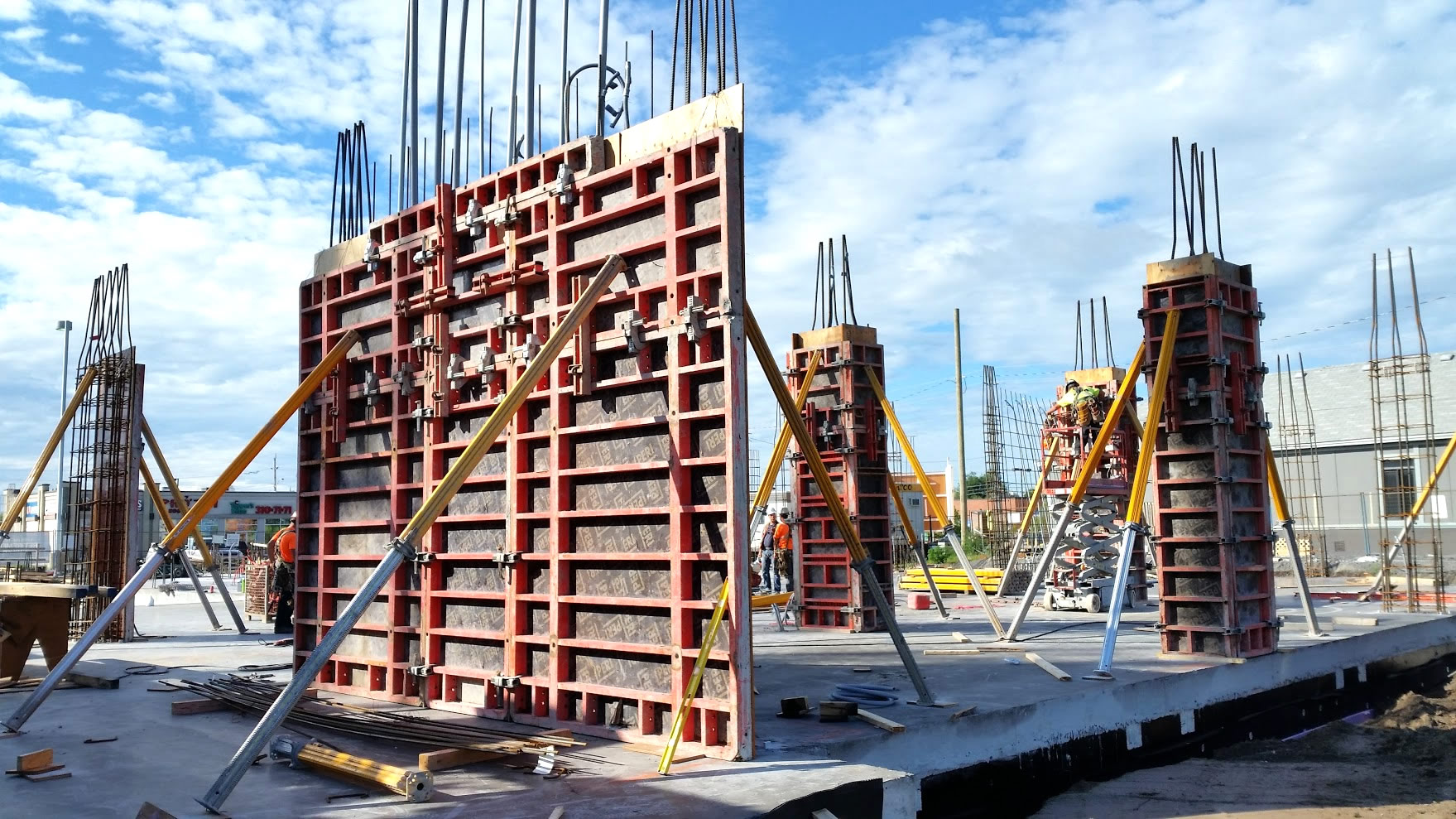
Early-age strength is not an academic number. It is the gate on the schedule. These are the operations it typically controls, and in every case the required strength comes from the project specification rather than from a rule of thumb.
| Operation | What the strength requirement protects against | Who sets the number |
|---|---|---|
| Formwork and shoring removal | Deflection, cracking, or collapse of an element that cannot yet carry its own weight plus construction loads | Engineer of record, in the specification and the formwork removal plan |
| Post-tensioning | Crushing and cracking at the anchorage zones, where prestressing force concentrates into a small area of concrete | Engineer of record, with the post-tensioning supplier’s requirements |
| Tilt-up panel lifting | Cracking or failure of the panel during the lift, when it is loaded in a way it was never designed for in service | Engineer of record and the lifting insert supplier |
| Opening a slab to construction loads | Damage from equipment, material stockpiles, and traffic before the slab can carry them | Engineer of record, in the specification |
| Cold weather protection removal | Freezing damage to concrete that has not yet developed enough strength to resist ice formation | Engineer of record, per the cold weather protection plan |
Getting these decisions wrong in either direction costs money. Acting early risks damage that is expensive to remediate. Waiting on a fixed calendar assumption gives away days the concrete had already earned.
How the Maturity Method Estimates Early-Age Strength
The maturity method estimates in-place compressive strength from the concrete’s temperature history. The principle is that a given mix reaching a given accumulated combination of temperature and time will have reached a given strength, regardless of how it got there. ASTM C1074 sets out the procedure.
It works in two stages.
Stage one, calibration, happens before the pour. A set of cylinders is cast from the mix, instrumented for temperature, and broken at several ages to build a strength versus maturity curve for that specific mix. This curve is what makes the estimate meaningful, and it is mix specific. Change the mix design and the curve has to be re-established.
Stage two, monitoring, happens on the element. A sensor embedded in the concrete logs temperature continuously from inside the element. That temperature history is converted into a maturity index, and the calibration curve converts the maturity index into an estimated in-place compressive strength.
Two properties make this useful at early ages specifically. The estimate reflects the curing conditions the element actually experienced, including a cold night or a heated enclosure, rather than the conditions in a curing tank. And it is continuous, so the team can watch an element approach its target rather than learning after the fact that it got there overnight.
What it is not: a measurement. The sensor measures temperature. The strength figure is an estimate derived from that temperature history through a calibrated relationship, and its quality depends entirely on the quality of the calibration. Most specifications that accept maturity also require a reduced set of cylinders to verify the curve over the course of the project.
SmartRock® sensors are the embedded piece of that workflow. They are fixed to the rebar before placement, log the concrete’s internal temperature, and send the data to the SmartRock app on site and to SmartRock® Web, where the calibration curve is applied, thresholds are set, and results are exported for the record.
Early-age concrete strength FAQ
What is considered early-age concrete strength?
It is the strength concrete develops before its specified acceptance age, which on most projects is 28 days. The period that matters most on site is the first few days, because that is when formwork removal, shoring, tensioning, and load release decisions are made. Some references narrow early age to the first 7 days and some run it out to 28. Either way, it is the window in which the concrete is still gaining strength quickly and the schedule is waiting on it.
How fast does concrete gain strength?
Strength gain is fastest in the first few days and slows steadily after that. The actual rate depends on the mix (particularly the cement type and the proportion of supplementary cementitious materials) and on curing temperature. Mixes with high fly ash or slag content gain strength more slowly at early ages and continue gaining well past 28 days. Because temperature drives the rate, no single figure applies across projects.
How is early-age concrete strength measured?
There are three practical routes. Field-cured cylinders broken at early ages give a direct number but only for the cylinder, and only at the moment it was broken. Semi-destructive in-place tests such as pull-out (ASTM C900) give a spot check on the element itself. The maturity method (ASTM C1074) gives a continuous in-place estimate from the element’s temperature history, which is why it is the common choice when the schedule depends on knowing strength day by day.
Does cold weather slow early-age strength gain?
Yes, substantially. Hydration slows as temperature drops, so the same mix placed in cold conditions can be well behind the strength a warm-weather assumption would predict, at the very moment a crew is planning to strip. This is the specific case where working from age rather than from temperature history goes wrong, and it is the main argument for monitoring in-place conditions on cold pours.
Can formwork be stripped based on maturity data?
On many projects yes, provided the specification accepts the maturity method as evidence of in-place strength and the calibration curve for the mix has been established beforehand. Maturity data supports the decision. It does not authorise it. The required strength and the sign-off both come from the engineer of record and the project specification.

**Editor’s Note: This post was originally published in October 2024 and was updated for accuracy and comprehensiveness in August 2026.