

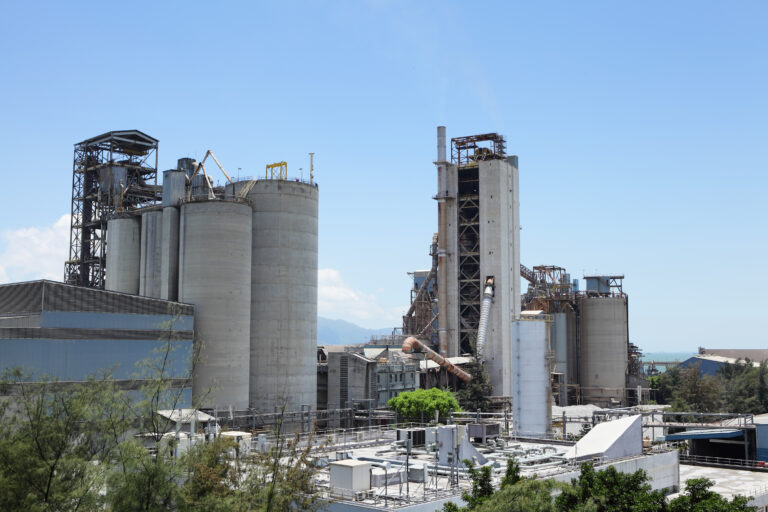

Walk into any ready-mix plant, and you’ll find the same paradox. Producers fine-tune cement to the kilogram, dose admixtures to the milliliter, and debate supplementary materials for hours, yet the single largest component of the mix, the one bought by the truckload, is still managed largely by feel. Aggregates make up roughly 75% of a concrete mix by volume, and they remain the least actively optimized ingredient in the batch. Meanwhile, the industry quietly overdesigns mixes in cementitious content by more than 20% on average, and roughly half of that buffer exists for no better reason than to absorb variability that current systems can’t see or manage.
Let’s take a look at how aggregate optimization works, why it decides far more about strength, slump, and cost than most producers give it credit for, and how an AI mix-optimization platform like Giatec SmartMix™ turns the mix’s biggest variable into its biggest opportunity.
What Aggregate Optimization Actually Means (and Why It Decides Strength, Slump, and Cost)
We’ll start with what a mix-optimization model is built to do. At its core, an optimization model ingests production data: mix designs, batch proportions, ambient conditions, and the measured outcomes of strength and slump, then learns the relationships between what goes into the mixer and what comes out of it. From there it can do three things:
- Predict how a given mix will perform,
- Redesign a mix to hit a target more efficiently, and
- Continuously optimizes across every lever in the design.
Those levers include cement content, supplementary cementitious materials (SCMs, the fly ash or slag that partially replace cement), admixture dosages, water, and critically, the aggregates.
Why 75% of the Mix Deserves 100% of the Attention
Aggregate optimization is the practice of treating that 75% of the mix as an active, tunable variable rather than a fixed recipe input. It means asking, for a given target strength and slump, what combination and proportion of the available sands and stones produces the most workable, most durable, lowest-cost result. The reason it matters so much comes down to packing and water demand. When fine and coarse aggregate are proportioned well, the particles nest together with fewer voids, which means less paste, less cement and water, is needed to fill the gaps and lubricate the mix. Proportion them poorly, and you pay for it twice: once in extra cement to reach strength, and again in extra water to reach workability.
That water penalty is not a rounding error. The water-to-cementitious-materials ratio (w/cm) sits at the heart of concrete performance. For any given set of materials, there is a unique relationship between w/cm and the strength and durability of the hardened concrete. Push the water up to chase slump because your aggregates are poorly graded, and strength and durability fall in lockstep. This coupling is exactly why ACI 211, the industry’s guide for proportioning mixes, treats aggregate grading and water demand as linked inputs: get that grading right and you need less water to reach workability, which protects the w/cm ratio that strength and durability depend on.
Here’s the honest part, and we’ll return to it: an optimization model is only ever as good as the data it learns from. Feed it rich, clean records and it sharpens; starve it of a key variable and it works around a blind spot. Aggregates are where both the largest gains and the most instructive blind spots live.
The Reactive Cost of Bad Aggregate Data
Aggregate gradation is simply the particle-size distribution of your sands and gravels. So, what does it cost to treat that gradation as a one-time setup you dialled in months/years ago and never revisited? The honest number is bigger than most plants realize, because the cost hides inside decisions that feel responsible.
What Else Drifts Besides Gradation?
But gradation is only one-way aggregate behaviour drifts, and treating it as the whole story is part of the problem. Aggregates are the mix’s biggest ingredient and its most variable one, yet the input most plants treat as fixed. Gradation itself shifts from load to load and across the seasons as quarry faces change, as stockpiles segregate (coarse particles rolling to the edges while fines settle in the middle), and as material is reworked, so the aggregate you batch today isn’t the one the mix was designed around. Free surface moisture swings day to day and even hour to hour with the weather and with where material sits in the pile, quietly moving your water content, which is the subject of the next section. Particle shape and texture, angular crushed stone versus rounded gravel, change how much water the mix needs to stay workable. And none of these respects the spec sheet: the same supplier, the same quarry, and the same paperwork can deliver material that behaves differently from one week to the next. That is what bad aggregate data really means: not one problem, but a whole family of variation the mix design never sees.
Producers are investing more in testing than ever, yet rejections, costs, and claims keep rising. See where ready-mix quality breaks down and why!
What Does Invisible Variability Actually Cost?
Materials are the single largest line item in a ready-mix operation, accounting for roughly 56% of total production costs according to the NRMCA Performance Benchmarking Survey. When aggregate behaviour drifts and a producer can’t see why, the instinctive fix is to add a safety cushion of cement. It works, in the sense that the cylinders pass. But it converts an invisible variability problem into a permanent, recurring cost which is paid on every cubic metre, on every ticket, for years. Think of it as paying interest on a loan you forgot you took out. The mix passes, the customer is happy, and the margin quietly leaks.
The leak compounds in two more places. Rejected loads which are concrete that arrives at the wrong slump and gets sent back, destroy the material, the trucking, and the schedule in one stroke. And in-plant rework, where operators chase a moving target batch after batch, burns labour and mixer time that never shows up on a single invoice but adds up across a year.
What Trio Ready-Mix Stopped Paying For
Trio Ready-Mix offers a concrete picture of what closing that leak looks like. After implementing SmartMix to manage their mixes proactively, the platform’s first recommendations cut roughly 50 kg of cement per batch, and within ten months 34% of their total production was optimized at an average saving of about $3 per cubic metre. None of that came from a new aggregate source or a capital upgrade. It came from finally seeing what the mix had been telling them all along and acting on it before it cost them another truck.
The Drift Your Probes Still Miss
But you have moisture probes at the plant, so aggregate moisture is handled, right? This is the assumption worth pressure-testing, because it’s where a lot of confident producers lose ground without knowing it.
Why Do Two Identical Loads Behave Differently?
Picture two loads of sand from the same supplier, same quarry, same spec sheet. On paper they’re identical. In the bin they are not. One sat under three days of rain; the other baked on a dry pad. Their gradation may differ batch to batch, and their free surface moisture, the water clinging to the outside of each particle rather than the water absorbed inside the pores, can differ by several percent. That free moisture is the part that ends up in your mix water and moves your w/cm, and it is notoriously unstable. Aggregate moisture fluctuates not just day to day but hour to hour, depending on storage and exposure to sun, wind, rain, and humidity. In Canada, CSA A23.1 explicitly requires mixing water to include the surface moisture on the aggregate and calls for that moisture to be monitored regularly, precisely because it refuses to stay put.
What Does a Moisture Probe Actually Miss?
Now the part that surprises people: a moisture probe is a real help, but it does not see the whole truckload. A bin-mounted sensor only detects the fraction of material in direct contact with it, which may not be representative of the bulk, and it wears heavily sitting in the material flow. Surface-contact readers pick up only the moisture at the top of the stockpile, so if that surface is wetter or drier than the bulk, the reading misrepresents the batch. And the pile itself won’t hold still: as water drains downward under gravity, the moisture profile keeps shifting. A probe reads a point, in a moment. The mix is made from a truckload, over time.
Correcting the Pattern, Not the Symptom
The cost of that gap is measurable. A moisture error as small as 1% in the sand can add about 18 lb of water per cubic yard, over two gallons, and every extra gallon per cubic yard can drop compressive strength by roughly 250 psi. In metric terms, that 1% slip is on the order of 10.7 kg/m³ of unplanned water, and the strength penalty works out to about 1.7 MPa (250 psi) for each gallon-per-yard of overshoot. So when a producer trusts the probe alone, two things follow: the batch needs reactive correction downstream, costing time and effort on every load, and a residual error still rides through to the pour. The probe answers “how wet is this scoop, right now?” It cannot answer “how is this material behaving across hundreds of tickets, and what should I do about it?”
That second question is where a learning platform earns its place. SmartMix doesn’t measure stockpile moisture in real time. That’s not its job. Instead, it learns from what the concrete actually did. Every batch sends its measured slump and strength back to the platform, and by pairing that feedback with the accumulated history of the mix, SmartMix corrects the water and proportions going into the following batches, converging on the right design without ever reading a moisture value. Whatever the true moisture happened to be, the slump reveals it after the fact, and the correction carries forward. Reliable per-batch aggregate moisture would sharpen this further, but most operations don’t have that luxury, and this feedback loop is exactly how SmartMix compensates for its absence, correcting a pattern instead of chasing a symptom.
What SmartMix Optimizes Today
Here’s what that looks like in practice, with the data a plant already generates. SmartMix, powered by Giatec’s Roxi™ AI engine, is built to adjust every component of a concrete mix design, fine-tuning cementitious materials, recommending precise admixture dosages, and optimizing aggregate ratios for improved on-site workability. For the aggregate question specifically, that means two concrete capabilities.
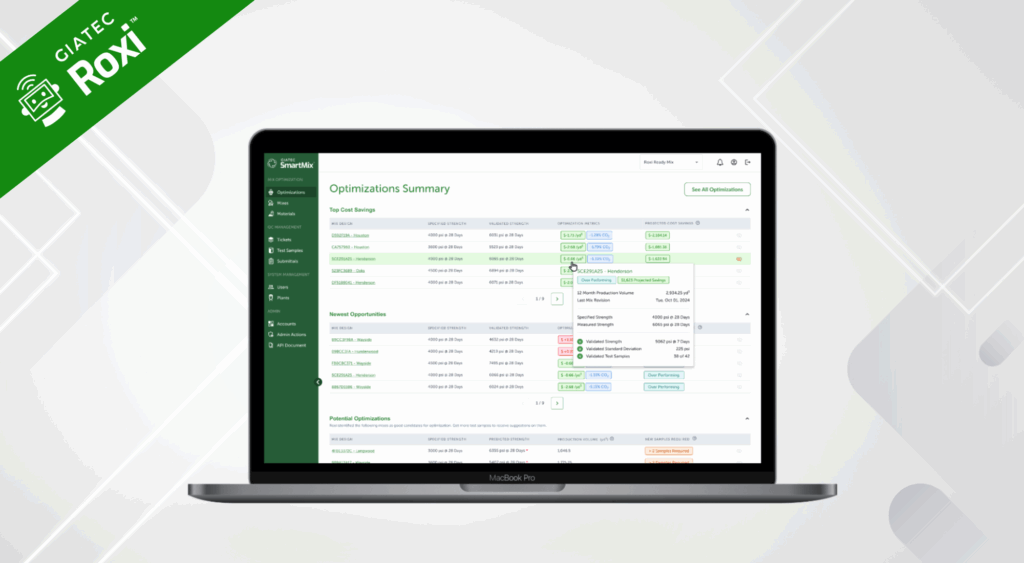
First, source selection and blending. A plant rarely runs a single sand and a single gravel; it often has two or three aggregate sources on hand, each with its own gradation and cost. With a database of mix and performance data behind it, SmartMix can evaluate which combination of those available sources, and what proportion of each, best hits the target strength and slump at the lowest cost. It turns a decision usually made by habit and gut into one made by data.
Second, the fine-to-coarse balance. The ratio of fine aggregate to total aggregate is too often treated as a fixed plant constant, applied to every mix regardless of spec. It shouldn’t be. A high-slump, pumpable mix and a low-slump, high-strength mix want different fine-to-coarse balances, and the optimal ratio shifts with the target. SmartMix tunes that balance per specification rather than per plant default, squeezing out the paste and water you were spending to cover a one-size-fits-all proportion.
Conewago Manufacturing saw how quickly this compounds. After connecting their data and automating their quality workflow with SmartMix, the results landed right away: 25% less testing volume, 12 hours saved every week, and data analysis four times faster. The difference between a fixed workflow and an optimized one, like the difference between a fixed recipe and an optimized one, shows up on the first batch, not after a year of trials.
Comparison: Traditional Fixed Mix Design vs. SmartMix Aggregate Optimization
| Approach | Best For | Pros | Cons | Cost | Environmental Impact |
| Traditional fixed mix design | Plants with one stable aggregate source and low spec variety | Simple, familiar, no new tooling | Blind to source and gradation drift; relies on cement buffers; one-size-fits-all fine-to-coarse ratio | Higher recurring cement cost on every m³ | Higher embodied carbon from excess cement |
| SmartMix aggregate optimization | Multi-source plants and performance-based specs | Selects best source blend per spec; tunes fine-to-coarse to target; learns from real outcomes | Depends on clean, complete input data; some properties not yet modelled | Lower per-m³ cost; savings appear on first batches | Lower embodied carbon via reduced cement |
Every one of these gains, though, is bounded by what the model can actually see in the data. And that boundary is exactly where the next set of gains is waiting.
Testing time is another quiet drain on ready-mix margins. See how Conewago Manufacturing reduced their concrete testing by 25% and saved hours a week with SmartMix!
Where Aggregate Optimization Goes Next
Let’s be clear about what this technology is and isn’t, because the honest version is more convincing than the hype. SmartMix is not a magic button. It is a scientific instrument, and like any instrument it depends on the quality of what you feed it.
How the Feedback Loop Actually Runs
Mechanically, here’s how it works. The platform pulls data straight from a producer’s dispatch system (the tickets, the mix designs, and the as-batched proportions) and pairs them with the measured outcomes that matter: slump and compressive strength. Before any model runs, that data passes through sanity and feasibility checks to clean out the impossible and the mistyped, because a model trained on garbage returns garbage. Then machine-learning models use the cleaned record to predict, redesign, and optimize, and they get sharper with every ticket that flows back. The accuracy of the inputs is the producer’s responsibility; the rigour of turning those inputs into trustworthy recommendations is the platform’s. That feedback loop is the opposite of a black box. It’s a discipline.
Every Edge Is a Feature Waiting for Its Data
It also explains where the model’s current edges are, and why those edges are better understood as a roadmap than a list of flaws. Take aggregate shape: the difference between angular crushed stone and smooth rounded gravel has a real, well-known effect on slump, pumpability, finishing, and even strength. Angular particles interlock and demand more water for the same workability; rounded particles flow more freely. Today, that shape data largely isn’t captured in the production records SmartMix learns from, so the model doesn’t yet optimize for it. That’s not a limit of the algorithm. It’s a limit of the data available to it. Supply the model with reliable shape information and crushed-versus-rounded becomes the next optimization axis, with a meaningful payoff in workability and strength. The same logic applies to feeding gradation insight back upstream to the production side of the aggregate operation.
Modern Concrete & Materials pointed at exactly this trajectory when they explained what gave them confidence to adopt the platform: the Giatec team’s precision and responsiveness to their feedback. Roxi is delivering deep insight today and evolving quickly through feedback from industry partners. The limitation, in other words, is a feature waiting for its data.
Aggregate optimization is one piece of a bigger shift in how concrete is produced, delivered, and monitored. See how Giatec’s construction technology solutions connect the mix to the pour and everything in between!
Optimized, Not Cheapened: Holding Spec While You Optimize
If you’re a QC manager, there’s a reasonable alarm bell ringing by now: doesn’t “optimize” too often turn out to mean “cheapen until something cracks”? It’s the right question, and the answer determines whether any of this is worth doing.
Real optimization is the discipline of removing only the excess that variability was forcing you to carry, never the margin that performance actually requires. The mechanism that keeps it honest is incrementalism. Rather than slashing cement in one bold move, a sound platform recommends small, validated steps, checking measured performance against spec at each one before taking the next. Strength, slump, and air content stay inside their required envelopes the whole way down; you’re trimming the buffer, not gambling with the structure.
This is also where the established standards do their work. ACI 214R, the framework for evaluating concrete strength test results, exists precisely to quantify variability and set how far a mix’s average strength must sit above the specified minimum to stay safe. Responsible optimization doesn’t ignore that statistical cushion. It measures it accurately so you stop padding it blindly. When the data shows your true variability is lower than your historical buffer assumed, the excess you remove was never protecting anyone; it was just costing you. Optimized and compliant aren’t in tension. Done with real data, they’re the same thing.
A Producer Who Stopped Guessing
Consider Tomlinson Ready Mix, an established Eastern Canadian producer, and what changed when they stopped relying on intuition and started reading their own data.
Before SmartMix, Tomlinson’s high-volume mixes were managed manually, leaning on the experience of the team. They’d tried a standard quality-control system to consolidate their performance data, but it demanded so much manual entry for so little payback that it wasn’t worth the time. The data existed. The means to act on it didn’t.
SmartMix changed the economics of that data. The platform ingested their dispatch and performance records, cleaned them, and turned them into something the team could actually use, fast. The first proof came on a job where Tomlinson was brought in as a secondary supplier under a demanding spec: 100% of design strength in seven days. To be safe, they did what the whole industry does: they overdesigned. But SmartMix let them confirm the mix was actually hitting full strength in three days, not seven, which made the room to optimize impossible to ignore.
Tomlinson cut 35 kg/m³ of cement in six weeks: an 8.8% cement reduction and 5% cost savings, with no compromise on quality. Read the full Tomlinson case study here!
The cost and carbon side of that loop is a story in its own right, and it’s where this series goes next: how systematic mix optimization turns these per-batch savings into lower cost and lower embodied carbon across an entire operation, without touching the spec.
Conclusion
Aggregates are concrete’s most tolerated problem: three-quarters of the mix, hiding in plain sight, managed by habit while producers obsess over the cheaper ingredients around them. The reason that persists isn’t negligence. It’s that the variability has been genuinely hard to see: buried in stockpiles that shift by the hour, masked by probes that read a single point, and papered over with cement buffers that quietly tax every cubic metre.
What’s changed is the ability to read the mix’s own outcomes and act on them with discipline. Treating aggregate proportioning as a living, spec-by-spec decision rather than a fixed recipe is the single largest lever most plants have never pulled, and producers are already pulling it, with first-batch savings and no performance trade-off to show for it. The technology isn’t magic, and it’s honest about its edges; the gains it can’t reach yet are simply the data it hasn’t been given.
The producers who win the next decade won’t be the ones who guess more carefully. They’ll be the ones who stopped guessing about the 75% of the mix that was always telling them what to do.
Frequently Asked Questions
What percentage of a concrete mix is aggregate?
Aggregate typically makes up 60 to 75 percent of a concrete mix by volume, which makes it the single largest component by a wide margin. Despite that scale, it is usually the least actively managed ingredient in the mix.
Does aggregate moisture affect concrete strength?
Yes. Free surface moisture on the aggregate goes directly into the mix water, and even small errors can shift the water-to-cementitious-materials ratio enough to affect measured strength. A moisture error of about 1 percent in the sand can add roughly 18 pounds of water per cubic yard.
How does AI optimize concrete mix design?
An AI mix-optimization platform ingests production data (mix designs, batch proportions, and measured outcomes such as slump and strength) and learns the relationships between them. It then predicts how a given mix will perform, redesigns a mix to hit a target more efficiently, and continuously optimizes across every lever in the design.
Can mix optimization reduce cement content without losing strength?
Yes, when done incrementally. A sound platform recommends small, validated cement reductions, checking measured performance against spec at each step. This removes only the buffer that variability was forcing the producer to carry, not the margin performance actually requires.