


Most ready-mix producers assume that getting more value means adopting new technology. In reality, the bigger opportunity often sits untouched in systems you already run every day.
In this blog, you will learn what smart concrete data is, where it already exists inside your operation, and how to turn it into cost and quality control gains without adding new hardware.
Your Data Isn’t Missing. It’s Just Disconnected.
If you run a ready-mix plant, you are not short on data. Your dispatch system logs every ticket, the batching system records every load, and your lab tracks every break. Each system does its job well, but none of them talk to each other.

This is smart concrete data: the operational information your plant generates every single day, from raw material quantities to strength test results, that has the potential to guide real decisions. The problem is that this data sits in separate systems, and nobody has the hours to pull it all together and act on it before the next batch goes out.
What Counts as Smart Concrete Data
Smart concrete data spans the full production and delivery cycle. Understanding where it originates helps you see how much you already have on hand.
| Data Source | What It Captures | Limitation When Used Alone |
| Dispatch systems | Ticket volumes, mix codes, delivery times | Confirms what was ordered and delivered, but not how the mix performed |
| Batching systems | Actual batched quantities vs. design | Confirms what went into the truck, but not the result at the jobsite |
| Lab and QC teams | Strength breaks, slump, air content | Confirms performance after the fact, but rarely ties back to real-time production conditions |
| Fleet telematics | In-transit conditions, water add-backs | Flags conditions during transit, but stays disconnected from the mix design and lab results for that load |
Each of these sources is useful on its own, but none tells the full story alone. Smart concrete data is not any single row above. It is what you get when you connect them: a dispatch ticket paired with its batching record, lab result, and transit conditions becomes a complete picture of how one load performed from plant to pour. That combination carries far more insight than any individual source, which is exactly why isolated systems leave so much value on the table.
According to the National Ready Mixed Concrete Association (NRMCA), quality control programs that rely on timely, connected performance data produce more consistent concrete than those relying on isolated batch records. The data itself is not the barrier. The barrier is the absence of a system that connects it in real time.
Why This Data Goes Unused
Three patterns show up again and again in ready-mix operations.
- Fragmentation. Dispatch, batching, and lab data are captured in different systems built for different purposes, so nobody sees the full picture at once.
- Time pressure. Concrete production runs on a just-in-time schedule, and quality control teams rarely have spare hours to manually reconcile spreadsheets against plant data.
- Missed patterns. Without a centralized view, small trends, such as a consistent overdesign in one mix or a recurring aggregate moisture issue, stay invisible until they cause a rejected load.
The result is that producers often overdesign mixes by a wide margin to stay safe. Industry estimates place average cementitious overdesign at more than 20%, largely to buffer against variability that better data visibility could catch earlier.
Turning Existing Data Into Action
That overdesign margin is a direct cost of not seeing your own data clearly. Closing that gap does not require new sensors, and it does not require replacing the systems you already trust. It requires a way to query them together.
Here are some practical shifts that consistently move the needle for producers:
- Connect before you replace. Dispatch, batching, and lab data describe the same mixes and the same plants. Querying them together tells a story no single system can tell alone, without asking you to migrate off any of them.
- Automate the repetitive work. Uploading and cross-referencing test results manually costs hours every week. Automated document processing turns that time into analysis time.
- Watch for variability, not just averages. A mix that performs well on average can still hide plant-to-plant inconsistency that drives up your safety margin unnecessarily.
The common thread across all three is connectivity, not consolidation. Producers rarely lack the raw numbers. What they lack is a way to see across dispatch, batching, and lab data at the same time, without needing a single platform to hold all of it.
What Approaches Have Been Taken So Far?
Up until now, producers have leaned on legacy systems to do the heavy lifting, trusting established vendors to eventually catch up on connectivity. Many have sought out “one-stop-shop” platforms promising to bring every data source together, only to find themselves locked into slow-moving vendors whose release cycles and interfaces were never built with the day-to-day user in mind. In practice, no single system handles dispatch, batching, lab management, and fleet monitoring equally well, so a platform built to do everything for everyone tends to do most of it adequately at best.
Part of the challenge is that the industry has been slow to adopt AI-friendly, cloud-based tools. Standards such as the Model Context Protocol, which let AI systems query multiple data sources through open APIs rather than one database, are only now starting to close that gap.
A recent Giatec industry assessment found that producers are moving away from asking where their data lives and toward asking whether they can get an answer from it on demand. The real divide emerging across the industry is not between large and small producers. It is between those using AI to connect and act on their data, and those still running on legacy systems and paper trails with no practical way to bring it together.
Giatec SmartMix™: Built to Unlock the Data You Already Have
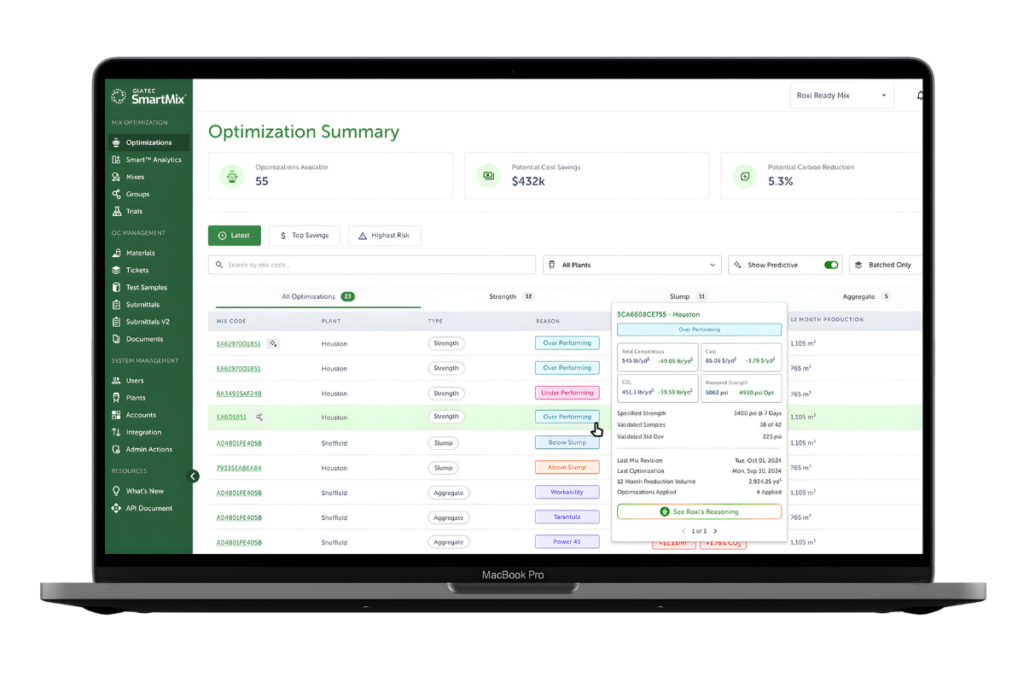
SmartMix was built specifically to connect the smart concrete data you already generate rather than ask you to create new data streams for stronger quality control and assurance. SmartMix connects your existing batching systems, dispatch platforms, fleet telematics, and lab results into a single operational view, then applies AI to surface where your mixes have room to optimize.
Conewago Manufacturing, LLC., a six-plant producer running nearly 1,000 active mixes, faced exactly this problem before adopting SmartMix. QC Manager Dylan Meade and his team were exporting break data by mix and reconciling spreadsheets by hand, with a single mix analysis taking 45 minutes to an hour. None of that data was new. It was already being generated at every plant; it had no central place to live., a six-plant producer running nearly 1,000 active mixes, faced exactly this problem before adopting SmartMix. QC Manager Dylan Meade and his team were exporting break data by mix and reconciling spreadsheets by hand, with a single mix analysis taking 45 minutes to an hour. None of that data was new. It was already being generated at every plant; it just had no central place to live.
After centralizing that data in SmartMix, Conewago:
- Cut testing volume by approximately 25%, and now targets checks based on air content and temperature trends instead of testing every mix the same way.
- Manual data analysis and spreadsheet review became roughly four times faster; submittal creation dropped by about 75%.
- Estimated savings of manual work around 12 hours a week!
Conewago did not change how they produce concrete or add new steps to their process. They unlocked value from the batch and test data their six plants were already generating every day.
What This Means for Your Bottom Line
Concrete remains a low-margin business, with material costs representing the largest single line item. Even small reductions in overdesign, driven by better visibility into your own data, translate into meaningful savings across thousands of loads per year.
Standards bodies such as ASTM International and the American Concrete Institute continue to emphasize the importance of documented, data-driven quality control programs. Connecting your existing data is a direct path toward stronger compliance and stronger margins at the same time.
Your dispatch tickets, batch records, and lab results already hold the answers to where your mixes can improve. Find out how SmartMix can help!