


For ready-mix producers, materials are the single largest cost in the business, accounting for approximately 56% of total production costs according to the NRMCA Performance Benchmarking Survey. And yet, industry data shows that concrete mixes are statistically overdesigned in cementitious content by more than 20% on average. Roughly half of that overdesign exists to buffer for variability that current systems cannot effectively track or manage.
The result is real money leaving your plant on every truck, every day. Mix design cost analysis is the process of understanding exactly where that money is going and what it would take to bring it back without compromising performance or compliance.
In this blog, we break down what that analysis should include, where most QC operations fall short, and how producers are using smarter tools to turn their mix data into measurable savings.
Manual Mix Analysis Is Costing You More Than You Think
According to the NRMCA Benchmarking Survey, average profit before tax in 2023 was $14.59 per cubic yard, while top quartile producers reached $29.39. That gap comes down to material margin management.
For decades, mix design cost analysis has looked something like this: a QC manager pulls data from spreadsheets, cross-references break reports, calculates material costs per cubic meter, and makes a judgment call on whether an adjustment is warranted. It works, until it does not.
The American Concrete Institute (ACI) 318 and ACI 301 standards establish the statistical framework that governs concrete mixture proportioning and required average strength, factoring in standard deviation to build appropriate safety margins. But applying those standards rigorously across a large production operation, with data scattered across systems and teams stretched thin, is precisely where manual analysis breaks down.

The problem is not a lack of expertise. It is a lack of time and visibility. When your QC team is spending days on processing third-party break reports, there is no bandwidth to proactively identify which mixes are overperforming, where variability is creeping in, or which adjustments represent the highest-value opportunity.
Real mix design cost analysis requires three things working together: complete data, fast processing, and a framework for prioritizing action.
Five Factors That Drive Real Mix Savings
Optimizing a concrete mix is not simply about reducing cement content. It involves evaluating the full interplay between materials, proportions, performance trends, and production variability, plant by plant, batch by batch.
A rigorous mix design cost analysis considers:
| Factor | Why It Matters |
| Cementitious content | Typically, the highest material cost, even small reductions per cubic meter compound significantly at volume |
| Strength distribution | Are you consistently beating target strength? That gap often signals room to optimize |
| Production variability | High standard deviations require larger safety margins, so reducing variability lowers the required overdesign |
| Material cost per unit | Price fluctuations in cement, SCMs, and aggregates change your optimization priorities over time |
| Environmental performance | GWP (global warming potential) and CO2 per cubic meter are increasingly tracked alongside cost |
Without a centralized system consolidating this data across mixes, plants, and time, it is nearly impossible to act on it efficiently. Most teams know the opportunity exists. They just cannot find it fast enough.
How Giatec SmartMix™ Transforms Mix Design Cost Analysis
This is where SmartMix fundamentally changes the equation. Rather than treating mix design cost analysis as a periodic, manual exercise, SmartMix makes it a continuous, automated process that surfaces optimization opportunities in real time and quantifies their impact before a single adjustment is made.
SmartMix consolidates data from dispatch systems, third-party break reports, and in-transit monitoring into a single platform. Roxi™, the AI engine powering SmartMix, analyzes performance trends across thousands of tickets and generates quantified optimization opportunities ranked by savings potential, so your team knows exactly where to focus.
Key capabilities that elevate mix design cost analysis:
- Quantified Optimization Opportunities: Roxi does not just flag that a mix may have room to adjust. It tells you how much you could save, what the projected performance impact is, and provides a recommended adjustment. The decision stays with your team. The analysis happens automatically.
- Savings Tracking by Mix: Each mix displays a cost savings chart that separates Roxi-enabled savings from user-driven adjustments. Over time, you build a clear picture of where optimization efforts are paying off and where more opportunity remains.
- Performance Trend Analysis: SmartMix maintains a complete history of every mix revision alongside performance data, so you can evaluate the impact of past changes and make the next adjustment with confidence.
- Variability Identification: Inconsistency across plants or batches often drives unnecessary overdesign. SmartMix helps pinpoint those variability sources, enabling targeted corrections that reduce your required safety margin and your material costs.
What Producers Are Seeing in Practice
The impact of a smarter approach to mix design cost analysis shows up quickly. Across SmartMix customers, producers have reported measurable results within months of implementation.
Tomlinson Ready Mix
- Challenge: Managing mix data manually across spreadsheets left no time for proactive optimization. Mixes were intentionally overdesigned with no efficient way to confirm room for adjustment.
- Cost Impact: Every overdesigned batch meant excess cementitious material going out the door on every cubic meter, without supporting data to justify a change.
- With SmartMix: Confirmed target strength was being hit in 3 days on a 7-day spec, then made three incremental Roxi-guided adjustments, cutting 35 kg/m³ of cementitious content in 6 weeks. The result: an 8.8% cement reduction and 5% cost savings with no performance trade-off.

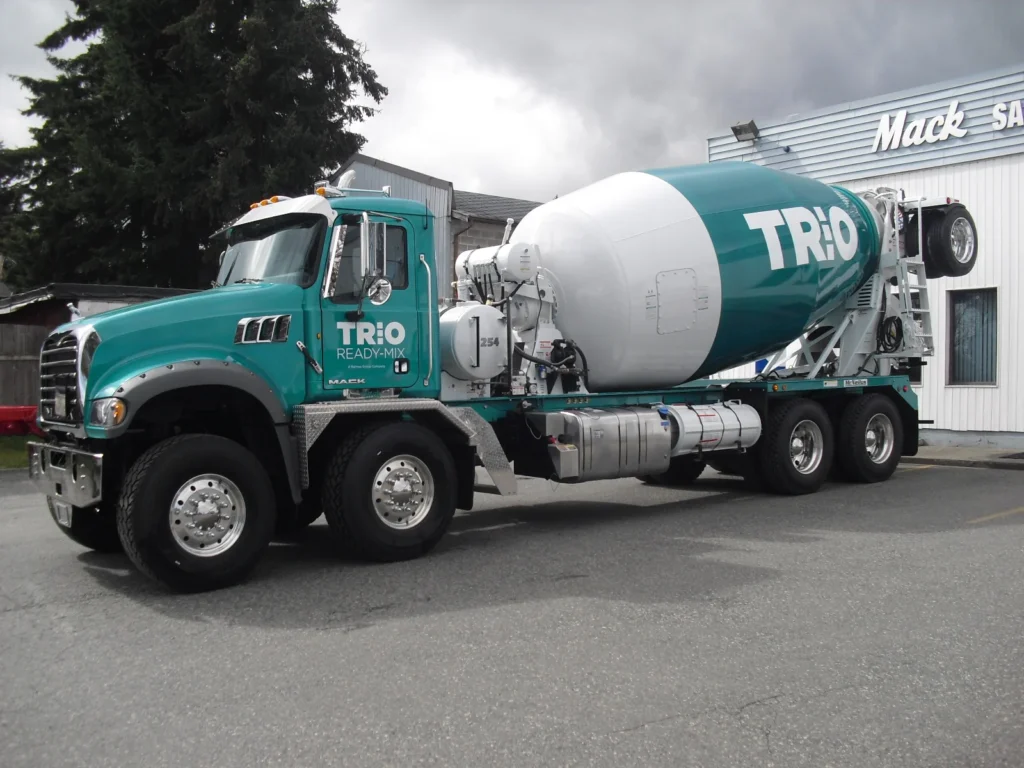
Trio Ready-Mix
- Challenge: High-volume mixes managed manually required significant time and expertise to maintain. The team had no real-time visibility into optimization opportunities across production.
- Cost Impact: Without centralized data, the cost of overdesign across thousands of tickets was invisible and therefore unaddressed.
- With SmartMix: Shifted from reactive to proactive mix management, cutting 50 kg of cement per batch through incremental adjustments. By month 10, optimizations covered 34% of total production at an average savings of $3 per cubic meter.
Modern Concrete & Materials
- Challenge: Data stored across multiple spreadsheets meant third-party break reports took 4 to 5 days to process, leaving the QC team with little time for analysis or strategic decisions.
- Cost Impact: Time spent on manual data processing was time not spent identifying mix savings, a direct drag on both productivity and margins.
- With SmartMix: Processing time dropped to about an hour. Submittals that used to take 10 to 15 minutes are now generated in minutes. In their first year, they forecasted six-figure savings and a 300% ROI.

There’s More to a Mix Than the Price Per Yard
The most important shift in modern mix design cost analysis is recognizing that cost is not the only variable. Optimizing exclusively for price, without accounting for strength consistency, workability, durability, and producer liability, introduces risk that can far exceed any material savings.
ACI 214R guides producers on evaluating concrete strength test results and interpreting variability, a framework that underpins responsible optimization. Reducing cementitious content incrementally, with data confirming each step, is exactly how SmartMix is designed to work. The system does not push aggressive cuts. It presents evidence, quantifies impact, and lets your QC team make informed decisions.
This balance between cost optimization and performance data is what separates a competitive QC program from a cost-cutting exercise.
The Savings Are Already in Your Data
In concrete, margins are tight, and materials are your highest cost. Your mix data already knows where the money is going. The producers pulling ahead are not the ones working harder, they are the ones working with better information, acted on faster.
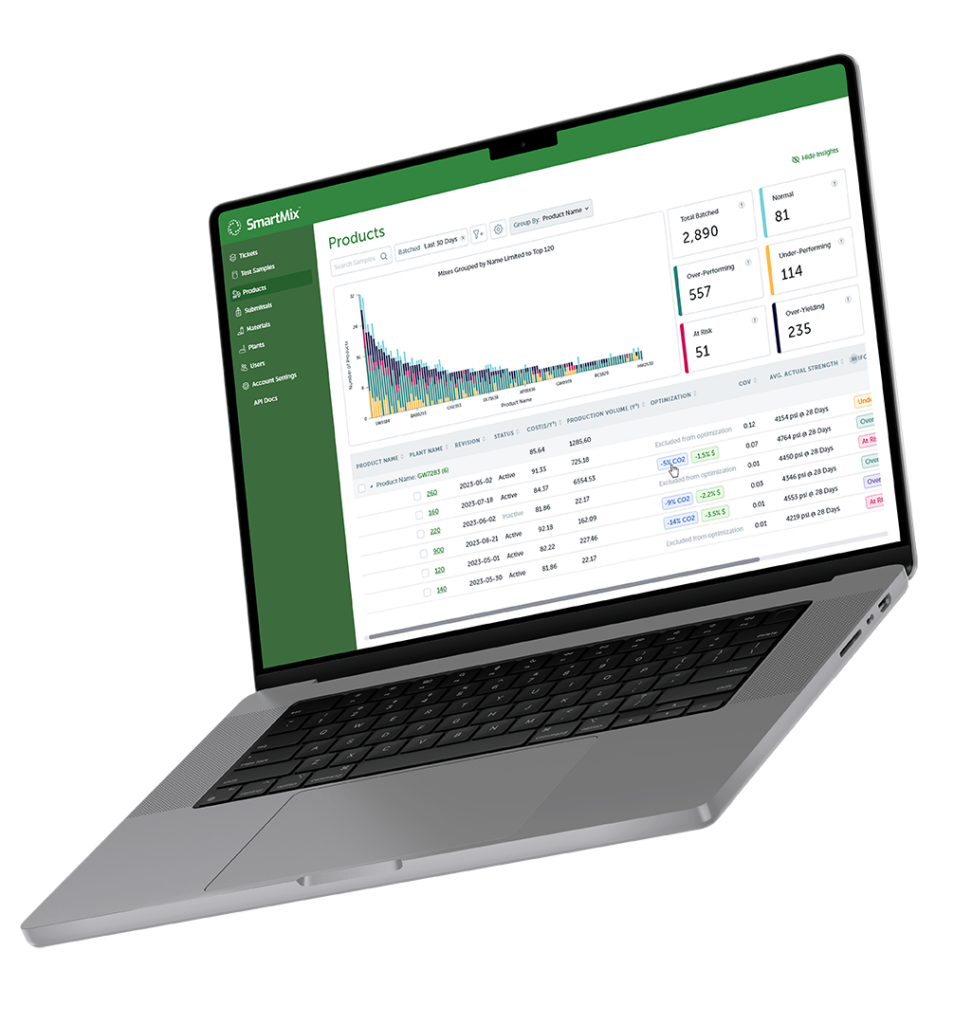
With SmartMix, your team spends less time gathering data and more time acting on it, identifying the mixes that are overperforming, understanding why, and making confident adjustments that protect quality while improving margin.
Give your team the visibility to find those opportunities, the AI-powered insights to act on them, and the confidence to do it without compromising a single mix design.
Get more control over your concrete mix designs! Book a demo with a Giatec Expert today.