
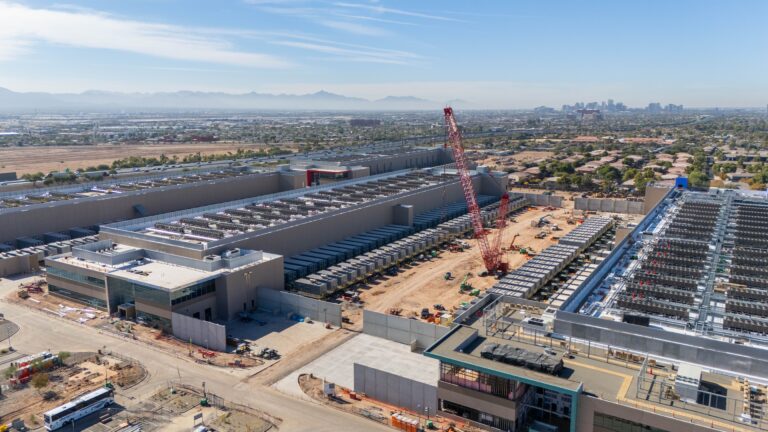
Data center construction has become one of the most demanding segments of the global construction industry. Hyperscale facilities built for cloud providers and AI infrastructure require concrete foundations, floor slabs, and structural elements engineered to carry floor loads of 150 to 350 pounds per square foot or more, far exceeding the 50 to 80 pounds per square foot typical of commercial office buildings.
The average global cost of data center construction reached $10.7 million per megawatt in 2025, with JLL forecasting a further 6% increase to $11.3 million per megawatt in 2026. Single campuses now require up to 4,000 workers at peak, and delivery timelines that once stretched 30 to 36 months are now expected to land between 12 and 18 months. That compression makes concrete the first and most schedule-critical scope on every build.
Industry analysis indicates that delays in commissioning a typical 60 MW data center can cost developers up to approximately $14.2 million per month in lost revenue and related impacts, which means every decision made during concrete curing carries direct financial consequences that simply do not exist on any other type of construction project.
What makes data center concrete uniquely demanding is not that each challenge is new. Mass concrete, post-tensioned slabs, large-scale deployments, schedule pressure, mix design, and transit quality are familiar territory for any experienced construction team. In this blog, we’ll explore the six most schedule-critical concrete challenges on data center projects and how construction teams are solving each one.
1. Why Mass Concrete Foundations Crack Before Loading
Mass concrete foundations crack when the temperature differential between the concrete core and surface exceeds 35°F (19°C) during cement hydration, a condition that occurs in the thick raft foundations required to support data center server loads.
Data center foundations are almost always mass concrete pours. The thick raft foundations required to support heavy server racks, UPS systems, generators, and cooling infrastructure generate significant internal heat as cement hydrates. According to ACI 207, when the temperature differential between the concrete core and its surface exceeds 35°F (19°C), the tensile stress at the surface exceeds what the concrete can withstand and thermal cracking occurs.
In a standard commercial building, a thermal crack is primarily a durability concern. In a data center, it is an operational one. Concrete particulates from cracking or spalling can migrate into cooling systems and cause overheating failures in active server infrastructure. This consequence does not exist on a residential or office project.
On the construction of the 28-story Wynn Hotel and Casino in Boston, S&F Concrete Contractors deployed SmartRock® sensors specifically to monitor temperature gradients during mass pours in the basement garage, where 150,000 yards of concrete were placed across the project. Real-time temperature differential data gave the team continuous visibility into curing conditions without wired sensors or manual reads, allowing them to manage thermal risk proactively rather than reactively.
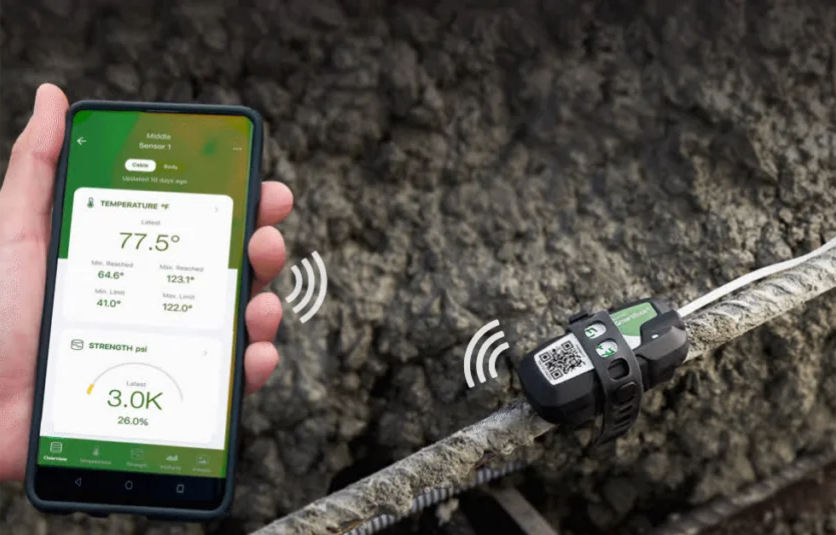
For data center foundation teams, the SmartRock Web thermal modeling feature extends this capability further. Before a pour begins, teams can input element dimensions, mix design parameters, and ambient conditions to forecast temperature behavior at multiple depths and determine what protective measures are needed and when they can safely be removed. This turns thermal risk management from a reactive exercise into a planned one.
Curious how much thermal cracking actually affects concrete strength development? Read our deep dive on why temperature differentials matter more than most teams realize.
2. When Can Post-Tensioned Slabs Be Stressed?
Post-tensioned slabs can be stressed only after the concrete reaches a specified in-place strength, typically 75% of design strength, which real-time maturity monitoring confirms in the field rather than the 24 hours required for cylinder break testing.
Data center floor slabs are almost universally post-tensioned. The load requirements driven by dense server racks, battery systems, and mechanical equipment demand slab capacities that conventional reinforced concrete cannot achieve economically. Post-tensioning delivers that capacity, but it introduces a critical dependency: the tendons cannot be stressed until the concrete has reached a specified in-place strength, typically 75 percent of design strength.
With traditional cylinder break testing, confirming that strength requires sending samples to a lab and waiting a minimum of 24 hours for results. If the first break does not confirm strength, the team waits another 6, 12, or 24 hours for the next one. On a project with dozens of floor pours, that waiting time compounds directly into schedule slippage.
On ONE Park Tower, a 35-story condominium in North Miami, Skyrise Engineering and Testing deployed 250 SmartRock Long Range sensors across approximately 75 post-tensioned pour sections. The project saved over 140 hours on the construction schedule. Eric Stern, P.E., Principal at Skyrise Engineering and Testing, said: “Superintendents loved it. They are 100% in on this system and how it helped them.” The same capability that saved 140 hours on a 35-story tower eliminates the same waiting time on every data center slab pour, multiplied across a campus-scale project.
3. How to Manage Dozens of Concurrent Pours on a Hyperscale Campus
Managing dozens of concurrent pours across a hyperscale campus requires wireless sensors that transmit strength and temperature data to a single cloud dashboard, giving the full project team live visibility into every active pour from any location.
A single hyperscale data center campus can span hundreds of thousands of square feet and involve dozens of active concrete pours running simultaneously across foundations, slabs, equipment pads, and tilt-up walls. Managing temperature, strength development, and thermal compliance across all of them using traditional methods, whether wired thermocouples, manual reads, or field-cured cylinders, is not operationally feasible at this scale.
The consequence of losing visibility on any single pour is not isolated. On a fast-track campus where structural steel follows concrete on a tight sequence, one pour that develops a problem undetected can hold up an entire phase of the schedule.
For a hyperscale campus, the same architecture scales to the full site footprint. SmartRock Long Range sensors transmit data via LTE to the SmartRock Web dashboard, giving the entire project team a single live view of every active pour regardless of where they are on the site or off it.
Curious how top construction teams are rethinking concrete’s role on hyperscale projects? Listen to the Construction Revolution Podcast!
4. Why Curing Uncertainty Is Directly Expensive on Data Center Projects
Curing uncertainty is directly expensive on data center projects because compressed 12 to 18 month schedules and commissioning-date penalty clauses convert every hour of waiting for cylinder break results into unrecoverable schedule loss.
No other building type compresses the construction schedule the way hyperscale data center projects do. Operators are delivering facilities in 12-to-18 months that previously took three years, and owner contracts increasingly include penalty clauses tied to commissioning dates. In this environment, uncertainty in the concrete curing phase is not a technical inconvenience. It is a financial liability.
Every hour a construction team spends waiting for a lab result before stripping formwork, stressing cables, or loading equipment is an hour the schedule cannot recover. Across a campus-scale project with hundreds of pour cycles, that uncertainty accumulates into weeks of preventable delay.
PCL Construction deployed SmartRock on the Stantec Tower in Edmonton, a 66-story building standing 823 feet tall. By replacing cylinder break dependency with real-time maturity monitoring, the team was able to make formwork and stressing decisions the moment strength targets were reached rather than waiting for lab confirmation. Myke Badry, Operations Manager at PCL Construction, said: “SmartRock readings were so accurate and to the minute. As a result, we were able to build the towers 4 months ahead of schedule.”
On a data center project where one week of delay costs $500,000 or more, four months of schedule recovery represents an outcome that no other single technology decision can deliver.
5. Why Data Center Mix Designs Must Be Optimized for Heat and Carbon
Data center mix designs must balance strength, heat generation, and embodied carbon because oversized cement content increases thermal cracking risk in mass concrete foundations and works against the carbon reduction targets hyperscale owners specify contractually.
The standard approach to mix design on large structural elements is to add more cement than necessary to ensure strength targets are met, compensating for uncertainty in raw material performance and field conditions. On a data center project, that overdesign creates two compounding problems.
First, excess cement generates more heat of hydration, directly increasing thermal differential risk in the mass concrete elements that data center foundations require. Second, hyperscale owners including Google, Microsoft, and Meta have made public commitments to reducing embodied carbon in their infrastructure and are increasingly specifying carbon reduction targets contractually. Overdesigned mixes work against both goals simultaneously.
Giatec SmartMix™, powered by Giatec’s Roxi™ AI algorithm, addresses this by analyzing concrete mix performance data across thousands of mixes and raw material combinations to identify where cement can be reduced without compromising specified performance. The AI is trained on over 300,000 mixtures and 75 million cubic meters of concrete data from 1,500 plants across 20 countries. Two ready-mix producers show what those cement reductions look like at production scale:
- Trio Ready-Mix implemented SmartMix and within ten months had optimized 34 percent of their overall production, cutting cement by 50 kilograms per batch with an average saving of $3 per cubic meter. Stephen Hay, General Manager at Trio Ready-Mix, said: “Something that would take us at least 20 minutes to do, SmartMix can do in the tenth of a second.”
- Tomlinson Ready Mix achieved a 35 kilogram per cubic meter cement reduction in six weeks using Roxi AI recommendations, representing an 8.8 percent cement reduction and a 5 percent cost reduction without any compromise to performance. For data center projects where foundation pour volumes are measured in thousands of cubic meters, reductions at this scale have direct impact on both project cost and thermal risk.
6. How Transit Quality Determines What Gets Placed
Transit quality determines what gets placed because concrete temperature rise, slump loss, and unauthorized water additions during delivery can alter a mix design optimized in the plant before the truck reaches the pour.
The mix design optimized in the plant is not necessarily the mix that arrives at the pour. During transit, concrete is subject to temperature rise, slump loss, and the risk of unauthorized water additions on site when workability falls below what the crew expects. On a standard project with moderate volumes, these variations are manageable. On a hyperscale data center site consuming large volumes of concrete on a compressed schedule, with trucks queuing before discharge on a large campus footprint, transit variability becomes a systematic quality risk.
In hot climate data center markets including Texas, Virginia, and Arizona, ambient temperatures during summer construction can push concrete delivery temperatures above specification limits before the truck reaches the pour. When that happens, the team faces a choice between rejecting the load and losing schedule time, or accepting concrete that does not meet spec. Neither option is acceptable on a mission-critical project.
MixPilot™ addresses this by providing real-time, non-invasive monitoring of slump, temperature, and volume inside the drum during transit, from the moment the truck leaves the batch plant to the point of discharge. The system uses patented algorithms and wireless sensors to calculate concrete properties continuously without interrupting the delivery process. Project teams receive live data on every truck, enabling them to identify variation before it reaches the pour, coordinate with the plant to adjust, and eliminate the conditions that lead to unauthorized water additions on site.
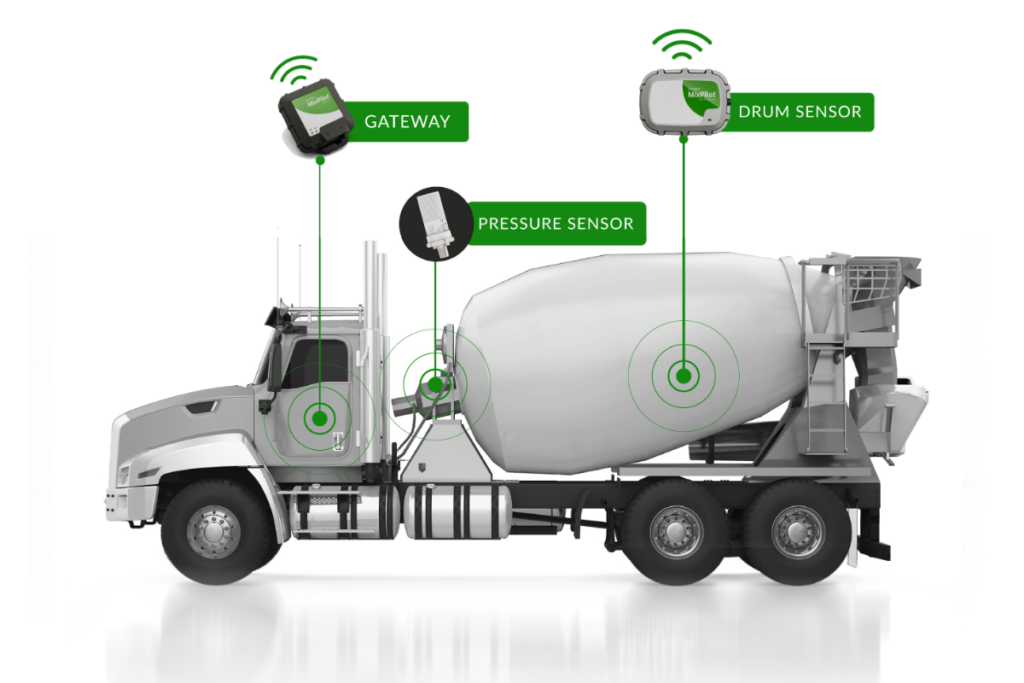
For data center projects where the mix design has been optimized specifically to manage heat generation and meet carbon targets, protecting that design through transit is not an optional step. It is the last line of quality control before the concrete goes into the ground.
Want to know exactly how slump loss silently costs concrete producers money? Read our breakdown of the hidden costs of slump variability.
Concrete Sets the Pace. Real-Time Data Keeps It.
Data center construction leaves no room for the uncertainty that traditional concrete testing methods were designed to tolerate. Cylinder breaks, wired thermocouples, and manual site visits were developed for an industry that measured schedules in years. Hyperscale projects measure them in weeks, and the financial consequences of falling behind are immediate.
The construction teams delivering the world’s most demanding data center projects are not waiting for the industry to catch up. They are using real-time concrete monitoring, AI-powered mix optimization, and in-transit quality control to remove the uncertainty from every stage of the concrete lifecycle, from the batch plant to the foundation to the post-tensioned slab.
SmartRock Long Range, SmartRock Web, SmartMix, and MixPilot give data center construction teams the visibility and control they need to keep concrete from becoming the risk that stops the schedule.
Ready to protect your data center concrete program? Get a quote for SmartRock Long Range today!
Frequently Asked Questions
What is the biggest concrete risk on data center construction?
The biggest risk is schedule delay caused by waiting for concrete strength confirmation. Data center projects operate on 12– to– 18 month timelines with penalty-clause commissioning dates, so every hour spent waiting for cylinder break results before stressing post-tensioned slabs or stripping formwork translates directly into unrecoverable financial exposure.
Why do data center foundations require mass concrete?
Data center foundations support server racks, UPS systems, generators, and cooling infrastructure that generate floor loads of 150 to 350 pounds per square foot, far above the 50 to 80 pounds per square foot typical of office buildings. The thick raft foundations required to carry those loads qualify as mass concrete and generate significant internal heat during curing.
How long does it take to stress a post-tensioned slab?
Post-tensioned slabs can be stressed once the concrete reaches approximately 75 percent of design strength. With traditional cylinder break testing, confirming that strength requires a minimum of 24 hours in a lab. With real-time maturity monitoring, the same confirmation happens in the field within minutes of the strength threshold being reached.
What is the difference between data center concrete and standard commercial concrete?
Data center concrete carries higher structural loads, uses post-tensioned slabs almost universally, requires mass concrete foundations, and runs on schedules two to three times faster than standard commercial construction. The financial cost of curing delays is also significantly higher because of penalty-clause commissioning dates.
How does AI reduce cement usage in data center concrete?
AI systems analyze concrete mix performance data across thousands of raw material combinations to identify where cement can be reduced without compromising specified strength. On large-volume data center foundation pours, cement reductions of 35 to 50 kilograms per cubic meter reduce both material cost and the heat of hydration that drives thermal cracking risk.