


Concrete cures best when the in-place temperature stays between roughly 50°F and 75°F (10°C and 24°C). Below about 40°F (5°C), cement hydration slows sharply and strength gain can stall entirely, which is why cold weather placements need protection and a minimum maintained temperature. Above about 90°F (32°C), concrete gains early strength quickly but reaches a lower final strength and lower durability, and in thicker elements the internal temperature and the temperature difference between core and surface become the controlling risks. The temperature that matters is the one inside the element, not the air temperature, so the limits below are checked against in-place readings.
| What is being limited | Typical value | Why it matters | Usual source |
|---|---|---|---|
| Minimum concrete temperature as placed and maintained, cold weather | 55°F (13°C) for sections under 12 in., 50°F (10°C) for sections 12 in. to 36 in. | Below this, hydration is too slow to build early strength before the protection period ends | ACI 306 and project specification |
| Cold weather protection period | Commonly 3 days minimum, longer for elements that will be loaded early | Removing protection too soon exposes concrete that has not yet gained enough strength to resist freezing | ACI 306 and project specification |
| Maximum fresh concrete temperature as placed, hot weather | Commonly specified at 95°F (35°C) | High placing temperatures accelerate slump loss, increase water demand and reduce 28 day strength | ACI 301, ACI 305, project specification |
| Maximum in-place curing temperature | 160°F (70°C), per ACI 301, section 8.1.3(a) | Above this, delayed ettringite formation and long term expansion and cracking become a risk | Project specification, mass concrete provisions |
| Maximum temperature differential, core to surface | 35°F (19°C), per ACI 301, section 8.1.3(a) | Larger differentials build restraint stress that causes thermal cracking | Project specification, thermal control plan |
| Freezing of fresh concrete | Avoid entirely in the first 24 hours | Concrete frozen before it sets can lose a large share of its potential 28 day strength permanently | ACI 306 |
These are the values most commonly specified. The governing numbers for any pour are the ones written into that project’s specification and thermal control plan.
Monitoring your concrete curing temperature during the early stages of construction ensures the integrity of your structure. This is especially true during extreme weather conditions when mixing and curing of concrete are subject to different environmental elements. If freshly poured concrete is exposed to temperatures that are too high or too low, or if it isn’t preserving enough moisture, the strength development of the concrete will be compromised. Thus, closely monitoring temperature variances in your concrete slab during curing is vital to ensuring strength, quality, and durability.
How to Control Concrete Temperature During Mixing and Curing
There are multiple methods to lessen the adverse effect of improper hydration temperatures. To control the temperature during the dormant and strength-gain phases of the hydration process, there are two possible approaches.
The first approach is to optimize the mix design. The second approach is to control the surrounding elements or curing properties that influence the temperature. These can also be combined.
Controlling Concrete Temperature During Mix Design
To maintain the desired temperature during heat of hydration (an exothermic reaction in cement), you need to design your mix to fit the specific application and ambient conditions of the concrete. Here are some things to consider when designing your concrete mix:
- Selecting the appropriate cement type changes the amount of heat generated. Compared to Type I cement, Type III generates more heat. Type II generates moderate heat, and Type IV generates less than the others.
- Adjusting the finesse of the cement (i.e. using a finer cement) will generate more heat.
- Using supplementary cementitious materials (SCMs) effectively reduces the heat generated during hydration. Replacing a portion of the cement with slag or fly ash reduces the amount of reactive material in the early stages. In turn, this reduces the amount of heat generated and delays concrete strength gain.
- Adding other types of admixtures such as retarders and accelerators can help control the length of the dormant period. However, these mixtures will not typically affect heat generation.
Learn how concrete temperature monitoring fits into your project
Why Proper Concrete Curing Temperature Is Important
Concrete curing helps maintain moisture content and temperature levels in early-age concrete so that it can reach its specific mix strength. Having the right amount of moisture in the concrete is important because the chemical reaction known as hydration tends to dry out the concrete due to the loss of heat. When concreting in extreme weather (hot or cold) there are specific measures to take in order to ensure the integrity of your concrete structure.
Hot-Weather Concreting
Hot weather is a problem for two reasons at once: the concrete arrives hotter, and it loses water to evaporation faster. A common rule is to keep the concrete as placed at or below 95°F (35°C), and to keep the in-place curing temperature below 160°F (70°C) in thicker elements. If the temperature of the concrete during hydration is too high, it will cause the concrete to have high early strength development. But, consequently, gain less strength in the later stage. This results in lower durability of the structure overall. Such temperatures also interfere with the formation of ettringite in the initial stage, but it can happen in the later stages which causes an expansive reaction and subsequent cracking.
Cold-Weather Concreting
ACI 306 defines cold weather concreting as the period when, for more than three successive days, the average daily air temperature is below 40°F (5°C) and the air temperature is not above 50°F (10°C) for more than half of any 24 hour period. Under those conditions, hydration slows and can effectively stop until the temperature rises again, so the concrete stops gaining strength while the schedule keeps moving.
How Extreme Weather Affects Concrete
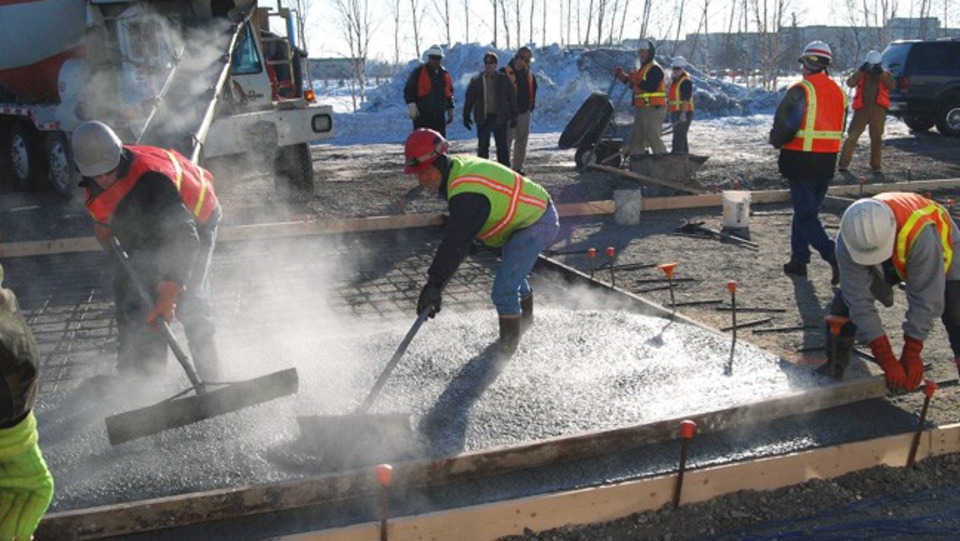
One of the ways to avoid overheating your concrete in hot weather is to schedule your pours at night when external temperatures are lower. Another technique is to use cold water in the mix or to cool aggregates down with ice.
In cold weather, the temperature can be managed using external heating systems in order to control curing conditions. Extreme curing temperatures can also be managed in mass pours by using cooling pipes.
Hot-Weather Concreting Tips
- Cool the mix using chilled water, ice replacing part of the mix water, or liquid nitrogen for larger pours.
- Shade and dampen aggregate stockpiles, and dampen side forms and subgrade before placing.
- Schedule placements for early morning or at night when air temperature, solar gain and wind are all lower.
- Keep an evaporation retarder on site and apply it if the evaporation rate rises during finishing.
- Start curing immediately after finishing. In hot, dry, windy conditions the window between finishing and plastic shrinkage cracking is short.
Cold-Weather Concreting Tips
- Place the concrete at or above the minimum temperature for the section thickness, and maintain it there for the full protection period rather than for a fixed number of days chosen by habit.
- Protect the placement with insulating blankets, heated enclosures or heated forms, and monitor the in-place temperature rather than the air temperature, because the two diverge quickly once blankets go on.
- Do not let fresh concrete freeze in the first 24 hours. Concrete frozen before it has set can permanently lose a large part of its potential 28 day strength.
- Never place concrete on frozen ground, snow or ice. Thaw the subgrade first.
- Remove protection gradually so the surface does not cool faster than the core. A sudden drop across the section is what cracks it, not the cold itself.
Curious About Monitoring Temperature in Extreme Weather? Click here!
The Most Efficient Tool to Monitor Concrete Curing Temperature
The process of placing and curing concrete on site requires precise temperatures so as to not damage the structural integrity of the concrete. With SmartRock, a wireless concrete curing temperature thermometer, you no longer have to worry about ambiguous wait times and faulty break tests. SmartRock delivers real-time, accurate data to your mobile device every 15 minutes. The free app calculates the data of your in-situ concrete, eliminating guesswork.

As a completely wireless sensor, SmartRock allows contractors to work efficiently without worrying about protruding wires. The sensor is fully embedded in the concrete and secured on the rebar within the formwork. This means you do not need to search for wires under heating blankets or rely on any external data loggers to collect or send data. With the touch of a button, you can download the free application and share data with your team instantly!
SmartRock’s ability to monitor the effects of the in-situ concrete and ambient temperatures makes it easier to control concrete curing and ensure optimal conditions. In addition, real-time results allow contractors to optimize the heating process, decrease energy costs, and save time in their project schedule by knowing when to move on to subsequent construction operations, such as formwork removal or post-tensioning. With the ASTM C1074 maturity method, SmartRock sensors can estimate the in-place strength of concrete.
Learn More About the Benefits of SmartRock Sensors Now!
Concrete Curing Temperature FAQ
What is the ideal temperature for curing concrete?
Roughly 50°F to 75°F (10°C to 24°C) measured in the concrete, not in the air. That range is warm enough for hydration to proceed at a useful rate and cool enough to avoid the strength and durability penalties that come with high curing temperatures. Laboratory curing for acceptance cylinders is held at 73.5°F plus or minus 3.5°F (23°C plus or minus 2°C) under ASTM C511, which is a useful benchmark for what “ideal” looks like.
What is the minimum temperature for concrete to cure?
Around 40°F (5°C) is the practical floor. Below it, hydration slows to the point where meaningful strength gain effectively stops, and it resumes only when the concrete warms again. Cold weather specifications therefore set a minimum concrete temperature to place and maintain, typically 50°F to 55°F (10°C to 13°C) depending on section thickness, rather than relying on the air temperature staying above freezing.
How hot is too hot for curing concrete?
Two limits apply. The concrete as placed is commonly capped at 95°F (35°C), which controls slump loss and water demand. The in-place curing temperature is commonly capped at 160°F (70°C), which controls the risk of delayed ettringite formation and long term cracking. In thicker sections the temperature difference between core and surface, commonly limited to 35°F (19°C), usually becomes binding before either absolute limit does.
How long should you monitor concrete curing temperature?
Monitor from placement through the end of the protection or curing period, which in most cases means at least the first seven days and longer in cold weather or in mass elements. The first 24 to 72 hours carry most of the risk, because that is when the peak temperature occurs in thicker elements and when freezing does the most damage in thin ones.
Does concrete cure faster in hot weather?
It gains early strength faster, but it ends up weaker. Concrete cured hot develops a coarser, less uniform hydration product structure, so it typically reaches a lower 28 day and long term strength than the same mix cured at moderate temperature, and it is more permeable. Faster early strength in hot weather is a schedule benefit bought with a durability cost.
Sources:
Tips and Recommendations for Pouring Concrete in Hot Weather
Learn How to Pour Concrete in Cold Weather
Concrete in Practice
Concrete Construction
**Editor’s Note: This post was originally published on December 19th 2018 and has been updated for accuracy and comprehensiveness.