

In This Episode
In this episode of The Construction Revolution Podcast, we're joined by Shelley Copsey, co-founder and CEO of FYLD. Shelley shares FYLD's unconventional origin story as a research project for one of Canada's largest pension plans, and how her background in infrastructure and business transformation led her to build an AI-powered frontline intelligence platform for utilities, heavy civils, and energy organizations across the UK and the Americas. We discuss how FYLD replaces paperwork-heavy safety processes with short videos from field workers, using AI to assess risk in real time, coach workers toward better risk assessments, and give remote managers visibility into which crews need attention most. Shelley explains why winning the trust of frontline workers, not just improving back-office efficiency, is the key to adoption, and how FYLD is helping cut standing time and improve safety outcomes on site.
Host
Steven Rossi-Zalmons
Marketing & Events Lead, Giatec Scientific Inc.

Guest
Shelley Copsey
Co-Founder and CEO, FYLD
Podcast Transcript
Steven Rossi-Zalmons:
Hello there and welcome to the Construction Revolution Podcast. My name is Steven Rossi-Zalmons, and here on the show we explore the latest trends, technologies, people, and organizations that are revolutionizing or disrupting the construction industry and changing what the industry will look like tomorrow.
Today on the show, I’m speaking with Shelley Copsey, the co-founder and CEO of FYLD. Shelley has over 20 years of experience at the intersection of physical infrastructure and digital technologies, and the human transformation required to make emerging tech actually stick in the field. She co-founded FYLD in 2020, building an AI-powered frontline intelligence platform for utilities, heavy civils, and energy organizations across the UK, US, and beyond. FYLD embeds real-time AI into field operations, giving workers and managers the intelligence they need to make faster, safer, and more accountable decisions on site.
Steven Rossi-Zalmons:
Hi, Shelley. Welcome to the Construction Revolution podcast. How are you doing today?
Shelley Copsey:
I’m great. Thanks for having me on, Steven.
Steven Rossi-Zalmons:
Yeah, absolutely. I’m excited to learn more about you and about FYLD, so why don’t we dive right in? Can you tell me the story about what led you to start FYLD?
Shelley Copsey:
So I didn’t come from a software background — I came from infrastructure and business transformation. Throughout my career in infrastructure, I kept seeing the same problems. Organisations invest millions and billions in assets and technology, yet the most important decisions were made with very little real-time information from the field.
When you get into the construction and utility sector, where I’m lucky enough to work, you find the most incredible people — people with engineering at their heart, people who are doing great service for their communities. But when they’re managed by people remote to the job sites where the work is actually done, they’re managed by people who are flying blind, and they end up managing in a reactive way.
AI became a real catalyst if you go back five or six years, where we could begin to think about the wealth of information that was sitting there about what these people were doing — but how could you synthesise that in real time and actually move from that old reactive way of working to working in a proactive manner? We decided to found FYLD because we wanted to become the intelligence layer between the field and the people responsible for running these massive pieces of infrastructure and building the infrastructure for our communities.
Steven Rossi-Zalmons:
Nice, yeah, that’s great. Can you tell me about how you actually founded — or co-founded — the company, and what that process was like? Obviously AI, as you mentioned, was just beginning when you started FYLD. Where are we now, and what has that journey been like?
Shelley Copsey:
So we don’t have the usual founding story. FYLD actually started as a project of one of Canada’s very large pension plans. That pension plan owns a lot of infrastructure companies globally, and they were seeing persistent problems in the field — this would be familiar to anybody in this space. They were seeing cost overruns, schedule overruns, quality problems, and people getting hurt at a rate higher than any of us think is reasonable, as we really push to try and get to zero harm.
They actually went to Boston Consulting Group originally looking for a consulting project, but fortunately for us, BCG looked at some of the technology trends that were around in 2020. First and foremost, things that we do in our personal lives tend to come into business — they were looking at how video had become such a form of communication between all of us privately, and how that would end up in the business world as time progressed. They were looking at the 5G standard — for anyone not familiar with it, we went from a world of assuming we’re all downloading information to our phones, to a world where we could upload and download equivalently. And they were looking at edge compute: our field workers are in environments that aren’t always connected, and we knew the ability to run complex AI on phones without connectivity would get better and better.
We looked at a number of these trends, and it caused us to say that the future of how we manage construction workers was no longer going to be about asking people to go from pen and paper to a digital form. It was actually going to be about getting people to take videos and tell us about their work sites, synthesising that information, and helping make field workers’ lives easier. So that project was done, and I was asked — given a small amount of money, a few team members, and an MVP, and given my background — whether I’d be willing to attempt to build a company around it. Five or six years on, here we are.
Steven Rossi-Zalmons:
Yeah, that’s a great story — definitely a more unique one than just an idea you came up with in a coffee shop with someone. Can you tell me, for the people who may not be aware, what FYLD is, and who your users and customers are?
Shelley Copsey:
We think of FYLD as effectively being an operating system for field work. The main users are the people who go out and do the work — if you think about a water network, the people digging up the pipe when you see a leak; in energy networks, they might be burying assets given climate volatility. Those people out in communities making sure our infrastructure is built well and run well are our core users. We effectively crowdsource data from all of those people — we get them to take short videos telling us about what’s going on.
Then you get to the back office, and you think about the remote manager who’s typically running somewhere between five and twenty crews in the field. When we start working with them, nobody’s built tools to help them understand what’s going on across those crews — who needs their attention, who’s in a dangerous environment, who’s facing job stand-down time because they don’t have the right tools and equipment.
All of a sudden, we help that remote manager say, of those 20 crews, here’s the one that really needs my attention next, here’s the job that looks like it’s going off track. They stop sampling and instead focus their attention where it counts, and we help them do that with data. You can imagine rolling that up to a district with 500 crews out. We help the people in the field make their day easier, help fill out forms for them, and make sure their job gets driven to safe completion every day. But we gradually go up the organisation, typically through to a COO who wants highly predictable operations every day.
Steven Rossi-Zalmons:
Right. So for people in those manager or leadership roles, or who aren’t on site every day, what does a traditional day look like for someone on site without using FYLD, and how does that change when they are using it?
Shelley Copsey:
If you think about someone sent out into the field to do one of these jobs, we still give them an awful lot of paperwork as the starting point. It might be digitised, but it’s really just a PDF form filler.
They arrive on site and have to do a safety assessment. If you’re not someone who goes out to an industrial work site — say you’re sitting in an office — what happens in the field is no different to what happens in the office: when you do something repetitive, you stop thinking about it, and that’s always where risk emerges. Our field workers go out into these environments every day, and there are things they stop seeing. A really common example is overhead cables — it’s one of the most common risks we help mitigate.
So with that risk assessment, instead of letting them sit in their huts and vans just ticking paperwork — no matter how proud these people are, we all get to that point — we let them talk to us about what’s going on. That changes their behaviour and brings governance to what they’re doing out there. The first thing that changes is they go from a tick-box safety procedure to a dynamic risk assessment, where we use AI to help them understand the real risks on site and ensure they’re applying controls to any hazards identified in a really effective way.
If we roll on a couple of hours, let’s say they hit a problem while doing the job. Today, the field worker would normally start calling or messaging their manager and waiting for that to get picked up — very often sitting there for an hour or two. At FYLD, by comparison, our remote command centres have a geospatial interface, and everyone in that command centre can see which jobs are on standing time. You get a different culture where that field worker is no longer left sitting on the side of the road. Members of the public don’t always understand that it’s not typically the worker’s fault, but it’s suddenly not okay to leave them sitting there, and the remote managers know exactly who needs attention. So you see that standing time go way down.
Another common example: at the end of the day, a lot of these sites aren’t finished, and they need to be left safe and secure. When things go wrong, there’s often a blame culture — did the field worker put up adequate bollards and barriers, cones, and so on? Our field workers again take videos showing us what they did, and we let AI assess in the moment whether the site is fully secured and whether there’s more they should do before they leave. So the field worker leaves work knowing they have proper evidence they did a great job and that members of the public should be safe — they can’t help it if someone interferes with the site after they leave. It’s a much more natural way of working: video, talking, rich information, but keeping them moving faster.
Steven Rossi-Zalmons:
Right, yeah, that’s great. I’m curious — you mentioned you’re changing the way people report, from forms and paperwork to audio and video. How did you build the platform and train these models when everything has traditionally been paperwork? If you’re not just automating paperwork, how did you go about building the platform?
Shelley Copsey:
People look at FYLD as an AI-native company, and yes, we are — but because of the unique way we were built, we were built with Scotia Gas Networks here in the UK, who have six and a half million customers. We were built with 750 field workers telling us about the challenges in their day. We never had a starting assumption of ‘let’s take your old process and replace it digitally’ — we just started by asking them what would make their day easier.
One simple example is the level of paperwork they have to fill out. Literacy isn’t always as high as we might assume in the field, and the conditions are harsh — people are working in beating sun or rain, these are physically intense jobs, and by the end of the day they’re exhausted and still need to fill out 30 pages of paperwork. So a really simple starting point for winning a field worker over is: if they’ve taken six short, snappy videos, how much of those 30 pages can we pre-fill for them? A lot, as it turns out.
We’ve always thought about how to make the field worker’s day easier, because the results come back to us if we do. That’s always been our starting assumption — make their day easier, and we’ll get higher satisfaction scores, they’ll give us more data, more high-quality data, and the better the data we get, the more we can do to predict a day’s outcomes, which lets remote managers help the people in the field even more. It’s a nice virtuous circle. But you’ve got to win the hearts and minds of the field workers — that’s always where platforms like ours fall down, when workers think the whole benefit is for the back office and there’s nothing in it that makes their day easier.
Steven Rossi-Zalmons:
Yeah, absolutely. And that actually brings me to my next question — how do you get teams and the users on site to adopt FYLD? Have you had any pushback, or hesitancy from people about recording everything they’re doing all the time?
Shelley Copsey:
In our earlier days there was a bit more hesitancy, but today, if you think about the application in the field being somewhere between a social media-style app, like Facebook, and a banking app — firstly, let’s keep it super simple for the person in the field, let’s not make it complex. The next thing is you have to learn how to deploy well. One of the things we always do at FYLD is start with a small group of people, somewhere between 50 and 100 field workers.
We give them a white-glove service, train them well, and let them feel supported. Too many software vendors in this industry sell and walk away, then come back 12 to 18 months later to a disaster — we don’t do that. Let’s get that first 50 to 100 people successful. From there you get the good news stories, you get field workers telling us this is making their life easier, and the growth we achieve at most of our customers because of field worker advocacy is very strong.
I also think middle managers are people who’ve been long forgotten — they just drive from site to site to site, sampling. We think heavily about how to make their day easier too. One of the things I love about this industry is the camaraderie and care people have for each other. If I think about a mid-manager who’s been working for 20 years, they’ve probably seen someone get badly hurt and been involved in incidents. If we can help them look after their crews better, and let the work of their crews be visible up the chain, we win their hearts and minds too. It’s person by person, but you’ve got to think at scale — you’re making everybody’s lives easier, and adoption tends to take care of itself.
Steven Rossi-Zalmons:
Yeah, no, for sure, that’s a great approach. And on the note of safety — you mentioned that’s how the whole company started, to address this issue. So how does FYLD help improve safety on job sites?
Shelley Copsey:
We always started with a vision of being an operating system for the field, but you’ve got to find that first piece of your product that people grab onto. One of the wonderful things about this industry is that everybody cares about their workers going home safe and sound every day, and we had a revolutionary new way of supporting that — that’s really what got us to market in the first place.
If you think about today, a lot of people are pencil-whipping forms, or doing their best to fill one out under harsh conditions. By comparison, with video we let three or four things happen. First, we get 100% governance that a risk assessment has actually been done — if you think about a world of paper or digital paper forms, you have no idea whether they’ve done a risk assessment at the start of the day or not. The next is governance on the quality of that risk assessment: because we’ve got them out of their huts and vans and telling us about job conditions, we can run AI over those videos in real time to assess the quality of what they’re telling us. If someone just aims the phone at the ground, or doesn’t talk much, we can give them real-time coaching on how to improve the risk assessment. So now we’ve got 100% of jobs with a risk assessment — people can still choose to submit a bad one, but we’ve coached them, so we get to a really high proportion of jobs with a quality risk assessment. That’s a great starting point.
We use natural language processing to understand the risks and hazards people report on site, but we supplement that with computer vision and geospatial intelligence to identify things they may not have seen — like overhead cables, or things they simply don’t know, like a school being around the corner. If you arrive on site at 10 a.m. and haven’t seen the morning traffic, you probably don’t realise it’s going to hit you again at 3 p.m., and you may not have set up a large enough exclusion zone. We bring all of those factors together to empower the field worker to make better decisions about keeping themselves safe, while making sure those decisions align with our customers’ risk and process management systems, since they’ll all have processes and procedures that must be applied when certain risks are identified.
Steven Rossi-Zalmons:
Yeah, nice. So for the longest time, infrastructure projects and field operations specifically — like you mentioned, when you see a problem on site, you call a manager and wait. How are things changing, and how are leaders becoming more open to this data-driven approach as opposed to just putting out fires?
Shelley Copsey:
First and foremost, we’re all seeing the labour shortages that exist. At FYLD, we track around 30% standing time on site — I wouldn’t run a business thinking that 30% of my available resource sitting idle was an okay outcome, but that’s what we see. So I see two things: there are real labour shortages, but there’s also more capacity hiding in the existing team. If you think about that holistically, you can start asking how to get breakthroughs in capacity from your existing team members. The other thing is, if I can increase spans of control, can I actually release more people to go work in the field?
I think a lot of organisations, as they grapple with this talent problem, are asking: with the resources I’ve got, how can I do more? We’re also seeing that when people — particularly the younger generation — look at where they want to work, technology is becoming a strategic advantage in attracting people. Safety is great, nobody wants to work somewhere they might get hurt, but beyond that, no 18-year-old wants to go somewhere where they’re filling out 30 pages of paperwork by hand at the end of the day. So you begin to see this confluence of factors in the market causing people to reimagine how field work can be done.
Steven Rossi-Zalmons:
Right. So moving away from FYLD for a bit — AI is obviously everywhere, and increasingly so in construction and infrastructure. Where do you see the real value for field teams, and where is it maybe just using AI for the sake of using AI?
Shelley Copsey:
Looking forward three to five years, the winners in this industry won’t necessarily be the ones with the most AI tools deployed, or even the most powerful tools. I think it’ll be those who started early — even three years ago — and figured out how to drive adoption in their teams and make better operational decisions. There are a lot of areas in this industry that can be optimised, that are lower-hanging fruit people can go after.
A simple example for us: if from a 60- to 90-second video at the start of the day, we can identify the likelihood that some form of permit to work will be needed later in the day, that’s huge — permitting is a big deal. Today, a field worker frequently sits there for two hours waiting for a permit to issue; if we can predict that and put it in place within two minutes at the start of the day, that’s a real breakthrough. There are a lot of these kinds of things where we can rapidly help organisations get to a better operational process.
But it’s an absolute imperative that people are thinking and acting now, making this part of their talent strategy across the organisation and building the corporate muscle of how to use these tools. The other thing I’d add is that too many organisations are still just thinking in terms of pilots. AI is very different from SaaS — with SaaS-style workflow products, you didn’t necessarily gain an advantage just because your whole organisation followed the same workflow. With AI, as you scale up and gather more data, you may not need the most powerful algorithm, but if you’ve got a huge amount of data fuelling a solid operational decision-making tool, you can get to some really great outcomes.
Steven Rossi-Zalmons:
Yeah, definitely — the data is the most important part. If you don’t have good, consistent data, whatever AI model you have, no matter how powerful, isn’t going to be very useful.
Shelley Copsey:
Precisely. And this data’s not easy to come by, so again — move now, don’t procrastinate.
Steven Rossi-Zalmons:
Yeah, absolutely. So apart from FYLD, what other technologies and software are you seeing on site, or in the construction industry in general, that excite you for the future?
Shelley Copsey:
Digital twins have been hyped for many, many years, but the disconnect between what was really happening as people built assets and what was in those models couldn’t be bridged. I think digital twins are actually becoming operational models rather than just engineering models — heaps of promise for the industry.
Robotics is another one. There’s a lack of workers, and we’re still putting humans into really dangerous environments, so I think robotics is going to be super interesting over the next five to ten years — particularly if you contrast a country like China with the US. In the US, we don’t have cities that are ten years old, built on a grid with very well-known infrastructure. So it’ll be really interesting to see how we bring the promise of robotics to life in our more convoluted, messy cities.
The other one is computer vision — continuously monitoring assets. We’ve never had this chance before, and we’re getting so much better at building massive data sets, and at understanding the poignant bits we want to keep versus what we can let go of, and how that impacts asset health and condition. That’s huge. But I think what’s most exciting is that so many of these impactful technologies are becoming genuinely applicable, and together they’ll form an operating system that’s vastly different from how we manage an infrastructure company today. I really look forward, in ten years, to stepping back and looking at how these organisations are run once these become dominant technologies, rather than that piecemeal, pilot-style development.
Steven Rossi-Zalmons:
Right, absolutely. So looking to the future of FYLD and the industry, how do you see operations and infrastructure evolving over the next five to ten years, once something like FYLD and other AI tools are fully embedded into their processes?
Shelley Copsey:
First and foremost, every field worker is going to have an AI assistant — a naturally easy-to-use assistant that just helps them do their job. They won’t think much of it, it’ll just be a normal way of working. Stepping back to managers, I think how much of a patch of operations any manager can run is going to be way bigger than it is today, and they’ll have even better visibility than they have now.
Risk prediction is going to become routine — predicting where we’re going off schedule, where we’re going to have a cost blowout, where someone’s going to get hurt. Risk from a multitude of angles: I think we’ll think nothing of predicting it and acting on it. Routine reporting, I reckon, will largely disappear — we’ll have so much contextual information from the field that anything the back office needs to do, we’ll just click a button and automate. The capacity that frees up for our field workers, and the job satisfaction that comes with it, shouldn’t be underrated.
Operational decisions are going to become evidence-based. It’s not the fault of this industry that they aren’t today — the technology sector just hadn’t built for this previously, but that’s fundamentally changing. If I bring it up to a higher level, the field worker will always be essential over the next five to ten years, in my mind. You hear a lot of people talk about humans disappearing — I can’t see that in the part of the world I operate in. What’s changing is that every worker is going to be supported by intelligence that simply wasn’t available before.
Steven Rossi-Zalmons:
Yeah, that’s great, and it’s an exciting future for sure. To wrap us up — if someone’s listening today and wants to learn more about FYLD, where should they go? And if they’re interested in getting started, what does that process look like? Also, what markets are you serving right now?
Shelley Copsey:
We’re currently in the UK and the Americas, from Canada to mainland America down to South America — serving infrastructure and utilities, so either the people who own these assets or their supply chain. We’re now also beginning to switch gears and get into the energy sector as well.
If people want to find us, we’re FYLD, so you can find us at fyld.ai — that’s f-y-l-d dot ai. You can also connect with me, Shelley Copsey, on LinkedIn. Between those two spots, you’ll find a wealth of information about the work we’re doing with our customers globally, and how we’re setting the scene for what an operating system for the field looks like.
Steven Rossi-Zalmons:
Great. Well, thank you so much for your time and for letting us know more about FYLD and about the future of operations.
Shelley Copsey:
Thanks, Steven, for having me.


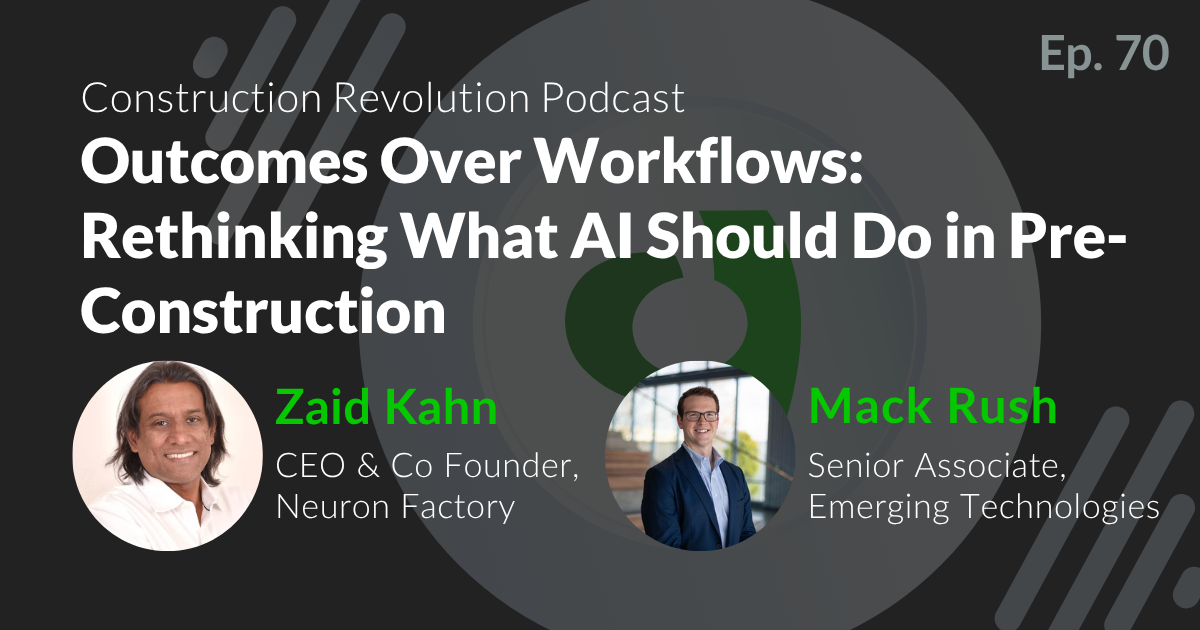
Outcomes Over Workflows: Rethinking What AI Should Do in Pre-Construction
In this episode of The Construction Revolution Podcast, we're joined by Zaid Kahn, CEO and Co-Founder of Neuron Factory, and Mack Rush, Senior Associate of Emerging Technologies at Suffolk Technologies. Neuron Factory, founded in 2025 by Zaid and his co-founder Salil Pandit, is building what they call the knowledge graph of construction, turning fragmented drawings, specs, and project communications into connected intelligence for pre-construction teams. The company first came up through Suffolk Technologies' Boost accelerator program before growing into an expanded design partnership testing the platform across real projects. We talk about why Zaid and Salil see pre-construction as a context problem rather than a data problem, and why asking “what is a drawing?” from a first-principles, outsider's perspective reshaped how Neuron Factory approaches scene understanding over simple object detection. Mack shares the project that convinced Suffolk the tech was a genuine step-change: an AI catching a risky, underspecified subcontract clause. We close on how AI is starting to change the way pre-construction teams and roles are structured, and where the Neuron Factory–Suffolk partnership is headed next.
 PLAY
PLAYA Week to Thirty Minutes: How Trayd Fixed Payroll
In this episode of The Construction Revolution Podcast, we're joined by Anna Berger, CEO and Co-Founder of Trayd. Anna grew up in a New York construction family, watching her father's back-office fill with filing cabinets, stacks of paper timecards, and systems that didn't talk to each other. In 2021 she founded Trayd with CTO Cara Kessler to fix it: an all-in-one back-office operating system that automates payroll, HR, and compliance for union and prevailing wage trade contractors running 50 to 1,000 people in the field.
We discuss what payroll week actually looks like for a 300 person electrical contractor, from a Monday morning stack of 250 paper timecards, through union rates, shift premiums and overtime rules worked out by hand in Excel, to the union benefit reports and workers' comp filings at the other end, and how Trayd compresses that full week into a run of thirty minutes or less. Anna explains why she believes construction has a software problem rather than an adoption problem, why point solutions have left back offices running eight systems that don't speak to each other, how pairing clock-in with visible earnings drove field adoption past 99%, and why structuring the industry's data has to come before AI can deliver anything meaningful.
PLAYFrom Paper to Platform: How Stratus is Digitalizing MEP Fabrication
In this episode of The Construction Revolution Podcast, we're joined by Jake Olsen, CEO of Stratus. Jake shares how his career spanning structural engineering, construction tech at DeWalt, and hands-on time inside a mechanical contractor's fab shop led him to take the helm at Stratus, an operating system for MEP contractors that digitizes the full workflow from BIM through fabrication, logistics, and field installation. We discuss why most MEP contractors are still running on PDFs, spreadsheets, and color-coded stickers, how Stratus connects live model data directly to the fab shop floor, and what Jake's State of MEP report revealed about the growing gap between contractors who have embraced fabrication and those who haven't. The conversation explores how off-site prefabrication is helping contractors solve the labor shortage, why the most competitive MEP contractors are starting to run their businesses more like manufacturers, and how going fully digital gives contractors the real-time data they need to actually improve their operations over time.
PLAY
 PLAY
PLAY