

In This Episode
In this episode of The Construction Revolution Podcast, we're joined by Anna Berger, CEO and Co-Founder of Trayd. Anna grew up in a New York construction family, watching her father's back-office fill with filing cabinets, stacks of paper timecards, and systems that didn't talk to each other. In 2021 she founded Trayd with CTO Cara Kessler to fix it: an all-in-one back-office operating system that automates payroll, HR, and compliance for union and prevailing wage trade contractors running 50 to 1,000 people in the field.
We discuss what payroll week actually looks like for a 300 person electrical contractor, from a Monday morning stack of 250 paper timecards, through union rates, shift premiums and overtime rules worked out by hand in Excel, to the union benefit reports and workers' comp filings at the other end, and how Trayd compresses that full week into a run of thirty minutes or less. Anna explains why she believes construction has a software problem rather than an adoption problem, why point solutions have left back offices running eight systems that don't speak to each other, how pairing clock-in with visible earnings drove field adoption past 99%, and why structuring the industry's data has to come before AI can deliver anything meaningful.

Host
Steven Rossi-Zalmons
Marketing & Events Lead, Giatec Scientific Inc.

Guest
Anna Berger
Co-Founder and CEO, Trayd
Podcast Transcript
Steven Rossi-Zalmons:
Hello there and welcome to the Construction Revolution Podcast. My name is Steven Rossi-Zalmons, and here on the show we explore the latest trends, technologies, people and organizations that are revolutionizing and disrupting the construction industry.
Today on the show, I’m speaking with Anna Berger, the CEO and Co-Founder at Trayd. Anna grew up in a New York construction family, watching her father lose hours every week to back office paperwork. In 2021, she founded Trayd with CTO Cara Kessler to fix this. Trayd is a back office platform that automates payroll, HR, and compliance for union and prevailing wage specialty trade contractors. Join us as we discuss the challenges that trade contractors traditionally face in their payroll processes, and how Trayd is revolutionizing this.
Hi Anna, welcome to the Construction Revolution Podcast. How are you doing today?
Anna Berger:
I’m great, Steven. Thanks for having me.
Steven Rossi-Zalmons:
Of course. I’m excited to learn more about you and about Trayd. So why don’t we start with that, and you can tell me the story about how you started Trayd and what led you to that.
Anna Berger:
So I’m Anna, I’m the founder and CEO of Trayd. Trayd was very much inspired by my father’s back office. I grew up in a construction family here in New York, and I got to live the realities of construction businesses: cabinets, stacks and stacks of pieces of paper, a lot of disjointed systems. After a certain amount of time I decided to do something about it. So Trayd is an all-in-one back office operating system that really specializes in payroll and compliance.
Steven Rossi-Zalmons:
Can you tell me a little bit more about what you do in terms of payroll, and mainly who you’re doing it for? You mentioned construction, but what sort of company specifically?
Anna Berger:
Construction is a massive, massive market, and a lot of companies tend to find their niche and go deep there. So it’s a great question. We work primarily with union and prevailing wage trade contractors, so the people that have anywhere from 50 to 1,000 people in the field. The whole concept of Trayd is that teams in the field are tracking their hours, their output, the materials and equipment that they’re using, so that the back office and finance teams have a real-time job cost and an accurate view of daily spend and burn while there’s still time to iterate on that. I think I grew up hearing the phrase “I’m flying blind” my whole life, and that is really the core insight of the Trayd platform. We are here to mold together all of the different data inputs from the field so that the back office can accurately assess the current status of a project and make any necessary in-flight changes.
Steven Rossi-Zalmons:
For someone like me who hasn’t sat in a back office of a trade company, can you walk me through what a traditional payroll process looks like? You touched on a lot of paper and cabinets that you’ve seen in your experience. What does that look like, and then how does it differ with Trayd?
Anna Berger:
So let’s take a 300 person specialty electrical shop, here in New York for example. On Monday morning, the payroll admins receive a stack of 250 pieces of paper coming in from the field. That’s if they’re lucky. Sometimes it’s emails and text messages as well, where they’re trying to reconcile who was working, where they were working, and what they were working on. So that early manipulation of time data from paper time cards into the system is the first body of work, and it could take anywhere up to a full day, eight hours. Then once the time data is in Excel, that’s when payroll admins are applying all of the different union rates that are so tricky, whether it’s prevailing rates, shift premiums, or overtime rules. So they’re doing all that in Excel, since older payroll platforms like ADP and Paychex aren’t really built to handle those types of rate calculations. Once all of that information is in Excel, then the team transposes that into the payroll system. Once it’s in the payroll system, they’re running payroll, they’re processing checks, and then they go into the reporting phase. After payroll runs, that’s when they’re preparing a journal entry for accounting. And then not only that, they are producing their union benefit reports, the workers’ comp reports, the 401(k)s, and so on and so forth. And that isn’t even accounts payable and receivables. This is just labor accounting. So that is a typical week for a payroll admin. That is a full week. And in construction, payroll is every seven days, so as soon as they finish this, they are starting again for the next week. It is incredibly time intensive, manual, and clearly there’s a lot of room to optimize.
Steven Rossi-Zalmons:
That’s crazy, the full nonstop loop of just doing it over and over, trying to reconcile.
Anna Berger:
These same people are now running payroll in thirty minutes or less on Trayd. So they’ve gotten three plus days back in their week, where they can take on other work and focus on other processes.
Steven Rossi-Zalmons:
Can you walk us through what those thirty minutes look like then? Instead of doing all those steps, how do you do it with Trayd?
Anna Berger:
On Trayd, that whole time import process doesn’t happen. Workers are clocking their hours from the field, their locations, what they’re doing, where they’re working, in those task codes. And so for the payroll admin on Monday morning, she logs on to Trayd, goes to the edit payroll table, and then can use our anomaly and issue detection to find the outliers and edge cases. All of the time data is already in there. She’s using our system to sort through every worker, where they were, does it add up. So it’s full automation, field into payroll.
Steven Rossi-Zalmons:
How do you find the response from people on site who are actually using it? I guess there’s an app on their phone that they submit everything through. When you’re onboarding companies, how is that getting them to implement, and what’s the adoption rate like? Any pushback from the people on site?
Anna Berger:
Great question, and this is probably my biggest sales objection. When I’m working with a construction company, I hear “my foreman will never do that.” And that is actually not the experience that we’ve seen. We have over 99% adoption of our field software. And do you want to know why? Because we’ve coupled clocking in and clocking out with pay stubs and tax documents. In order to enable the field software, you also have access to your bank information, and as you’re earning money throughout the week, Trayd is exposing that to the worker. So whether they’re making the same rate or prevailing wages, they have predictive insights to know what their paycheck is going to look like on Friday. That kind of visibility has never existed before, and it has completely changed the way in which users are interacting with the field software.
Steven Rossi-Zalmons:
That’s a game changer for sure. Being able to show them the transparency both ways is big. When we’re looking at specialty contractors and also even general contractors, where do you see opportunities beyond just payroll and hour entry to optimize things between the field and the back office?
Anna Berger:
That’s a great question. The list is pretty endless. My moment of pause was, where do I start? But I think there is a lot that foremen and workers are doing to intake materials on the job site. They receive shipments and things like that that are so important to track for the back office teams. So streamlining that data input into the back office is something that frankly Trayd is working on. Material stockpiles, inventory management, all of that really rounds out, outside of just labor, all of the different financial components of project tracking. So I’d say that’s a core piece. And then in general, how money moves through construction has always been the trillion dollar question. How money flows down from the owner into the GC, into the subs, and into the workers, that is the chain of command. And any tools that make that faster and better and stronger are important, whether that’s bill pay or invoice management, or fixing certified payrolls so that the GC releases the money. You name it. Anything that helps move the money through the ecosystem better is something worth doing.
Steven Rossi-Zalmons:
That’s a great perspective. So the labor shortage in construction is no secret. I’m curious how you see Trayd helping to resolve that, both in terms of helping with field workers, but then also helping to optimize the time of people in the office.
Anna Berger:
I think workers have historically been pretty frustrated when their pay is continuously wrong. There’s so much optionality in construction, these workers can jump around, so they are going to look for the companies that offer steady and reliable paychecks. And so if you can stabilize payroll, and not only that, streamline onboarding, so a worker is on site and working in five minutes or less, which is what we do, they’re encouraged to get involved and stay involved. If you then layer on tools where a worker can see their earnings, see their pay stubs, add different functionality around bank accounts, splits, sending money to one place or another, you’re giving them tools that they want. And if you’re giving them tools that they want and can use, because it comes in 11 languages and it’s something that they can understand, then you’re going to see natural adoption. It’s like if you build it, they will come, the age old expression. And so that’s really our thesis. It’s not just about the back office. If you don’t have buy-in from the workers, they won’t provide the necessary information in the field to make the back office stronger. So you can’t just look at one persona here, you have to look at the whole ecosystem.
Steven Rossi-Zalmons:
Absolutely. As technology is coming everywhere and especially into construction, more and more, as people are adding these different systems, that can also sometimes mean that they’re adding a bunch of disconnected siloed systems. What do you think contractors and Trayd contractors should think about when they’re bringing new systems on and trying to bring all their data and workflows together to actually optimize things, rather than just make different work?
Anna Berger:
This is my whole thesis: collapse the silos, structure the data to allow you to learn from what’s actually happening. I would really, really warn contractors before they buy a solution that does one single thing. What I mean by that is, a lot of times I walk into a back office and they have eight systems, a scheduling tool, a payroll tool, an invoicing tool, a time tracking tool, an accounting system, and they don’t speak to each other. So yes, a startup may come in and say we do bill pay better than anybody’s ever done bill pay, but if that bill pay sits in a silo detached from everything else, it only adds to the problem. So when evaluating software, I would ask, are you adding or eliminating from your tech stack, and is this going to make you go slower or faster? I think those are the truest questions. In construction, there is no downtime. That’s what makes these implementations so complicated. There are few industries that are moving as quickly and as repetitively as construction is. We are truly on a seven-day turnaround, and that makes tech enablement almost impossible, but there are a few startups that are doing it really well. So you just have to deeply understand the workflows, the business that you’re looking to support, and really provide a holistic platform for them. I think point solutions have killed this industry, truly. It’s the hill I’ll die on. So many startups coming out and doing one thing has led to this deeply fragmented space that contractors are now trying to claw out of.
Steven Rossi-Zalmons:
For sure. There’s definitely a solution for everything, but as you mentioned, it’s only doing that one thing and it’s not able to talk to anything else, so it’s really not that helpful.
Anna Berger:
Totally. In fact, I’d say it’s counterintuitive.
Steven Rossi-Zalmons:
Although we say now we’re starting to accelerate, technology adoption traditionally has a reputation for being slow. And to your point, there are a lot of reasons for that. It’s very challenging to implement and the stakes are high. When you’re talking to these companies, what do you think actually convinces them to change a process that maybe isn’t perfect but works, and they know it’ll get done? How do you actually convince them to implement something like Trayd?
Anna Berger:
Well, to take a step back, something I’m pretty certain on is that construction doesn’t have an adoption problem, it has a software problem. I think we have been trying to fit a square peg into a round hole with software and construction. For so many years, we’re talking 20, 30 years, we’ve had these giant incumbents, Sage, Foundation, [unclear: “EZ”, likely a fourth construction ERP], even Trimble Vista, that have built generic ERP and SaaS systems, and then 10 years in recognize construction as a market, change their branding, and say we’re for construction. So taking a software that is not really for construction but saying it is, and then forcing an adoption of it, of course there’s going to be problems. I think in the last few years you’ve seen the rise of construction native platforms, designed for the workforce. And that’s where you’re starting to see really successful implementations, because these companies like Trayd are coming in and meeting this company where they are. And that quite literally means in their back office, because that’s the only way that you can do a successful first payroll run with a new construction company. We understand the weekly and intense nature of payroll, and our implementation process is designed to support it. So just in general, why has adoption failed? Because for the past 30 years, construction didn’t have its own software. It finally does. And now we’re trying to bring this era forward on, we understand the realities of your business. A lot of that comes from trust building in the sales cycle. I’m the founder, but I’m still leading the sales charge here. I am selling to contractors all day, every day. And my conversations with them are, look me in the eye, I’m right here with you, I’ve been there, I’ve done this a hundred times, I understand the realities. This is hard stuff. Construction payroll, specifically union and prevailing wage payroll, there is no harder payroll out there, full stop. And you can only build trust by showing up and proving that.
Steven Rossi-Zalmons:
For sure. You’re not the first person to tell me that it’s actually not a construction problem, it’s the technology, it’s the provider problem.
Anna Berger:
Totally.
Steven Rossi-Zalmons:
And to your point, a lot of the companies we have on here are led by people who were in the industry before, saw the problem, and that firsthand experience really does pay dividends when you’re building something specifically to address a problem that you’re so familiar with.
Anna Berger:
Totally. It’s the concept of jack of all trades, master of none. Look at QuickBooks. They sell heavily into construction. There’s nothing construction about that platform. It’s been companies forced to believe that software’s been built for them when in fact, frankly, up until a few years ago, that actually wasn’t the case.
Steven Rossi-Zalmons:
It’s marketed to them but not built for them, absolutely.
Anna Berger:
Bingo.
Steven Rossi-Zalmons:
So diving more into your experience, you mentioned you grew up a lot in construction, so I’m curious to hear more about your experience in construction before starting Trayd. And why do you think all these other technology companies who are outside of construction, what are they misunderstanding?
Anna Berger:
To be honest, I was never in the field. I had the vantage point of just watching my father, and watching all of his contractors struggle through projects. So I have a unique insight, because I got to watch the struggle, and I’m coming in with more of a tech background to try to solve their problems. I have seen the pain points, I’ve seen the spreadsheets and the stacks and stacks of paper. I’ve tried to get involved, I’ve tried to help, but ultimately you can’t fix what is not designed to be fixed. There are these cabinets that should never be opened again, and that’s ultimately true. I think for us the philosophy at Trayd is very much, listen closely, listen to what they complain about, ask smart questions, and build. And build fast. We are builders in our own way, we’re just building for the builders. And that’s really, really special, because they deserve their own ecosystem built for them.
Steven Rossi-Zalmons:
Absolutely. Then stepping back a little bit from Trayd, but in the industry in general, and not just construction, everywhere: everyone is talking about AI.
Anna Berger:
What’s that?
Steven Rossi-Zalmons:
Exactly. What do you think needs to happen for the construction industry, but also Trayd contractors specifically, to get meaningful insights out of AI?
Anna Berger:
There’s a new article every single day on a new construction startup that’s like AI this, AI that. The reality is, if the data is unstructured, it’s unusable. And so the job of Trayd is to structure the impossible, to structure the mess, so that one day AI can do something about it. AI is an incredible, incredible quantum leap. For us, it makes all of us move faster, think bigger, do better. But if there are no foundational data sets to work off of, it’s only going to go so far. So our role in all of this is to basically create the benchmark. Where are we today? Where have we been the past 15 years? Let’s structure that and then go from there. And I think at that point, AI will be pretty powerful.
Steven Rossi-Zalmons:
And that leads me directly to my next question. So if we are looking five, even farther out, years ahead, once Trayd has consolidated all that data, you have data to analyze, and also just as a company, as a platform, you mentioned an ecosystem. Where do you see Trayd going in the next five plus years, and also the construction industry in general?
Anna Berger:
Trayd will be more than just payroll and compliance. It will be a true operating system filled with historicals, filled with projections, filled with actuals. How are we burning down to the minute in the day? And with such a rich data set, past, present, and future, Trayd is powering the business insights needed to get a specialty contractor from a one to two percent gross margin to a ten percent gross margin. That is the change we’re looking to make, by collapsing a tech stack into a single place, so that there’s no disconnected, disjointed systems that are not making the data move from one place to another. It’s all together. And when it’s all together and it’s all structured, then it’s limitless. And I think that is ultimately the goal: an entire construction business operating off of a single operating system.
Steven Rossi-Zalmons:
For sure. Lastly, if someone’s listening and they want to learn more about Trayd, where should they go, and what does that initial process look like to get everyone started and onboarded with it?
Anna Berger:
Our website is probably the best intake, so buildtrayd.com. From there, just clicking “let’s talk” in the top corner will basically shoot a message to our sales team. And we’d love to meet you. We will do an initial discovery: what kind of system are you on, how many workers do you have, what kind of tools are at play, and we’ll see if we’re a good fit. I say this all the time to my team, we do not sell this software lightly. If a company is not a fit for Trayd and will not benefit from the Trayd ecosystem, we won’t push it on them. Because again, to your point earlier about, does software have an adoption problem? No. I think just too many software systems not designed for construction have pushed themselves on construction businesses and failed, and that’s why we’re in the moment that we’re in. So taking a step back, it’s rewriting that process. After we decide it’s a mutual fit, then we go through some demos. If we decide to move forward, we get a contract in place and then our implementation starts. It’s in everyone’s best interest to get you live within a month. There is no good that comes from a company being stuck in an implementation for a year. It’s not good for Trayd and our business model, and it’s not good for the construction company that’s in limbo. So my implementation team kind of comes in like a SWAT team and gets a company live in about four weeks. Of course, we can extend, we can decrease, but that is the baseline. And I think everyone wins in that reality. So we’re in lockstep, because if setup goes well, everything else goes well. It’s all about the implementation and making sure the accounts are configured perfectly.
Steven Rossi-Zalmons:
Absolutely, that’s great. Well, thank you so much for your time. It’s clear how passionate you are about Trayd and about the industry. So it’s been great talking to you, and looking forward to seeing where you and Trayd go from here.
Anna Berger:
Thank you so much, Steven. Great to chat, I really appreciate it. And we’ll see you around.
Steven Rossi-Zalmons:
All right, awesome, thank you.


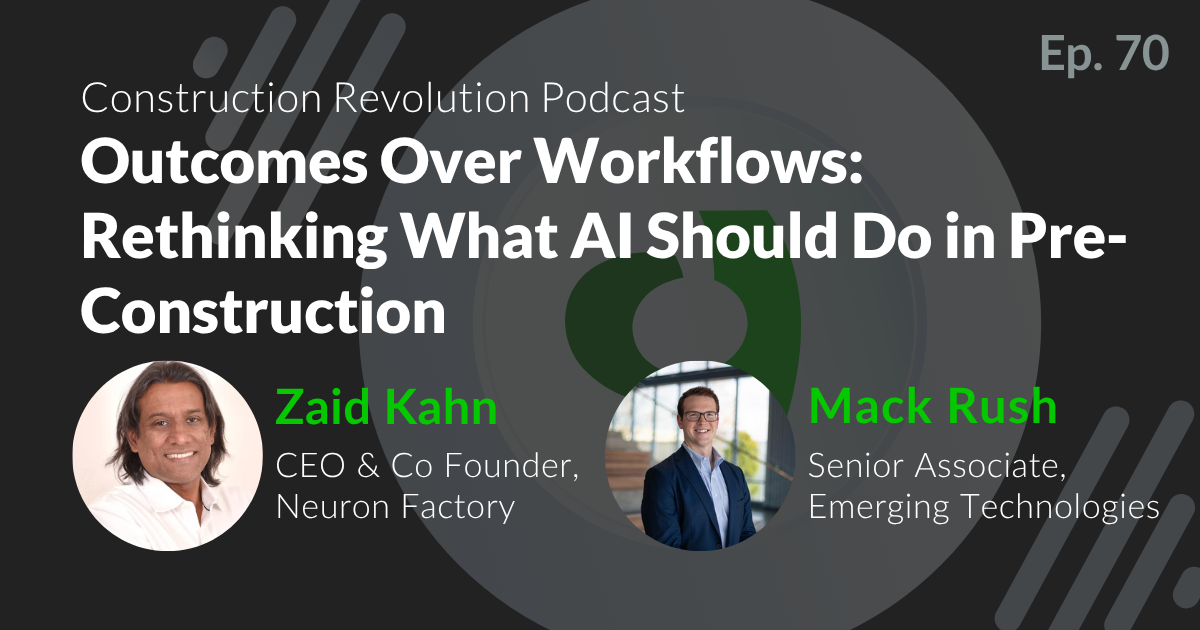
Outcomes Over Workflows: Rethinking What AI Should Do in Pre-Construction
In this episode of The Construction Revolution Podcast, we're joined by Zaid Kahn, CEO and Co-Founder of Neuron Factory, and Mack Rush, Senior Associate of Emerging Technologies at Suffolk Technologies. Neuron Factory, founded in 2025 by Zaid and his co-founder Salil Pandit, is building what they call the knowledge graph of construction, turning fragmented drawings, specs, and project communications into connected intelligence for pre-construction teams. The company first came up through Suffolk Technologies' Boost accelerator program before growing into an expanded design partnership testing the platform across real projects. We talk about why Zaid and Salil see pre-construction as a context problem rather than a data problem, and why asking “what is a drawing?” from a first-principles, outsider's perspective reshaped how Neuron Factory approaches scene understanding over simple object detection. Mack shares the project that convinced Suffolk the tech was a genuine step-change: an AI catching a risky, underspecified subcontract clause. We close on how AI is starting to change the way pre-construction teams and roles are structured, and where the Neuron Factory–Suffolk partnership is headed next.
 PLAY
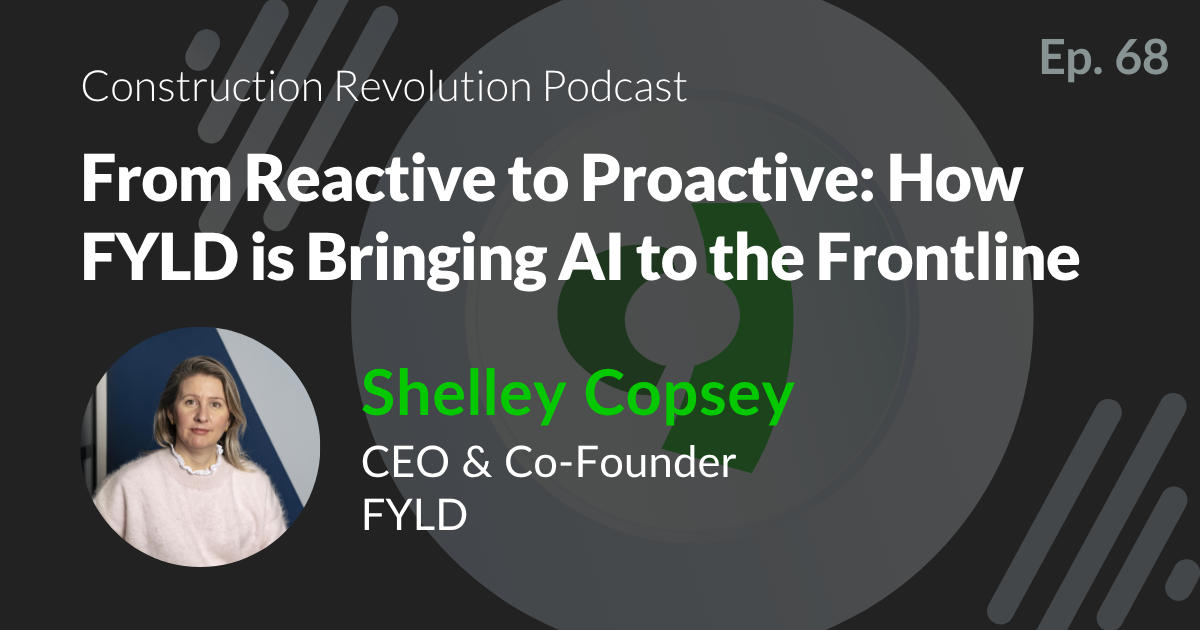
PLAYFrom Reactive to Proactive: How FYLD is Bringing AI to the Frontline
In this episode of The Construction Revolution Podcast, we're joined by Shelley Copsey, co-founder and CEO of FYLD. Shelley shares FYLD's unconventional origin story as a research project for one of Canada's largest pension plans, and how her background in infrastructure and business transformation led her to build an AI-powered frontline intelligence platform for utilities, heavy civils, and energy organizations across the UK and the Americas. We discuss how FYLD replaces paperwork-heavy safety processes with short videos from field workers, using AI to assess risk in real time, coach workers toward better risk assessments, and give remote managers visibility into which crews need attention most. Shelley explains why winning the trust of frontline workers, not just improving back-office efficiency, is the key to adoption, and how FYLD is helping cut standing time and improve safety outcomes on site.
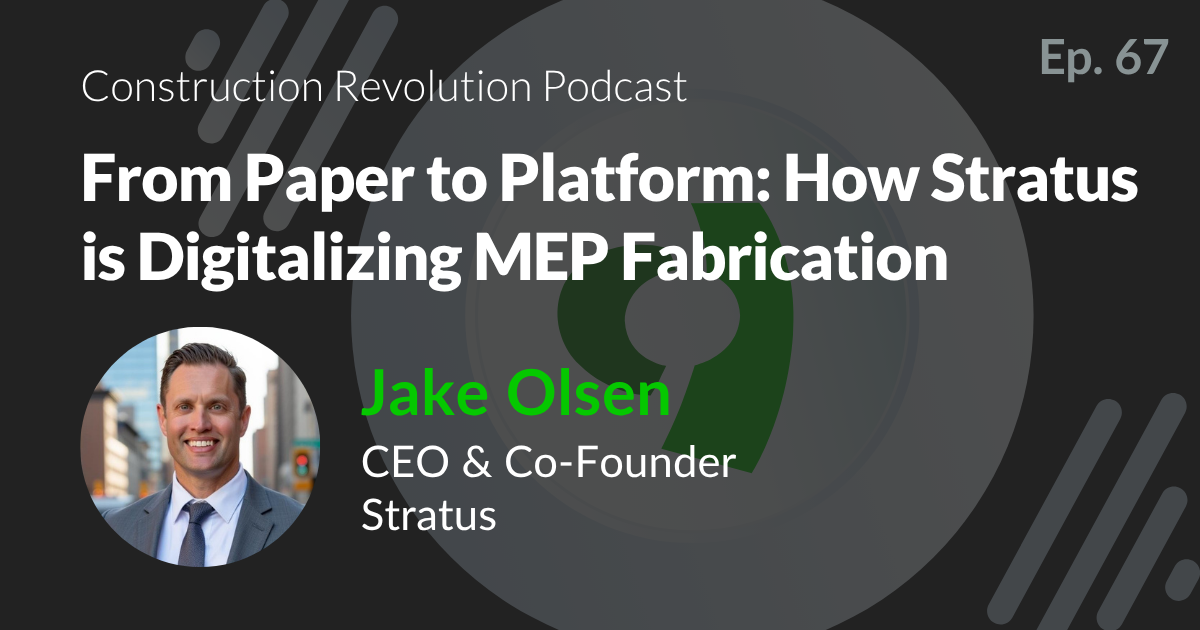
PLAYFrom Paper to Platform: How Stratus is Digitalizing MEP Fabrication
In this episode of The Construction Revolution Podcast, we're joined by Jake Olsen, CEO of Stratus. Jake shares how his career spanning structural engineering, construction tech at DeWalt, and hands-on time inside a mechanical contractor's fab shop led him to take the helm at Stratus, an operating system for MEP contractors that digitizes the full workflow from BIM through fabrication, logistics, and field installation. We discuss why most MEP contractors are still running on PDFs, spreadsheets, and color-coded stickers, how Stratus connects live model data directly to the fab shop floor, and what Jake's State of MEP report revealed about the growing gap between contractors who have embraced fabrication and those who haven't. The conversation explores how off-site prefabrication is helping contractors solve the labor shortage, why the most competitive MEP contractors are starting to run their businesses more like manufacturers, and how going fully digital gives contractors the real-time data they need to actually improve their operations over time.
PLAY
 PLAY
PLAY