

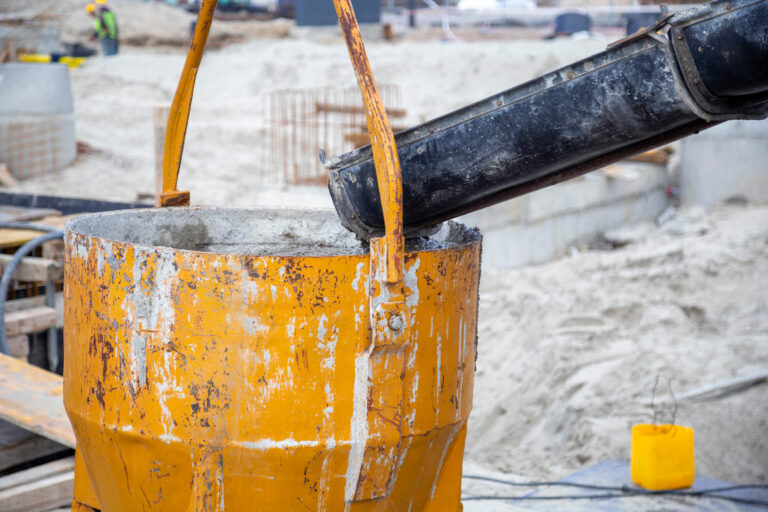
Concrete slump is one of the most familiar measurements in the construction industry. Whether at a ready-mix plant, a bridge project, a high-rise development, or a residential slab pour, one of the first questions asked before placement is usually simple: “What’s the slump?”
Despite being one of the most widely used concrete tests in the world, slump is also one of the most misunderstood. Some people associate slump with water content, while others use it as a quick indicator of concrete quality. In reality, slump is neither. It provides valuable information about the consistency and behavior of fresh concrete, but it only tells part of the story.
Modern concrete is far more sophisticated than it was a few decades ago. Today’s mixtures often contain supplementary cementitious materials (SCMs), high-range water reducers, viscosity-modifying admixtures, air-entraining agents, shrinkage-reducing admixtures, fibers, and other performance-enhancing technologies. These materials allow producers to optimize strength, durability, sustainability, and workability, but they also make fresh concrete behavior increasingly complex. This is why understanding what slump actually measures—and what it does not measure—is becoming more important than ever.
What Is a Concrete Slump Test?
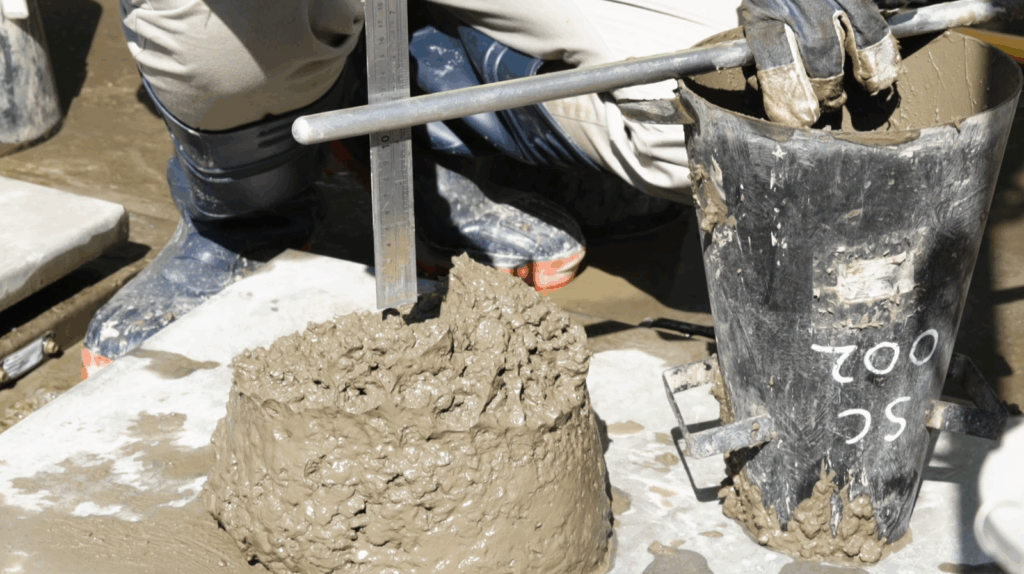
The slump test is a simple field procedure used to assess the consistency of freshly mixed concrete. Standardized under ASTM C143 and similar international standards, it remains one of the most widely accepted quality control tests in concrete construction.
The test uses a metal mold known as the Abrams Cone or Slump Cone. Fresh concrete is placed into the cone in layers, compacted, and then the cone is carefully lifted. The concrete settles under its own weight, and the reduction in height is measured as the slump value.
The procedure itself takes only a few minutes, requires minimal equipment, and can be performed almost anywhere. This simplicity is one of the main reasons why the slump test remains so popular, even in an era of advanced digital monitoring systems and sophisticated laboratory testing equipment.
However, while the test is simple, interpreting the results correctly requires a deeper understanding of fresh concrete behavior.
What Does Slump Actually Measure?
One of the biggest misconceptions in concrete construction is that slump directly measures workability. Technically, that is not entirely accurate.
The slump test primarily measures the consistency of fresh concrete and provides an indication of how the mixture may behave during handling, pumping, placement, consolidation, and finishing. While higher slump values generally suggest easier placement, workability itself is influenced by many other factors, including aggregate grading, paste volume, air content, particle shape, cohesiveness, and admixture chemistry.
In my experience working with concrete producers and construction teams, one of the most common misconceptions is treating slump as a direct indicator of concrete quality. I’ve seen mixtures with nearly identical slump values perform very differently because their water-to-cement ratio, admixture system, and overall mix composition were completely different.
In practical terms, slump can provide useful information about how easily the concrete can be transported, placed, and consolidated. A mixture with insufficient slump may be difficult to pump or compact properly, while excessive slump may indicate instability or segregation risks.
What slump does not tell us is equally important. It is not a direct measure of strength, durability, permeability, shrinkage potential, or long-term performance.
Can Two Concretes Have the Same Slump but Different Performance?
This is one of the most important concepts in concrete technology, and one of the main reasons why slump should never be used as a standalone indicator of quality. Imagine two concrete mixtures that both measure 120 mm slump. One achieves this consistency through the use of a high-range water-reducing admixture while maintaining a low water-to-cement ratio. The other achieves the same slump simply by adding more water.
The slump values may be identical, but the resulting strength, durability, permeability, shrinkage behavior, and service life can be dramatically different.
The same principle applies to mixtures containing different SCMs, aggregate gradations, admixture systems, or air contents. Slump provides a snapshot of consistency at a specific moment in time, but it does not reveal the complete picture of concrete performance.
Understanding Slump Requirements
There is often a tendency to categorize slump values as either good or bad. In reality, the appropriate slump depends entirely on the application. Concrete used in pavements and slip-form construction often requires relatively stiff mixtures to maintain shape and stability. Concrete placed into heavily reinforced structural elements may require higher slump values to ensure proper consolidation. Pumped concrete typically demands greater workability than concrete discharged directly from a chute.
Rather than asking whether a slump value is high or low, the more important question is whether it falls within the specified range for the intended application.
Types of Slump Results
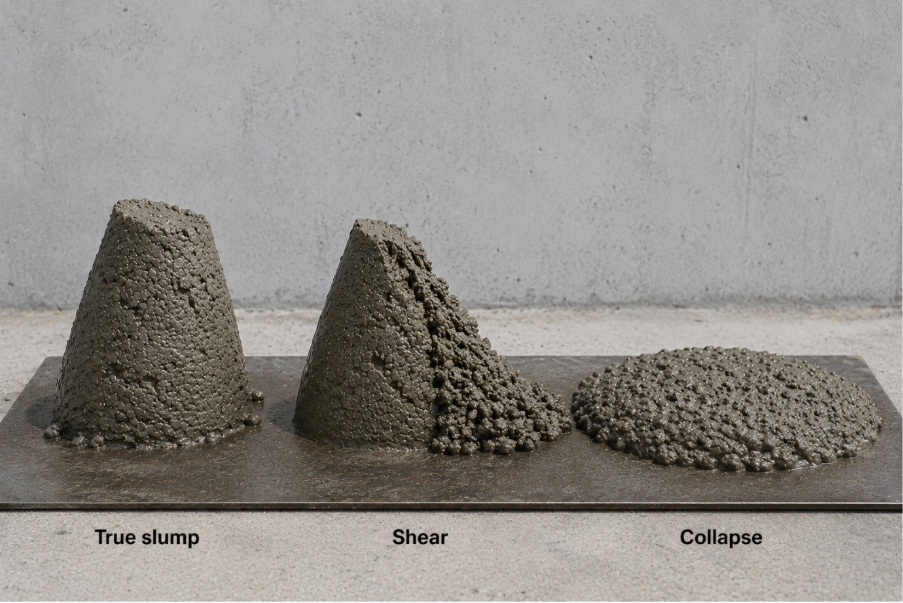
Not all slump tests produce the same type of deformation. The shape of the concrete after the cone is removed can provide valuable information about mixture stability.
- A true slump occurs when the concrete settles uniformly while generally maintaining its overall shape. This is the desired outcome and usually indicates a cohesive mixture.
- A shear slump occurs when one side of the concrete mass slips away from the other. This may indicate poor cohesion, instability, or issues with aggregate grading.
- A collapse slump occurs when the concrete loses its shape entirely after the cone is removed. This often indicates extremely high workability or a mixture that may be outside the effective range of the traditional slump test.
Why Does Slump Change Between Batches?
One of the most common frustrations in concrete production is receiving different slump values from trucks that were supposedly batched using the same mix design. The reality is that concrete is a dynamic material, and even small changes in production conditions can influence consistency. Aggregate moisture variations are among the most common causes of slump fluctuations.
In my experience, consulting with ready-mix producers, aggregate moisture miscorrection is the single most frequent cause of unexpected slump variation—and it is almost always invisible to the driver. I’ve also seen situations where producers initially blamed admixtures or batching equipment, only to discover that inaccurate moisture corrections were responsible for the inconsistency.
Temperature also plays a significant role. Higher temperatures can accelerate hydration and increase slump loss during transportation. Variations in cement chemistry, aggregate properties, and SCM characteristics can further influence fresh concrete behavior.
Admixture performance is another important factor. Modern concrete often relies on multiple admixtures working together to achieve specific performance objectives. Changes in dosage, compatibility, batching sequence, storage conditions, or environmental factors can influence how the mixture behaves.
Transportation conditions also matter. Two trucks leaving the same plant may arrive with different slump values if one experiences longer travel times, traffic delays, different ambient temperatures, or a different number of drum revolutions during transit.
This is why maintaining consistent slump requires much more than simply controlling water content.
The Limitations of the Slump Test
Despite its value, the slump test has limitations that every concrete professional should understand. The most significant limitation is that the test represents only a single point-in-time measurement. It tells us how the concrete behaved when the sample was taken, but it provides no information about what happened before that moment or how the concrete will behave later. A truck may leave the batching plant with a perfectly acceptable slump and arrive at the jobsite with significantly different workability due to hydration, temperature changes, transportation delays, or admixture interactions that occurred during transit.
The slump test also cannot directly measure strength, durability, water-cement ratio, segregation resistance, or long-term performance. It provides valuable information, but it is only one piece of the quality control puzzle.
Closing the Gap Between Plant and Pour
For decades, one of the biggest blind spots in concrete quality control has been what happens between the batching plant and the jobsite. Traditionally, producers measure slump before the truck leaves the plant and contractors measure slump again when it arrives on site. While these measurements are important, they provide only two snapshots of concrete behavior. Very little information exists about what happens in between. Yet this period can significantly influence concrete quality.
A ready-mix truck is often described as a “factory on wheels” because the concrete inside the drum continues evolving throughout the journey. Hydration continues, temperatures change, drum revolutions accumulate, and admixtures continue interacting with cement particles. Depending on travel time, weather conditions, and mixture characteristics, the concrete that arrives on site may behave quite differently from the concrete that left the plant. This challenge has driven interest in technologies that provide greater visibility into concrete behavior during transportation.
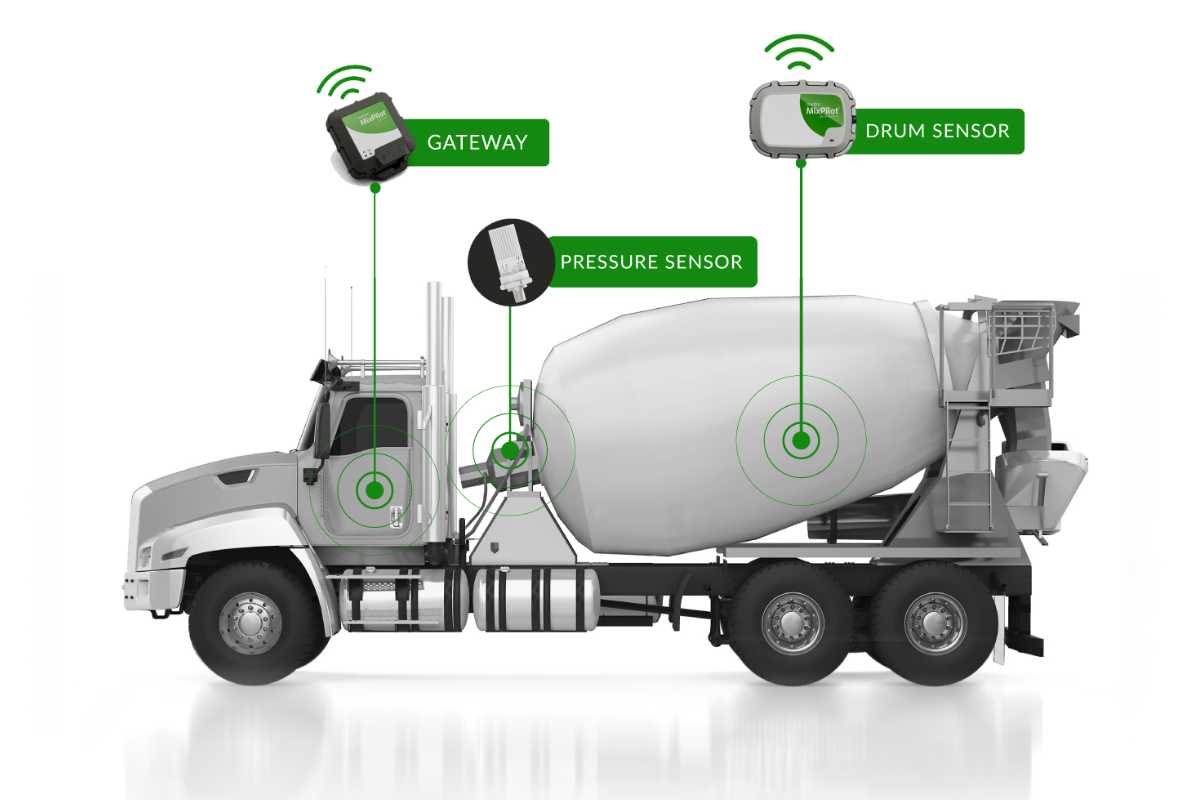
Giatec developed MixPilot™ to specifically address this gap. As the world’s first non-invasive, calibration-less, in-transit slump monitoring system, it continuously measures key parameters including slump, temperature, drum revolutions per minute (RPM), and concrete volume throughout delivery. Rather than relying solely on measurements taken at the beginning and end of the process, producers gain real-time insight into how the concrete behaves from plant to pour.
The objective is not to replace traditional slump testing. The slump cone remains one of the most trusted and widely accepted quality control tools in the industry. Instead, continuous monitoring complements conventional testing by helping producers, dispatchers, quality control personnel, and drivers better understand what is happening inside the truck during transit.
As concrete mixtures become more advanced and quality requirements become more demanding, this additional visibility is becoming increasingly valuable.
Final Thoughts
The concrete slump test remains one of the most valuable and widely used quality control tools in construction. It is simple, fast, inexpensive, and capable of providing immediate insight into the consistency of fresh concrete.
However, understanding what slump actually tells us is just as important as performing the test itself.
Slump is an indicator of consistency and fresh concrete behavior—not a direct measure of strength, durability, or overall quality. Two mixtures can produce the same slump while delivering very different performance in service. Likewise, a satisfactory slump at the plant does not guarantee the same workability at the point of placement.
As the concrete industry continues moving toward more sophisticated mixtures and stricter performance requirements, quality control is becoming increasingly data-driven. Traditional field tests such as the slump test will continue to play an essential role, but they will increasingly be supported by technologies that provide continuous visibility into concrete behavior throughout the delivery process.
In the end, better decisions come from better information. Understanding the full story behind slump is an important step toward producing more consistent, reliable, and higher-performing concrete.
Want to know how MixPilot can save on your operation? Check out our ROI calculator!
Frequently Asked Questions About Concrete Slump Testing
Q: What does a concrete slump test measure?
A: The concrete slump test measures the consistency of freshly mixed concrete by assessing how much a sample settles after the slump cone is removed. It provides an indication of workability and fresh concrete behavior but does not directly measure strength, durability, or water-cement ratio.
Q: Why do slump test results vary between batches of the same mix design?
A: Slump variation between batches is most commonly caused by aggregate moisture fluctuations, temperature changes, admixture dosing inconsistencies, variations in cement chemistry, and differences in transportation time or drum revolutions during transit.
Q: What is an acceptable slump range for ready-mix concrete?
A: Acceptable slump ranges depend entirely on the application. Pavement mixes may require 25–75 mm, while pumped concrete or heavily reinforced sections may require 100–175 mm or higher. The appropriate range is always defined by the project specification.
Q: How do chemical admixtures affect concrete slump test results?
A: Superplasticizers can significantly increase slump without adding water, while retarders extend slump retention during transportation. Admixture dosage, compatibility, and temperature sensitivity all influence how the mixture behaves at the time of testing.
Q: Why does concrete slump change during transit?
A: Concrete continues to hydrate inside the drum during transportation. As hydration progresses, cement particles consume water, reducing slump over time. Higher temperatures, longer transit times, and increased drum revolutions can all accelerate this process.
Q: What is the difference between slump testing and continuous slump monitoring?
A: Slump testing provides a single point-in-time measurement of fresh concrete consistency. Continuous slump monitoring tracks concrete behavior throughout the entire delivery process from plant to pour, providing real-time visibility into how the mix evolves during transit.
References
ASTM C143/C143M – Standard Test Method for Slump of Hydraulic-Cement Concrete
ACI 211.1 – Standard Practice for Selecting Proportions for Normal, Heavyweight, and Mass Concrete
Neville, A.M. (2011). Properties of Concrete (5th Edition). Pearson Education